

Audio By Carbonatix
As the 2024 elections approach, civil society organisations are intensifying their calls for greater transparency and accountability in the education sector.
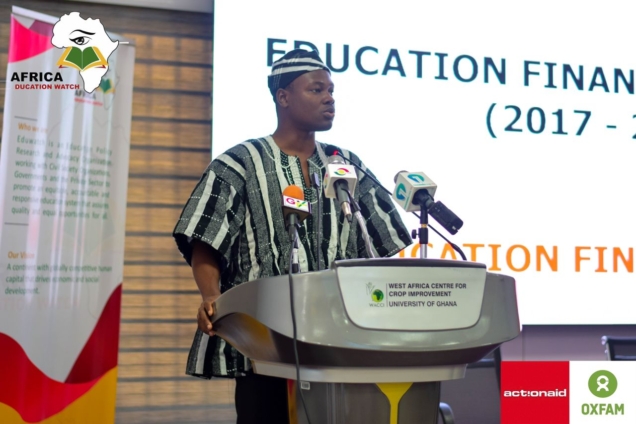
Africa Education Watch (EduWatch), supported by Oxfam and ActionAid, recently hosted its Annual Education Financing Conference to present a comprehensive report on education financing from 2017 to 2024.
The conference, held on August 29, 2024, at the West Africa Centre for Crop Improvement (WACCI) at the University of Ghana, highlighted the urgent need for stronger financial commitment and effective allocation of resources in the education sector.
The report critically evaluates the government's financial contributions to education over the past seven years, comparing them to international standards.
Divine Kpe, Snr Programme Officer of Eduwatch noted that GDP allocation between 2014-2024 is averagely 4% while the percentage of total annual expenditure is averagely 7%.
He pointed out that while the 4% allocation meets the lower threshold, it remains inadequate for addressing the sector's needs, urging the government to aim for the higher end of the benchmark to ensure sufficient funding.
Budget credibility also emerged as a significant concern.
Mr Kpe explained that although budget allocations for initiatives like the Free Senior High School (FSHS) program and capitation grants may seem adequate on paper, actual disbursements often fall short.
He noted that the FSHS program's budget credibility has decreased from 120% in its initial year to just 61% recently.
“The feeding grant for special schools has also faced delays, and it is crucial to highlight these issues to ensure that attention is directed toward resolving them,” he added.
The report also criticised the government’s funding approach for Technical, Vocational, Education, and Training (TVET), which receives only about 8% of total education expenditure.
Mr Kpe called for a distinct financing model for TVET to address its capital-intensive nature and improve practical training and enrollment.
“To effectively support TVET, we cannot apply the same financing model used for the FSHS program,” he said.
“There is a pressing need for a dedicated financing model for TVET to tackle its unique challenges and enhance the quality of technical education in Ghana.”
Latest Stories
-
NSA regional director Emmanuel Reagan files nomination to contest NDC Ashanti Regional Organiser position
4 minutes -
Obuasi SHTS: Number of students alleging sexual abuse rises to 16
9 minutes -
Ghana’s economy grows by 7.4% in July 2026
20 minutes -
NDC member challenges Dennis Yeboah Twumasi’s eligibility for Bono Regional Secretary elections
30 minutes -
Popular Nigerian gospel singer Toluwanisings dies
40 minutes -
Spio-Garbrah proposes debt swaps to fund reparative justice in Africa and Caribbean
48 minutes -
Alban Bagbin calls for governance reforms and coordinated action to address Africa’s debt crisis
50 minutes -
AAK Academy Ghana trains 22 chocolate and confectionery companies in production techniques
52 minutes -
Adwumawura Programme trains second cohort of young entrepreneurs in Bono East
53 minutes -
Destroying Jimi River for gold could cost us our lives – Asantehene
1 hour -
Sammy Gyamfi didn’t say BoG has ceded its forex role to us – GoldBod
2 hours -
High Court sets November 4 for ruling on Wontumi’s bail application
2 hours -
Tetteh Kwetey files nomination for NDC Greater Accra Regional Chairmanship
2 hours -
Korle Bu appeals for more doctors, nurses as A&E Centre struggles under pressure
2 hours -
AFCON 2027Q: ‘I’m optimistic Black Stars can turn things around’ – Agyemang-Badu
2 hours