

Audio By Carbonatix
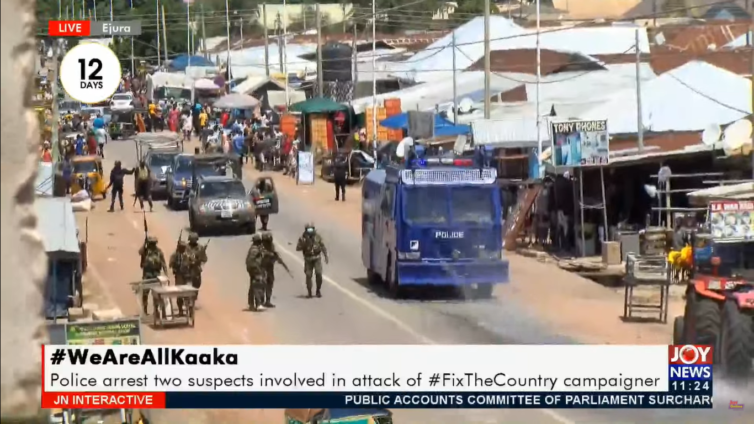
The Director, Faculty of Academic Affairs and Research at the Kofi Annan International Peacekeeping Training Centre (KAIPTC) has said that the clash between the Military and youth of Ejura yesterday, that resulted in casualties, portrays a massive operational failure on the part of the security force.
Speaking on Joy FM’s Super Morning Show, Wednesday, Prof. Emmanuel Kwesi Aning said, "what happened yesterday, is truly a massive operational failure that cuts across several levels. First, is the decision making process. What were the assessments that formed the basis for someone to invite the military to come?
"Number two. Normally, during these demonstrations, it is the Ghana Police Service (GPS) who are trained and equipped with the appropriate tools; water cannons, tear gas to disperse such crowds.
The Military is only brought in during crisis situations where communities are being threatened, their very existence or the existence of the state, is threatened. The nature of Military training is that they come in to face an enemy, and to defeat and conquer that enemy."
Prof. Emmanuel Kwesi Aning added that by aiming and firing at the youth, the Military personnel broke the rules of engagement of security personnel.
"That was a decision taken on the spur of the moment and reflects, I would argue, the old historical boogie of civil-military relations in which those who are armed under certain conditions perceive that they can use their weapons indiscriminately."
He was one of the discussants on Joy FM’s Super Morning Show Wednesday. The topic for discussion was the shooting incident that happened at Ejura yesterday, after a campaigner for #FixTheCountry, Ibrahim Mohammed was attacked and murdered by an angry mob at Ejura on the dawn of Saturday for asking for a better Ejura.
The deceased, is said to have been repeatedly struck on the head with objects until he lost consciousness. According to sources, he died on Monday, June 28 at the Komfo Anokye Teaching Hospital.
This incident led the youth of Ejura to take to the streets to demand justice for the social activist, Ibrahim Mohammed. The demonstration resulted in a clash between Military personnel and the agitated youth, leaving two people dead and four others severely injured.
Prof. Aning said that one of the rules of engagement the Military trainees learn during their training is that, they can’t shoot people at the back, neither can they shoot unarmed people.
He said that a thorough assessment of the actions of the Military personnel has to be undertaken, as well as the specific orders which were given them prior to showing up at the protest.
As a Security Analyst, he believes that there is a lot of work that needs to be done in ensuring the Ejura incident does not happen again.
Latest Stories
-
Gold edges lower with focus on Fed minutes, rate path clues
57 minutes -
Oil prices rise as storms and air strikes threaten supply
1 hour -
Nigeria nears 2,000 repatriations from South Africa after latest evacuation flight
1 hour -
‘I never gave up’ – Abanga Fusani reflects on journey to NPP Youth Organiser victory
2 hours -
World Bank maintains Ghana’s growth rate forecast at 4.8% in 2026
2 hours -
Cedi was worst African currency in quarter 2, 2026 – World Bank
2 hours -
US death row inmate Christa Pike awake and speaking after failed execution, lawyers say
2 hours -
AI gains can lift three times as many people out of poverty in Ghana – World Bank
3 hours -
Scammers target ECG customers with fake meter sales and MoMo payment calls
4 hours -
Abanga Fusani credits hard work and consistency for NPP Youth Organiser victory
4 hours -
We did not take security issues seriously – Abanga Fusani reflects on NPP’s 2024 election loss
5 hours -
Nigeria’s Dangote refinery aims to draw more retail investors than Aramco IPO, CEO says
5 hours -
Banker in court for allegedly stealing GH¢1 million
5 hours -
Police arrest suspect over jewellery theft during fire outbreak
5 hours -
EOCO returns Hanan’s £6,700, GH¢2,750 and devices after defence challenge
5 hours