

Audio By Carbonatix
For years, Ghana’s oil industry was seen as one of the country’s biggest economic success stories. Commercial production began in 2010 after the discovery of the Jubilee Field, and output climbed rapidly as more fields came on stream.
Ghana’s crude oil production peaked at 71.44 million barrels in 2019. Six years later, production had fallen to 37.3 million barrels in 2025 which is a decline of almost 48% from the 2019 peak. The decline has now become one of the biggest challenges facing the country’s upstream petroleum sector. And it comes at a time as the country is trying to attract a new wave of investment.
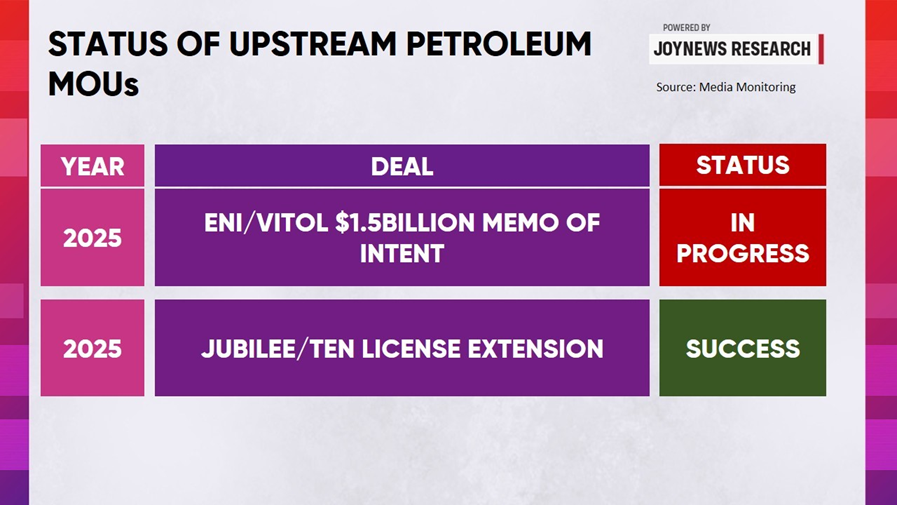
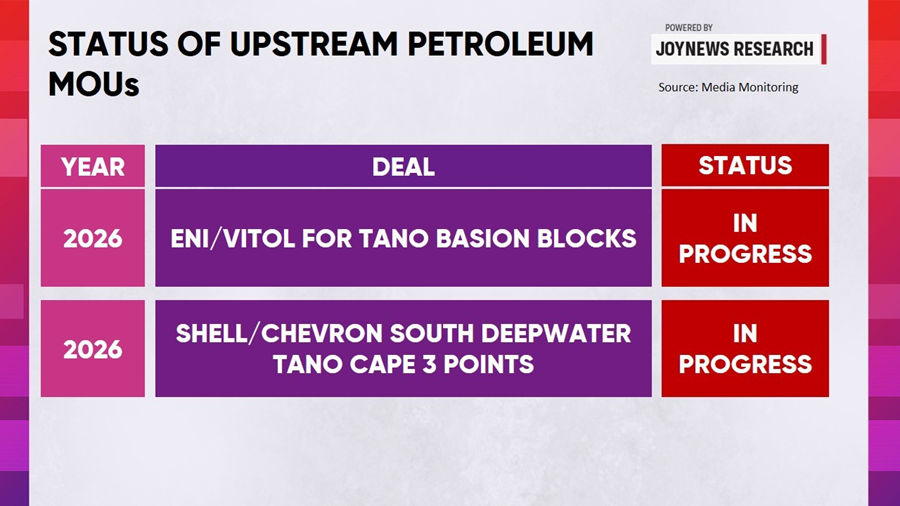
In recent months, the country has signed new Memoranda of Understanding with international oil companies, including Eni, Vitol, Shell and Chevron, as government seeks to open up new acreage, increase exploration and develop more petroleum resources.
The latest move came on September 10, when Eni Ghana and Vitol Upstream Tano Limited signed two MoUs with government covering the GH-WB-03 and GH-WB-08 blocks in the Tano Basin. Just days earlier, Shell and Chevron signed a preliminary, non-binding agreement with Ghana covering the South Deepwater Tano-Cape Three Points area. An agreement which is expected to provide the basis for negotiations towards a final petroleum agreement.
But, the question is whether these new deals can do what previous agreements have sometimes failed to do: Which is turning investment interest into actual wells, new discoveries and, eventually, more barrels of oil.
What changes will these agreements bring to the country’s upstream sector in terms of crude output?
Ghana's production story over the past 16 years tells two very different stories. In 2010, the country produced about 1.18 million barrels. Production increased to 24.2 million barrels in 2011 and continued rising as activity expanded across the offshore fields. By 2015, production had reached 37.41 million barrels.
Production rose to 58.66 million barrels in 2017, 62.14 million in 2018 and eventually reached a record 71.44 million barrels in 2019. Since then, production has fallen every year.
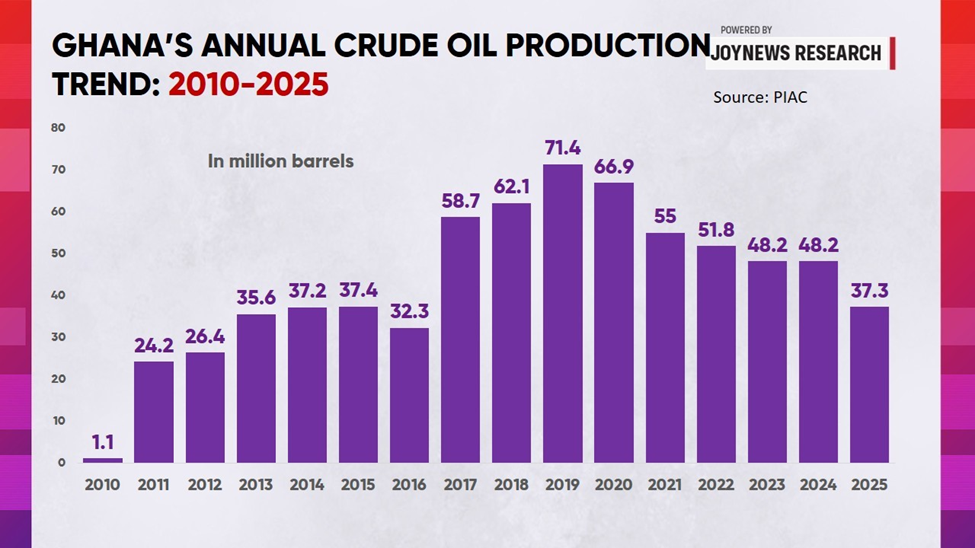
A development flagged by the Public Interest and Accountability Committee (PIAC) as really concerning as production declined for the sixth consecutive year in 2025.
The committee attributed the decline largely to the maturity of Ghana's three producing fields and declining output from them. Jubilee produced 22.21 million barrels in 2025, TEN produced 5.83 million barrels and Sankofa-Gye Nyame produced 9.26 million barrels.
PIAC has therefore been calling for more investment in existing fields, improvements in the regulatory and fiscal framework and more exploration in new basins.
But have we ran out of oil in our reservoirs?
The fall in production does not mean Ghana has run out of petroleum resources. The problem is that the country needs more investment to find, appraise and develop those resources.
The Petroleum Commission currently lists 14 Petroleum Agreements held by 12 operators at different stages of Ghana's upstream petroleum industry.
Only three producing fields are currently responsible for Ghana's oil production:
- Jubilee
- TEN
- Sankofa-Gye Nyame
According to energy think tank, Africa Centre for Energy Policy (ACEP), these are the only three producing fields among the 14 active petroleum agreements and says Ghana has experienced limited exploration and development activity.
Which means, the country has a pipeline of petroleum agreements, discoveries and prospects. But there is a major difference between having an agreement and producing oil.
So what happens after an oil agreement is signed?
Signing a petroleum agreement does not mean oil will immediately start flowing. For an exploration block, the company first has to carry out geological and geophysical studies depending on the type of agreement signed. And this may include seismic surveys designed to help identify structures beneath the seabed.
If the data indicates a promising prospect, the company then drills an exploration well. If hydrocarbons are discovered, the company has to determine whether the discovery is commercially viable. That can require appraisal wells and additional studies. The company then moves towards development, which requires major capital investment and regulatory approvals. Only after that process can a field move into production.
This is why the latest MoUs should not be confused with new oil production. They are steps towards investment and exploration, not barrels already coming out of the ground.
Ghana has signed agreements before
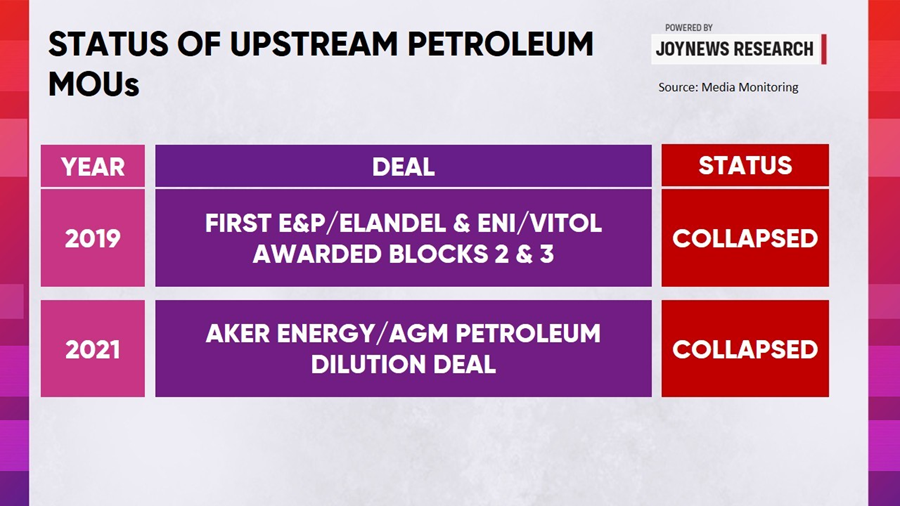
This is where Ghana's recent history becomes important. The country has previously attracted investors to offshore blocks, but not all agreements have delivered the expected exploration activity. Some agreements have been delayed, others have been terminated and some discoveries have taken years to move towards development.
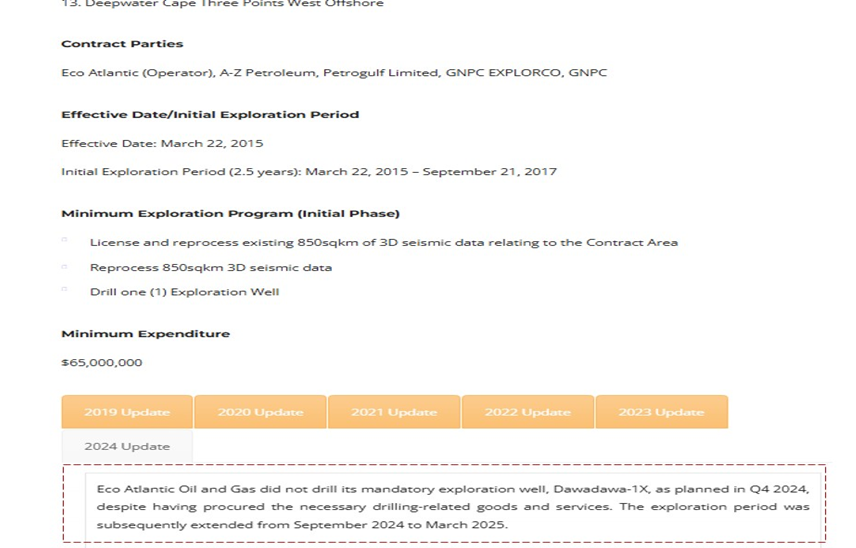
One example is the Deepwater Cape Three Points West block operated by Eco Atlantic where the contractor was required to drill an exploration well known as Dawadawa-1X. But the well was repeatedly postponed. The drilling schedule moved from 2022 to 2023 and beyond, while the exploration period was extended.
Source: ACEP, Ghana Contract Monitor
The Ghana Contract Monitor reports that by 2024 the mandatory well had still not been drilled, although the contractor had procured drilling-related goods and services. The exploration period was subsequently extended from September 2024 to March 2025. This does not by itself mean that the agreement has failed. But it demonstrates the gap that can exist between contract signing and actual exploration activity.
Some agreements have actually failed.
Ghana has also terminated petroleum agreements because companies failed to meet their contractual obligations. In 2021, the Ministry of Energy terminated four agreements because of non-performance.
They were:
- Brittania-U's Southwest Saltpond block;
- Sahara Energy's Shallow Water Cape Three Points block;
- UB Resources' Offshore Cape Three Points South block; and
- Swiss African's Onshore/Offshore Keta block.
ACEP found that the initial exploration periods for some of these blocks had already expired four or more years before their eventual termination. The Shallow Water Cape Three Points agreement is a useful example. The agreement involving Sahara Energy, Sapholda and GNPC became effective in July 2014. The contractor was expected to undertake exploration activities, including seismic work and the drilling of an exploration well. But the agreement ultimately became one of the four contracts terminated by government in 2021 for non-performance.
For Ghana, the lesson is clear. An agreement only creates the opportunity for investment. It does not guarantee that investment will happen at the required speed.
The importance of effective regulation
The problem is therefore not simply whether companies are willing to invest. It is also about how government manages the contracts after they are signed. ACEP has been monitoring Ghana's upstream petroleum contracts since 2017.
In its 2023 Upstream Petroleum Monitoring Report, the organisation assessed the performance of non-producing petroleum agreements against their work obligations. ACEP's concern is that some contractors were able to remain on blocks despite failing to meet their minimum work obligations.
The organisation also raised concerns about the transparency of work programmes and the enforcement of contractual obligations. It argued that weak enforcement can allow non-performing contractors to continue holding acreage that could otherwise be made available to investors willing to explore. This is important because an oil block tied up for years without meaningful exploration represents an opportunity cost for the country. Ghana cannot produce oil from acreage simply because an agreement has been signed.
Eni and Vitol are taking another route
The Eni-Vitol agreements also have an important feature. The companies say the GH-WB-03 and GH-WB-08 blocks fit their near-field and infrastructure-led exploration strategy. In simple terms, this means looking for new resources close to existing infrastructure and producing areas. That can potentially reduce the cost and time required to develop a discovery because some infrastructure may already exist nearby. But again, exploration success is not guaranteed. The MoUs are intended to pave the way for final Petroleum Agreements.
The real bottleneck may come after discovery
There is another lesson from past experience. Finding oil is not the same as producing oil. A company can spend millions of dollars exploring an area, drill a successful well and still need billions of dollars to develop the discovery. The next stages can involve appraisal wells, engineering studies, subsea infrastructure, pipelines, production facilities and other major investments. This is why Ghana's upstream challenge is not simply an exploration problem. It is also a development and financing problem.
These experiences call for the need to accelerate the development of discoveries into production, while intensifying the call for greater investment to sustain output.
Can the new agreements revive Ghana's oil production?
Yes, but not immediately and not simply because the agreements have been signed. The new deals could help Ghana rebuild its production base if they lead to successful exploration, commercial discoveries, adequate financing and timely development. They also come at a time when government says it is reviewing the fiscal and regulatory framework to make the sector more competitive.
At the opening of Africa Oil Week in Accra, Energy and Green Transition Minister John Jinapor said proposed reforms include new fiscal terms based on water depth, a reduction in GNPC's initial carried interest, longer petroleum agreements and more flexible exploration and relinquishment provisions.
Those reforms could matter because international oil companies compare investment opportunities across countries. But making Ghana more attractive to investors is only one side of the equation. The country also needs to ensure that investors who obtain acreage actually deliver. That calls for stronger monitoring of work programmes, clear timelines, transparent reporting and timely enforcement when contractual obligations are not met.
Latest Stories
-
Photos: Antoine Semenyo says ‘I do’ to longtime partner Jordeen Buckley
5 minutes -
Gender Minister visits Nana Akua Addo, assures family of support
6 minutes -
You need to fake it sometimes to make it fun – Stephanie Benson tells couples
25 minutes -
Mahama Cares says political affiliation will not determine access to medical support
27 minutes -
Government inherited GH¢111bn debt burden but continues infrastructure projects – Lands Minister
33 minutes -
Mallam Atta traders urge government to speed up 24-hour market redevelopment
42 minutes -
Catholic Church has a duty to speak on issues affecting human dignity – Bishop Gyamfi
52 minutes -
KATH sickle cell, blood bank project stalled over $1.6m legal dispute – CEO
1 hour -
Restricting preaching in moving vehicles is an attempt to gag the church – Rev. Kwadwo Bempah
1 hour -
Central Charismatic Baptist Church marks 30 years, urges review of law restricting preaching on buses
1 hour -
Mafi Kope residents appeal for urgent medical intervention over illnesses affecting children, adults
1 hour -
ECG to limit planned power outages in Ashanti to two days a week
1 hour -
NYA CEO, management doing ‘yeoman’s job’with meagre budget — Parliament’s Youth Committee Chairman
1 hour -
Mahama commends Trade Minister for championing Ghana’s industrial growth
2 hours -
Public cautioned against transactions over Borteyman land as Supreme Court rules in favour of Sino Africa
2 hours