

Audio By Carbonatix
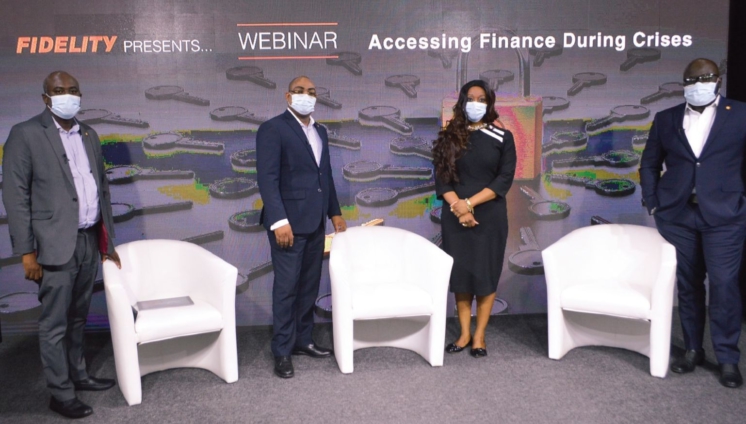
Fidelity Bank in collaboration with the International Finance Corporation (IFC) held the second session of its four-part webinar series on the topic 'Accessing Finance During Crises'.
This is in line with Fidelity Bank’s deep-rooted commitment to growing its Small and Medium Enterprises (SMEs) base.
Organized under the 'Fidelity Presents…' thought leadership initiative, this second session focused on training SMEs on how to access loans, funds and grants to grow their businesses during and after the COVID-19 crisis.
SMEs drawn from various sectors of the economy took part in the webinar to get adequate information on the topics of funding options, loan vs. line of credit, borrower considerations, and lender considerations.
Opening the webinar, Linus Kumi, Director, Commercial and SME Banking of Fidelity Bank Ghana, noted that, “a number of small businesses struggle to gain access to finance. The situation has become more difficult with the emergence of the COVID-19 pandemic.
Without adequate financing it is difficult for small businesses to run successfully.
Fidelity believes in SMEs, not only as clients but as partners in job creation and economic growth. Hence, we saw the need to help SMEs to understand the key considerations for borrowing money.”
Nana-Esi Idun-Arkhurst, Divisional Director, Retail Banking of Fidelity Bank Ghana added that “our strong commitment to the growth and development of SMEs led to the provision of incentives like loan moratoriums, loan restructuring, and other considerations to help SMEs to fortify their businesses to withstand the economic shocks resulting from the pandemic.”
On the possible reasons for pandemic borrowing, leading IFC consultant, and the facilitator for the webinar, Margaret Jackson advised participants to invest borrowed money into technology to adapt to changing trends and to increase production to meet demand.
“Do not borrow money to repay debt. You put your business in a debt cycle that is difficult to exit” she informed participants.
Ms. Jackson added that participants need to create a plan to keep their businesses profitable, manage their cash flow and adapt for the crisis and the future.
While expressing appreciation and gratitude to Fidelity Bank and IFC for providing them with such valuable content, participants also requested for more capacity building programmes in the area of finance.
Fidelity Bank held the first edition of its thought leadership series Fidelity Presents…for SMEs on June 11, on the topic An SME Perspective: Surviving Today to Thrive Tomorrow.
The next edition in the SME webinar series will take place on July 30, at 10 am on the topic Communicating with Stakeholders During Crises.
The final edition titled Adjusting your Business Plan During Crises will be held on August 13, at 10 am.
Latest Stories
-
Striking teacher unions to meet Fair Wages and Salaries Commission on October 6
7 minutes -
EOCO working with AG to arraign Nana Baffour Awuah before weekend court
11 minutes -
Duraplast reassures customers after fire, announces October 5 reopening
19 minutes -
Call off strike, gov’t will not renege on promotion arrears pledge – Haruna Iddrisu appeals to teacher unions
21 minutes -
Committee set up to validate teachers eligible for 20% deprived-area allowance – Education Minister
25 minutes -
Five-member committee to search for new Black Stars coach after Sports Ministry-GFA meeting
60 minutes -
Pinktober: Breast cancer survival exceeds 90% when detected early – Breast Society of Ghana
1 hour -
TCDA to adopt Upper West’s MATCO mango farm as northern prototype, issues warning against felling shea trees
1 hour -
‘Fear delegates’ tag: Afoko touts genuineness among delegates ahead of NPP delegates conference
1 hour -
John Boadu: The leader our party needs at this time – Amb. Edward Akwasi Boateng
1 hour -
Baffour Awuah: EOCO arrested, detained MP after hours of waiting, questioning – Afenyo-Markin
2 hours -
EOCO court warrant authorised search of Baffour Awuah’s law firm, not residence – Afenyo-Markin
2 hours -
NPP delegates conference: 3,000 to 4,000 police personnel deployed for security in Kumasi – Anthony Karbo
2 hours -
KGL Foundation commits $200,000 to support juvenile football for the next two years
2 hours -
UNDP invites Mahama Ayariga to Northern Peace Conference in Tamale
2 hours