

Audio By Carbonatix
Cybersecurity expert and former Director General of Cyber Security Authority, Dr Albert Antwi-Boasiako, has warned that education systems are failing to keep pace with the rapidly evolving digital threat landscape, describing the situation as an “epistemological crisis” driven by the fluid and perishable nature of knowledge in the modern era.
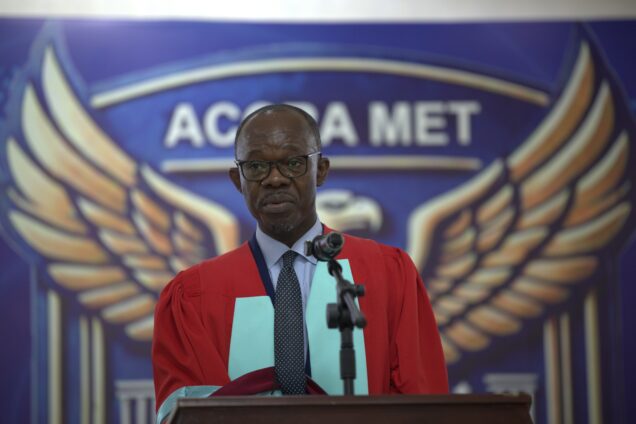
Delivering a public lecture on the theme " From Curriculum to Capability: Cybersecurity and Intelligence Education in the Algorithmic Era” at the launch of MSc programmes in Cybersecurity and Digital Forensics, as well as Security and Intelligence, at Accra Metropolitan University College on Wednesday, April 22, Dr Antwi-Boasiako questioned the continued reliance on traditional academic models in a world increasingly defined by uncertainty and complexity.
“If the world has changed so fundamentally, why has education not kept pace?” he asked. “Knowledge is no more stable. In cybersecurity and intelligence, it is fluid, perishable and highly context dependent. What is true today may be obsolete tomorrow.”
He explained that conventional education systems, built on structured answers and predictable outcomes, are increasingly misaligned with real-world cyber environments characterised by ambiguity, incomplete information and rapidly shifting adversarial behaviour.
“Are we educating students for certainty in a world defined by uncertainty?” he queried.
Dr Antwi-Boasiako, who is currently the Executive Chairman of the E-Crime Bureau, also highlighted the fragmentation of knowledge across academic disciplines as a major structural weakness, warning that siloed learning undermines the ability to address complex, interconnected challenges.
“Cybersecurity without law, intelligence without ethics and technology without philosophy, yet reality is integrated,” he said.
According to him, the prevailing emphasis on examinations over practical problem-solving has widened the gap between academic instruction and operational capability.
“The old model of education is largely aligned to passing exams rather than solving real problems,” he noted. “The result is a widening gap between what is taught and what is required.”
Citing global threat data from Check Point Research, he revealed that organisations now face nearly 2,000 cyberattacks per week on average, with incidents more than doubling in recent years. He added that artificial intelligence is accelerating both the speed and sophistication of attacks.
“These attacks are not only more frequent but also faster, some now execute in seconds and spread across systems in under 30 minutes,” he said, pointing to the rise of automated phishing, AI-assisted malware and synthetic identity fraud.
Further referencing findings from the World Economic Forum’s Global Cybersecurity Outlook survey, he noted that 72 per cent of respondents reported increased cyber risks, particularly in areas such as social engineering and ransomware.
“This reflects how generative AI is strengthening attack strategies,” he explained.
Dr Antwi-Boasiako stressed that the pace and complexity of modern cyber threats have outgrown traditional curricula, creating a critical disconnect between training and real-world demands.
“Education systems are preparing students for a cybersecurity landscape that no longer exists,” he warned. “The focus must shift from simply understanding tools to understanding systems, how they behave, how they fail and how they can be secured in dynamic environments.”
He further underscored the multi-dimensional nature of modern cyber incidents, noting that they now span technical, legal, economic, political, sociological and psychological domains simultaneously.
In this context, he cautioned against what he termed the “Credential Illusion”, where academic qualifications are mistakenly equated with competence.
“The old model of educational curriculum has largely equated certification with competence and degrees with capability,” he said, urging a recalibration towards demonstrable skills and operational readiness.
Dr Antwi-Boasiako concluded that without urgent reform, education systems risk becoming increasingly disconnected from the realities they are meant to address, leaving institutions and nations exposed in an era of heightened digital vulnerability.
Latest Stories
-
Horticulturists call for dedicated authority, irrigation and tomato factory revival
12 minutes -
Nakpayili E-Block opens, admits first batch of 650 students after nearly a decade of neglect
13 minutes -
Ethel Cofie writes: You need board experience to get board experience
17 minutes -
Baffour Awuah expected in court as EOCO moves to meet bail deadline
26 minutes -
Happy 76th Birthday to the Daily Graphic!
31 minutes -
Weija Children’s Hospital now operational with 120-bed capacity – Health Minister
42 minutes -
Health Minister orders deployment of 40 additional health workers to Weija Children’s Specialist Hospital
54 minutes -
Greater Accra teacher unions back nationwide strike over three key demands
59 minutes -
Bawumia promises leases and redevelopment for businesses affected by La Beach demolition
1 hour -
Bawumia condemns La Pleasure Beach demolition, questions destruction of movable assets
1 hour -
Livestream: Newsfile discusses EOCO arrest of Manhyia South MP, drug trafficking, teachers’ strike and Ghana’s sports crisis
1 hour -
Chief of Staff urges effective implementation of laws to strengthen public confidence
2 hours -
La Dadekotopon NDC, MP demand answers over demolition of La Pleasure Beach
2 hours -
GPL 2026/27: Hearts of Oak seek immediate response against Dreams
2 hours -
Mahama arrives in Egypt for AU summit and inaugural Alamein Africa Forum
2 hours