

Audio By Carbonatix
The Executive Chairman of E-Crime Bureau, Dr Albert Antwi-Boasiako, has called for a radical redesign of educational systems to prioritise practical capability over theoretical knowledge, warning that future professionals must be equipped to operate under pressure in high-stakes environments.
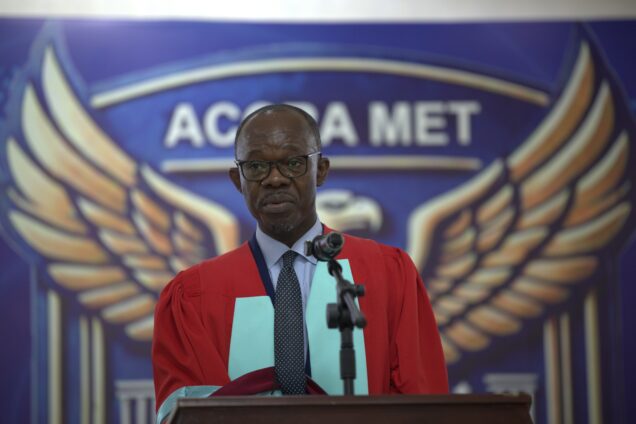
Addressing participants at the launch of specialised master's programmes at Accra Metropolitan University College in Accra on Wednesday, April 22, Dr Albert Antwi-Boasiako said the concept of capability must be redefined to reflect the demands of the modern digital landscape.
“Capability is not what you know, it is what you can do, under pressure, in uncertain conditions, with real consequences that impact on the human condition,” he stated.
Dr Antwi-Boasiako, who is the former Director-General of the Cyber Security Authority (CSA), argued that education must move beyond passive instruction and instead immerse students in real-world problem-solving. Drawing on philosophical foundations, he urged a return to experiential learning.
“We learn not by being told, but by engaging with reality,” he said, advocating for curricula that embed practical competencies at their core.
He outlined critical areas that must form the backbone of modern cybersecurity and intelligence training, including threat analysis, digital forensics, intelligence synthesis, counter-intelligence analysis, offender profiling and risk-based decision-making.
“These competencies are not optional, they are essential,” he emphasised. “The future professional in the Algorithmic Era must be a technologist, an analyst, a strategist and an ethicist at the same time.”
According to him, the most significant risks in the digital age stem not from technical breakdowns, but from flawed human judgement.
“The most dangerous failures in this era are not technical, they are mostly failures of judgment,” he cautioned.
Dr Antwi-Boasiako further challenged students and institutions to adopt a more critical approach to emerging technologies, particularly algorithm-driven systems.
“Students in this era must not only use algorithms, but they must interrogate them,” he said. “What assumptions underlie this model? What biases are embedded? What are its limitations and security implications?”
He described this approach as extending beyond technical training into the realm of philosophical inquiry, where learners are encouraged to question systems rather than accept them at face value.
“This is not just technical training, it is also a philosophical training in disguise,” he noted. “Students must learn not just to trust systems, but to question them.”
Dr Antwi-Boasiako concluded by warning against rigid academic structures, stressing that education must continuously evolve to remain relevant in a rapidly changing world.
“In an era of constant change, education is no longer a phase,it is a permanent condition,” he said, calling for dynamic curricula that adapt to the shifting realities of the Algorithmic Era.
Latest Stories
-
Follow the evidence, not assumptions, in Baffour Awuah case – Victoria Bright
7 minutes -
48-hour detention rule is not an automatic entitlement for EOCO – Victoria Bright
30 minutes -
Baffour Awuah’s arrest is a political witch-hunt – Kofi Bentil
36 minutes -
MT Asharami Ghana arrives in Tema as government pushes stronger LPG infrastructure
39 minutes -
Weweso JHS wins 5th edition of Otumfuo Reading Competition 2026
42 minutes -
‘Criminal law can’t turn every poor commercial judgment involving state entity into an offence’ – Victoria Bright
43 minutes -
Baffour Awuah has shown willingness to cooperate, qualifies for self-recognisance bail – Kofi Bentil
53 minutes -
NPP elections: Here are the 46 candidates seeking votes of 7,163 delegates
58 minutes -
EOCO is only carrying out its mandate, not violating Baffour Awuah’s rights – Dzimegah
1 hour -
Heavy security at Baba Yara Stadium as NPP elects national officers today
1 hour -
Horticulturists call for dedicated authority, irrigation and tomato factory revival
2 hours -
Nakpayili E-Block opens, admits first batch of 650 students after nearly a decade of neglect
2 hours -
Ethel Cofie writes: You need board experience to get board experience
2 hours -
Baffour Awuah expected in court as EOCO moves to meet bail deadline
2 hours -
Happy 76th Birthday to the Daily Graphic!
2 hours