

Audio By Carbonatix
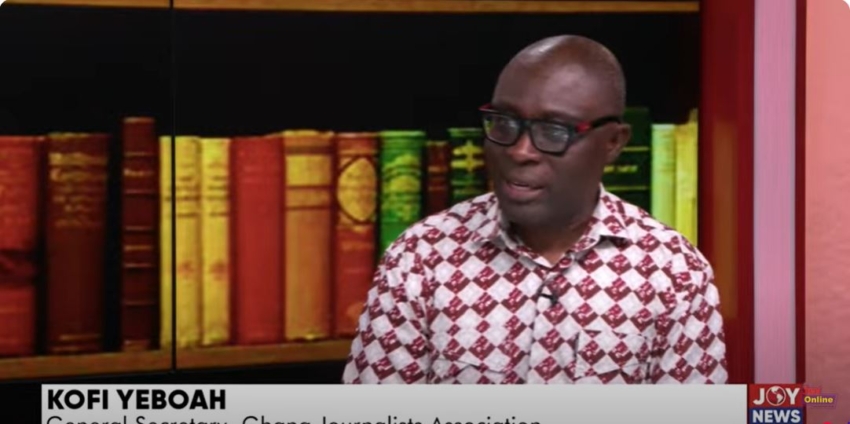
The General Secretary of the Ghana Journalists Association (GJA), Mr. Kofi Yeboah, has called for an end to the criminalisation of free speech in Ghana, describing it as inconsistent with the spirit and letter of the 1992 Constitution.
His comments come in the wake of the recent jailing of a blogger for publishing false news about the dollar, while a Member of Parliament for Bolga Central, Isaac Adongo, who made a similar public claim, has not faced prosecution. The incident has sparked renewed debate over Section 208 of the Criminal and Other Offences Act, 1960 (Act 29), which criminalises the publication of false news likely to cause fear and alarm to the public.
Speaking on JoyNews' The Law on Sunday, he said: “Our position is that we cannot—and we should not—criminalise free speech,” Mr. Yeboah said.
“The example you gave, where a blogger was jailed for 30 days while an MP walked free for a similar offense, only confirms what we’ve always maintained: even where the law is applied, it is done selectively. Otherwise, why wouldn’t the MP also be arrested and prosecuted under the same law?” he questioned.
He criticised what he described as the biased and selective application of the law, particularly by the police, who he believes disproportionately target media professionals.
“In our humble view, if you look at the 1992 Constitution and interpret it as a whole, it leans strongly toward protecting and guaranteeing freedom of speech and expression,” he said.
He cited Article 21(1)(a), which guarantees freedom of speech and expression, and Article 21(1)(f), which upholds the right to information.
Mr. Yeboah also pointed to Chapter 12 of the Constitution, which promotes media freedom, and Article 163, which enjoins state-owned media to provide fair opportunities for the presentation of divergent views and dissenting opinions.
“All these provisions are geared toward deepening democracy and encouraging civic engagement. If this is truly the aim of our Constitution, why then should we seek to silence free expression through criminal prosecution?” he questioned.
He further argued that misinformation should be countered through civil remedies, public corrections, or regulatory sanctions rather than punitive criminal action.
Latest Stories
-
GRA assures Tullow of collaboration to settle $393m tax liability without disrupting its petroleum operations
9 minutes -
South Korea demands apology from Pyongyang for landmine blasts that injured three
12 minutes -
Carlos Queiroz not the sort of coach Black Stars need – Nii Lante Vanderpuye
42 minutes -
AFCON 2027Q: ‘Our Black Stars team is gone’ – Former Sports Minister
1 hour -
Prof. Prempeh calls for public review of draft constitutional reform bills
1 hour -
AFCON 2027Q: ‘I have never seen a poor performance from Black Stars like against Gambia’ – Nii Lante Vanderpuye
1 hour -
Nigeria set to launch National Digital Address System 9 years after Ghana showed the way
2 hours -
Policy rate decision takes time to reflect in lower lending rates – BoG
2 hours -
Western Regional Minister applauds Karpowership’s role in Ghana’s power sector
2 hours -
Playback: Road safety crises: Where are we getting it wrong?
2 hours -
Enterprise Life celebrates 25 years of protecting families and building trust
2 hours -
ICC London rules in favor of Ghana against Tullow over $400m tax charge
3 hours -
We are disappointed in ICC’s ruling over our corporate income tax assessment in Ghana – Tullow Oil
3 hours -
Cost of building inflation for August 2026 increases to 4.6% – GSS
3 hours -
Today’s front pages: Wednesday, September 30, 2026
3 hours