

Audio By Carbonatix
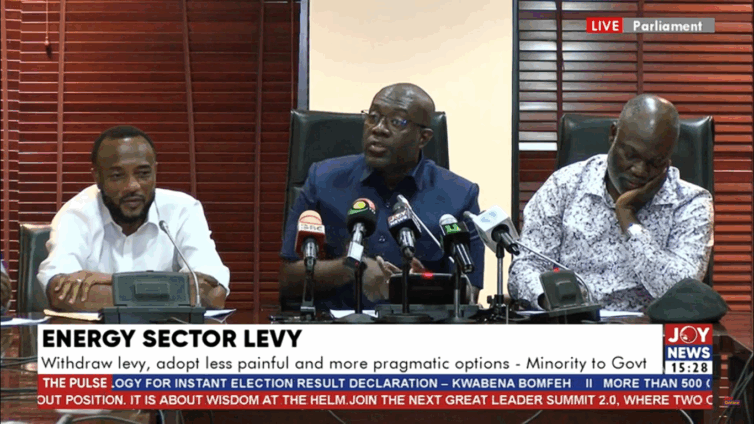
The Minority in Parliament has called on the government to urgently conclude re-negotiations on power purchase agreements (PPAs) to address the growing energy sector debt without overburdening Ghanaians with the GH₵1 fuel levy.
Speaking at a press briefing on Monday, 9 June 2025, the Ranking Member on Parliament’s Economy and Development Committee, Kojo Oppong Nkrumah, on behalf of the minority, criticised what he described as a dishonest approach by the government in introducing a new levy to pay off the debt in the energy sector.
“You recall the day the e-levy was repealed, our good friend the Majority Leader was on his feet saying the government has put 2 billion cedis back into the pockets of Ghanaians,” he said. “This Dumsor levy is taking from everybody over 5.7 billion cedis for this fiscal year. So if repealing the e-levy puts 2 billion back into the pockets of Ghanaians, what does introducing the Dumsor levy that takes away 5.7 billion do?”
Mr Oppong Nkrumah argued that the levy undermines the government's claim of providing economic relief. “This government is taking 5.7 billion cedis from the pockets of Ghanaians, and we think it is very dishonest,” he stated.
“Because if you claim that you are giving Ghanaians 2 billion back, which was described as evil by the previous government, how do you give back 2 billion and take 5.7 billion? It is only the NDC government that does that, justifies it and expects everybody to say that is some smart economic approach.”
While expressing opposition to the levy, the Minority offered alternative solutions. Mr Oppong Nkrumah said the government should focus on renegotiating the power purchase agreements, a process that was initiated by the previous administration.
“We think that what the government should do is to complete the re-negotiations of the power purchase agreements, which were started by the previous administration,” he suggested.
According to him, the re-negotiations should include passing fuel and capacity charges into the PPAs, allowing them to be reflected in electricity tariffs. “Government should include these in the tariffs calculations to eliminate the need for off-book debt that is caused by the take-or-pay clauses in the energy sector contracts that were signed between 2013 and 2016,” he explained.
He noted that these take-or-pay clauses and capacity charges have been the major contributors to the current energy sector debt. “Now and then, a bill is sent to the Finance Ministry to pay, and that bill is accumulating,” he said.
“If the government is really intended to pay, one of the things it should do is to complete the renegotiation, move the fuel purchases and the excess capacity charges into the PPAs so that when people consume a certain realistic amount, then they will pay,” Mr Oppong Nkrumah added.
Latest Stories
-
Government plans mandatory drug tests for public service jobs — Muntaka
54 seconds -
Media urged to intensify awareness campaigns on breast cancer
6 minutes -
Interior Minister urges public to share drug intelligence
12 minutes -
Afadzato South DCE commissions water projects, teachers’ bungalow
17 minutes -
Council of State urges sustained dialogue, negotiations as teachers resume work
22 minutes -
We are committed to leaving a legacy in Mandari – Bole-Bamboi MP
26 minutes -
Greater Accra teachers resume work after strike suspension
34 minutes -
Education Minister assures teachers of salary adjustments by October 16
39 minutes -
Abass Osabutey declares bid for NDC Deputy National Organiser position
41 minutes -
Education Minister inaugurates NDU Governing Council, announces $25m seed funding
49 minutes -
THE LAW 101: La Beach Demolitions – The State’s own documents, the courts’ orders – and the bulldozers
52 minutes -
DVLA contributes GH¢17.7m to Consolidated Fund in 2025
55 minutes -
Why disaster risk reduction must connect early warnings, preparedness and financial protection to household-level resilience
1 hour -
Fentuo Tahiru narrates how 2018 Commonwealth Games visa scandal became an international embarrassment
1 hour -
The AI Gold Rush: Who strikes gold and who gets left behind?
1 hour