

Audio By Carbonatix
Ghana risk a European Union (EU) ban on fish importation if the country does not take the necessary steps to sanitise its fishing space.
Already, the country has received two yellow cards from the EU -one in 2013 and another in 2021- and should the problem persist by 2026, the country will receive a red card.
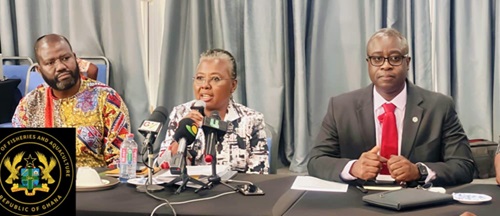
This was made known by the Chairman of the Parliamentary Select Committee on Food, Aquaculture and Cocoa Affairs, Dr Godfred Seidu Jasaw, at a stakeholders’ meeting in Accra on Friday.
The meeting was to finalise a draft Fisheries bill that will help bring sanity to the country’s fishing space.
He said on both occasions, the country was singled out for yellow card warning for illegal, unreported and unregulated fishing.
To this end, he said the draft bill, which was now with the committee of parliament, has made satisfactory inputs but still needed stakeholders in the industry to help finalise it so that Ghana can pass the EU specifications and not receive a red card in 2026.
Value chain
The Minister of Fisheries and Aquaculture, Emelia Arthur, in a welcome address, said three million people in the country depended on the fishery value chain, saying a ban would, therefore, have dire consequences.
Also, she said the country was one of the biggest markets for fish importation into the EU market and a red card would affect export revenues.
She, therefore, said a law was needed to regulate and sanitise the country’s fishing space.
The bill, she said, has, therefore, been laid before parliament under a certificate of emergency.
Mrs Arthur said when finalised, the bill would further be presented to the EU and the Food and Agriculture Organisation (FAO) for contributions before it is passed.
Stakeholders expressed their concerns, saying fish was an important resource in the country that needed to be properly managed.
They said the country had international obligations to manage the resource well.
Some called for the penalisation of captains of vessels that get involved in illegalities in the country’s waters.
They said such captains should not just be repatriated to their home countries but be made to face the full rigours of the country’s laws to serve as a deterrent to others.
Bill
The Fisheries and Aquaculture bill, which elapsed with the last parliament and, therefore, is undergoing consideration in the present parliament, has 167 clauses and 170 sections.
The bills will deal with issues, including inland fishing management, aquaculture issues, offences and penalties.
Latest Stories
-
UTAG-UG threatens strike on October 19 over unpaid allowance
30 seconds -
Let The Constitution direct Chieftaincy to deliver “All Development Is Local”
1 hour -
John Jinapor outlines renewable energy, nuclear power priorities for 2027
2 hours -
Ghana explores centre of excellence for hearing, communication and cochlear implant care
3 hours -
Schizophrenia-related disorders lead mental health cases recorded in Ghana
3 hours -
Dutch authorities enlist Ghana in hunt for fugitive drug lord Bolle Jos
3 hours -
Ghana housing finance conference adopts communiqué to improve affordable housing access
8 hours -
Special Initiatives Minister urges Wa Technical Institute to enrol more girls as EU-backed solar training lab opens
8 hours -
In the matter of my first year at the Bar
8 hours -
ActionAid Ghana calls for an end to child marriage, greater investment in girls’ rights
8 hours -
Newsfile to tackle World Cup visa scandal, beach demolitions, education strikes, BRICS bid
9 hours -
UK-Ghana Trade & Investment Summit: Trade Resource Centre to help businesses maximise UK-Ghana trade opportunities
9 hours -
Embassy of Denmark celebrates World Maritime Day
9 hours -
Linking LEAP to productive inclusion could cut extreme poverty by 2030 – UNICEF
10 hours -
Trade Ministry backs use of creative arts to rehabilitate prison inmates
10 hours