

Audio By Carbonatix
The World Bank has advised Ghana to be intentional and bold about breaking away from its repeated reliance on International Monetary Fund (IMF) loan-supported programmes.
Experts have acknowledged the efficacy of IMF-supported programmes but argue that its short-term orientation does not meet the sustainable macroeconomic stability needs of Ghana.
Accentuating this, the World Bank said the country could only achieve long-term economic transformation through fiscal discipline, sound governance, and structural reforms.
In the Bank’s latest Policy Notes on the country, titled “Transforming Ghana in a Generation,” it underscored an urgent need for reform, saying, “Ghana must break from past governance failures marked by fiscal indiscipline, inefficiency, and repeated IMF programmes.”
The report indicated that Ghana could sustain growth above 6.5 per cent and triple its per capita income by 2050 if it adopted bold policies and strengthened institutions, citing weak structural transformation and heavy dependence on natural resources as a challenge.
The Policy Notes outlined four critical foundations for driving Ghana’s transformation: restoring macro-financial stability, boosting productivity and jobs, sustainable management of natural resources and resilience in agriculture and infrastructure, and reinforcing governance.
That required the country to boost revenue collection, strengthen expenditure management, and undertake reforms in key sectors like energy and cocoa to reduce fiscal risks.
The report also called for an enhanced business environment that attracted investment in high-productivity sectors, while improving education, health, and social protection to build human capital.
Ghana must also sustain the management of its natural resources and enhance resilience in agriculture and infrastructure for broad-based, inclusive growth, while reinforcing governance through stronger institutions, anticorruption efforts, and public sector to restore trust and support effective development.
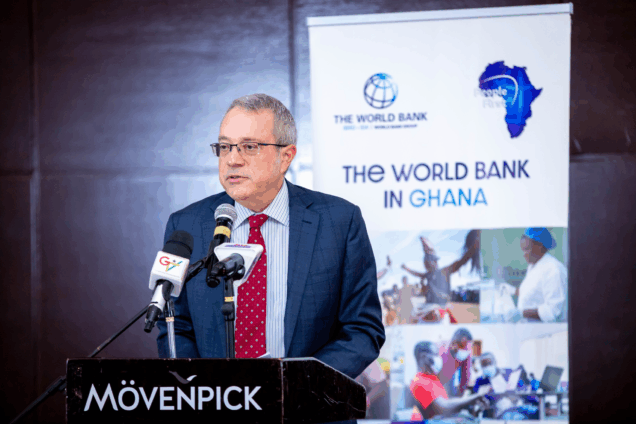
“Ghana has a unique opportunity to restore fiscal discipline, improve governance, and leverage natural and human capital resources for broad-based and inclusive development to transform the country within a generation,” said Robert Taliercio, World Bank Division Director for Ghana, Liberia and Sierra Leone.
“To sustain high growth, it must join other countries that have maintained prolonged periods of robust economic growth and successfully avoided the middle-income trap by maintaining macroeconomic stability, low inflation rates, and sustainable public finances,” he stated.
Mr Stefano Curto, Lead Economist and Lead Author of the report, said, “The choices Ghana makes now can unlock a generation of inclusive, resilient growth, and deliver on the promise of quality jobs for its citizens.”
He expressed the World Bank’s readiness and commitment to supporting the country’s leadership and all stakeholders for a sustainable economic transformation.
Latest Stories
-
COCOBOD’S GH¢16.3bn SPV: Real progress toward a sustainable cocoa sector
13 minutes -
Ghana lose Morocco friendly as Atlas Lions turn to Mali
2 hours -
2026/2027 GPL: Kelvin Nkrumah strike sends Medeama top of league table
2 hours -
Emmanuel City crowned champions of maiden Global Game Scouting Tournament
2 hours -
Thomas Partey loses father Jacob Teye Partey
3 hours -
Martin Kpebu explains when EOCO can arrest Manhyia South MP after securing court warrant
3 hours -
EOCO’s reasons for seeking Manhyia South MP arrest warrant not justified – Kpebu
3 hours -
MTN Ghana warns SMEs against sharing PINs amid digital fraud risks
3 hours -
Yendi nursing students warn restricted access to skills lab could affect their training
3 hours -
Minority awaits formal notice of arrest warrant for Manhyia South MP – Annoh-Dompreh
3 hours -
LTIF announces 2026 Pan-African edition in Accra from October 6-7
3 hours -
Mfantsipim needs broader funding partnerships to bridge infrastructure gap – Prof Baiden
3 hours -
MP status must not shield anyone from law enforcement – Kwakye Ofosu
3 hours -
EOCO had tactical team ready to arrest Baffour Awuah – Felix Kwakye Ofosu
4 hours -
Afoko can unite NPP’s factions, says Charles Owusu Juanah
4 hours