

Audio By Carbonatix
Governance expert and Founder of the Boardroom Governance Summit, Prof. Douglas K. Boateng, has called for a change in the values and attitudes of Ghanaians to build a stronger governance culture and prepare future leaders.
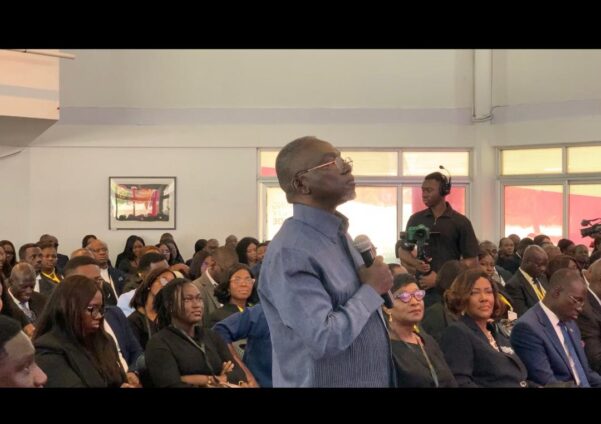
Speaking at the Greater Accra Regional Bar Week Conference in Accra, Prof. Boateng urged professional bodies, including the Ghana Bar Association (GBA), to play a greater role in shaping ethical leaders through mentorship, training and public education.
He said integrity, accountability and fairness must become central values in Ghana’s leadership and governance systems.
According to him, the country’s governance challenges cannot be addressed solely through institutional reforms but require a deeper transformation in societal attitudes and personal conduct.
“Good governance begins at home,” Prof. Boateng said, stressing that families play an important role in teaching children discipline, responsibility and respect for rules.
He explained that children who grow up in environments that promote honesty and accountability are more likely to become responsible leaders in the future.
Prof. Boateng also expressed concern about growing political polarisation in Ghana, saying national issues are often assessed through partisan lenses rather than the broader interest of the country.
He urged citizens and leaders to prioritise Ghana’s collective development above political affiliations.
“Leadership should not be driven by political loyalty but by integrity, accountability and the wellbeing of the people,” he said.
The governance expert encouraged professional institutions to expand mentorship programmes aimed at equipping young people with ethical leadership skills.
He said initiatives that promote honesty, fairness and responsible decision-making among the youth would help create a generation of leaders committed to national progress.
Prof. Boateng added that organisations and public institutions must reflect the same values expected of leaders, noting that governance is ultimately a mindset that begins with individual choices and behaviour.
He believes strengthening Ghana’s governance culture requires a collective effort from families, professional bodies, civil society and state institutions.
Latest Stories
-
Mr President, Ghana was mentioned at the UN; why aren’t we talking about it?
2 hours -
Accra to convene Africa’s regulators and markets on tokenisation at AVAS 2026
2 hours -
The Paradox of Plenty — When every smartphone becomes a newsroom
2 hours -
GTA sensitises taxi drivers in ‘Know Ghana’ tourism campaign
4 hours -
Archbishop Agyinasare calls for responsible speech amid growing social media abuse
4 hours -
‘It will be inexcusable for gov’t not to honour payment of teachers’ arrears by 30th October’ – Haruna Iddrisu
4 hours -
Forbes’ World’s Best Employers 2026: No Ghanaian firm ranked among 900 companies
4 hours -
Electronic processing of teachers’ data: ‘The decision is the Controller’s’ – GES boss
4 hours -
Teachers’ Strike: Haruna Iddrisu questions paper-based processing of promoted teachers’ data
4 hours -
Savannah Region: Kunfusi bridge collapses again, leaving nearly 4,000 residents cut off
4 hours -
Teachers’ strike: GES targets Monday deadline to submit promotion data to Controller
4 hours -
Inflation to average 11.3% in 2027 – Fitch Solutions
5 hours -
‘I didn’t campaign for NDC to come and do this nonsense’ – Kpebu on EOCO’s conduct
5 hours -
Fitch Solutions maintains policy rate forecast of 14% by December 2026
5 hours -
Diaspora Nasara Caucus congratulates Mohammed Ali Suraj, new NPP executives
7 hours