

Audio By Carbonatix
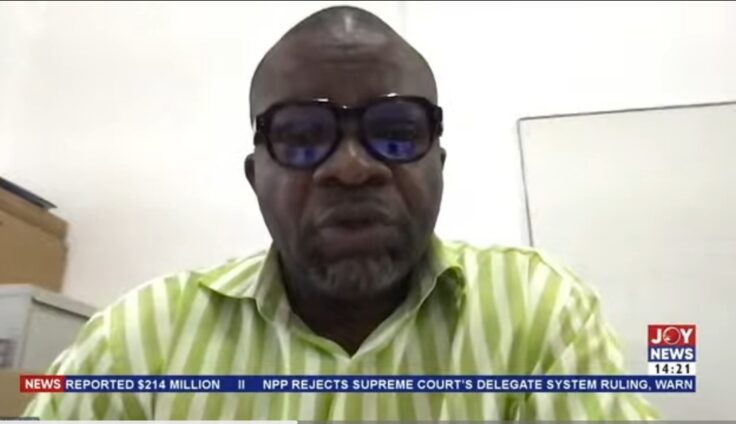
Political analyst Dr Kwame Asah-Asante says the Supreme Court's decision to scrap the delegate system for internal political party elections could help address concerns over the growing influence of money in party politics.
According to him, although the implementation of the ruling may come with challenges, it presents an opportunity to improve Ghana's democratic processes and reduce the excesses associated with "moneycracy".
Speaking on JoyNews' The Pulse on Wednesday, August 5, Dr. Asah-Asante said he supports the Supreme Court's decision, arguing that a broader participation system could help create a fairer internal election process.
"I support the Supreme Court ruling because this is one of the surest ways by which we can deal with some of the excesses relative to moneycracy associated with political parties," he said.
He added that the ruling could help "tidy up the whole process for a better kick-off for the democratic process."
Dr. Asah-Asante acknowledged concerns about the financial implications of conducting wider internal party elections but argued that the challenge could be managed through a combination of state support and contributions from political party members.
"I belong to that school of thought. I won't share the view that political party financing must not be brought to the table for discussion. We need that, so as to support a call like this," he said.
He, however, stressed that political parties must also explore ways of financing their own activities rather than relying entirely on public funds.
One option, he suggested, is for party members who wish to participate in internal elections to contribute financially towards the process.
"Those who are coming to the register can be levied to pay for exercising their rights. I'm not sure it will be a difficult one for people who really want to tell the world that they are members of a certain political party," he said.
Responding to concerns that state funding could give governments undue influence over political parties, Dr. Asah-Asante argued that such fears can be addressed through proper structures and stakeholder involvement.
He explained that any funding arrangement should not be controlled by government alone but should involve key stakeholders, including political parties and relevant institutions.
"If it's coming from government, it's all of us, our contribution. So government cannot control anything," he said.
He proposed that funds meant for internal party elections could be managed through an independent arrangement, with clear guidelines to ensure transparency.
"The Electoral Commission can manage as part of their budget, that this is money earmarked for this exercise, and then political parties will add maybe an X amount of money or nothing, then we move on," he added.
Dr. Asah-Asante maintained that with proper safeguards, state support for political party elections could strengthen Ghana's democracy without compromising the independence of political parties.
Latest Stories
-
Mr President, Ghana was mentioned at the UN; why aren’t we talking about it?
3 hours -
Accra to convene Africa’s regulators and markets on tokenisation at AVAS 2026
3 hours -
The Paradox of Plenty — When every smartphone becomes a newsroom
3 hours -
GTA sensitises taxi drivers in ‘Know Ghana’ tourism campaign
5 hours -
Archbishop Agyinasare calls for responsible speech amid growing social media abuse
5 hours -
‘It will be inexcusable for gov’t not to honour payment of teachers’ arrears by 30th October’ – Haruna Iddrisu
5 hours -
Forbes’ World’s Best Employers 2026: No Ghanaian firm ranked among 900 companies
5 hours -
Electronic processing of teachers’ data: ‘The decision is the Controller’s’ – GES boss
5 hours -
Teachers’ Strike: Haruna Iddrisu questions paper-based processing of promoted teachers’ data
5 hours -
Savannah Region: Kunfusi bridge collapses again, leaving nearly 4,000 residents cut off
5 hours -
Teachers’ strike: GES targets Monday deadline to submit promotion data to Controller
5 hours -
Inflation to average 11.3% in 2027 – Fitch Solutions
6 hours -
‘I didn’t campaign for NDC to come and do this nonsense’ – Kpebu on EOCO’s conduct
6 hours -
Fitch Solutions maintains policy rate forecast of 14% by December 2026
6 hours -
Diaspora Nasara Caucus congratulates Mohammed Ali Suraj, new NPP executives
7 hours