

Audio By Carbonatix
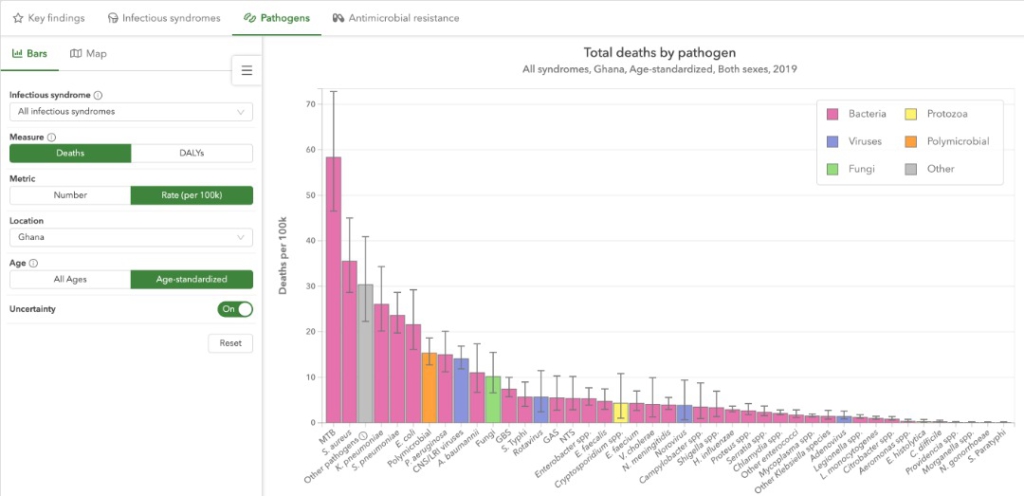
A new analysis conducted by the Global Burden of Disease and Antimicrobial Resistance Collaborators has revealed that Ghana recorded 88,649 infection-related deaths in 2019.
According to the analysis, 49,066 deaths were caused by bacterial infections, including tuberculosis, 25,309 deaths were caused by a resistant bacterial infection, and 5,923 deaths were caused by a resistant bacterial infection.
24,564 children under the age of five died as a result of sepsis. Bloodstream infections were the most lethal infectious syndrome among children, accounting for 8,194 deaths.
According to the analysis, lower respiratory infections and all related infections in the thorax account for 25% of the total.
In the first global mortality estimate, bacterial infection was responsible for 55% of sepsis deaths. The remaining 45% was caused by other pathogens such as viruses, fungi, and parasites.
Dr. Christopher J.L. Murray, Chair of Health Metrics Sciences at the University of Washington and Director of the Institute for Health Metrics and Evaluation (IHME), and leader of the Global Burden of Disease and Antimicrobial Resistance Collaborator told JoyNews few hours after the release of the first global estimates of mortality involving 33 bacterial pathogens and 11 types of infection, claims they were responsible for 7.7 million deaths worldwide in 2019.
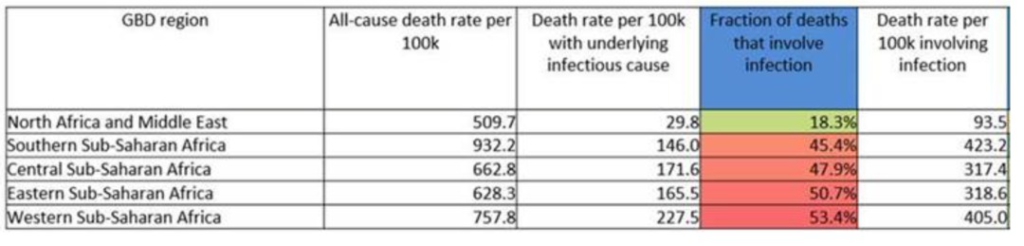
In 2019, deaths caused by these bacteria accounted for 13.6% of all global deaths and more than half of all sepsis-related deaths. Lower respiratory infections (LRI), bloodstream infections (BSI), and peritoneal and intra-abdominal infections (IAA) accounted for more than 75% of the 7.7 million bacterial deaths. S. aureus, E. coli, S. pneumoniae, K. pneumoniae, and P. aeruginosa were the pathogens responsible for 54.2% of the deaths among the bacteria studied. S. aureus was the pathogen responsible for the most deaths worldwide, accounting for 1.1 million deaths.
E. coli (950 000 deaths), S. pneumoniae (829,000), K. pneumonia (790,000), and Pseudomonas aeruginosa were the other pathogens linked to more than 500,000 deaths (559,000).
The leading bacterial pathogens were linked to a similar number of female and male deaths. The most deadly pathogens and age-standardised mortality rates varied by location.
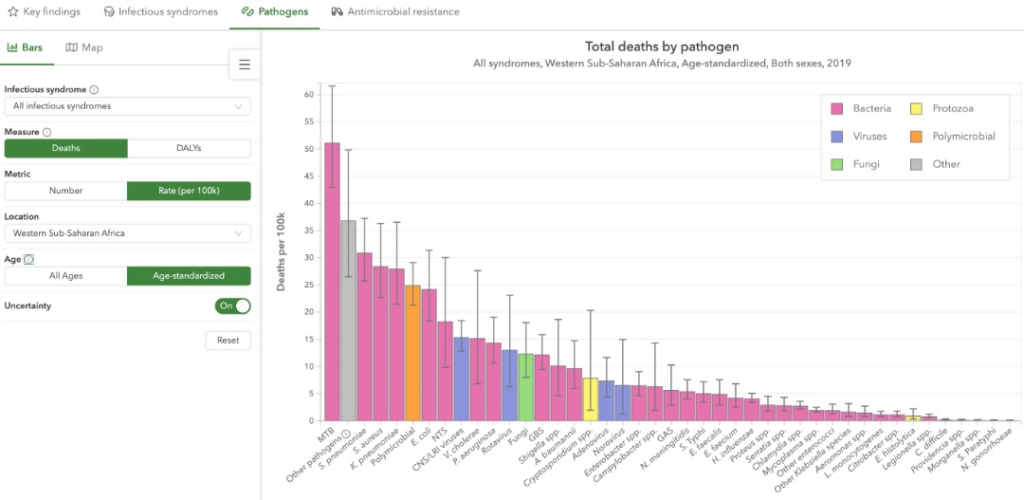
With 230 deaths per 100,000 people, Sub-Saharan Africa had the highest mortality rate. The high-income super-region, which includes Western Europe, North America, and Australasia, had the lowest mortality rate, with 52 deaths per 100,000 people. In 135 countries, S. aureus was the leading bacterial cause of death, followed by E. coli (37), S. pneumoniae (24), and K. pneumoniae and Acinetobacter baumannii (4 countries each).
While many estimates exist for pathogens such as tuberculosis, malaria, and HIV, estimates of the disease burden of bacterial pathogens have previously been limited to a few specific pathogens and types of infection, or have been limited to specific populations.
More deaths have been linked to two of the most lethal pathogens, S. aureus and E. coli - than HIV/AIDS (864,000 deaths) in 2019, despite the fact that HIV research received $42 billion dollars, while $800 million has been allocated for E. coli research.
According to the authors, such funding gaps may have arisen due to a lack of data on the global burden of these infections until now.
According to Dr. Murray, common bacterial infections were the second leading cause of death in 2019 after ischaemic heart disease, accounting for one out of every eight deaths worldwide.
When asked if it surprises him, he said, "It does. You know, I think, many people would expect that. Um, these pathogens, you know, aren't, such killers as they are, so it is quite surprising that they are still there in the community still causing a lot of harm."
"Well, I think some of the deaths from these pathogens are sort of hidden, because, uh, we tend to cluster uh things together in syndrome like pneumonia or a bloodstream infection, or a wound infection, and don't really dig into the details to see what are the bacteria causing those problems. And that's when you do that. You reveal that some bacteria that most people aren't that familiar with are actually at the root cause of multiple different um syndromes. And so part of the research is to shed light on the importance of these bacteria,” he added.
Part of the reason Sub-Saharan Africa had the highest mortality rate is due to risk factors for some of the infections that are more common in Africa, such as pneumonia, wound infections, and skin infections.
“It's very common in West Africa that has to do with both. You know the environment, malnutrition, lack of vaccination in some cases, for example, for streptococcus pneumonia. So those all come together to make the risk of those uh infections, these bacterial infections higher,” Dr. Murray said.
According to Dr. Murray, the world has not invested enough in research for these bacterial pathogens, which is due in part to their obscurity.
“So some of the research funders don't see the totality of their impact. And that's why we put all this stated together so that hopefully people recognize the importance of these bacterial pathogens in the future. The world needs to invest in vaccines and new drugs for these pathogens. But at this point uh it doesn't seem like investments in a vaccine are working very well. Uh, and there doesn't seem to be any prospect in the near future, or the next. Even ten years, perhaps, or even longer, for a vaccine,” he stated.
Dr. Murray believes that there is a need to rebalance the research and development focus in order to pay more attention to these pathogens. He called on researchers and funding agencies around the world to focus more on bacterial pathogens.
Latest Stories
-
NPP Delegates conference: The wisdom of the masses will prevail – Napo
12 minutes -
NPP Bosome Freho Constituency Chairman reportedly arrested over ballot paper incident
34 minutes -
Happy 76th Birthday to the Daily Graphic!
59 minutes -
Amin Adam celebrates Prof. Alhassan Musah on appointment as KAAF University Vice-Chancellor
1 hour -
Mahama reaffirms commitment to Volta development at Asogli Te Za
1 hour -
Bawumia urges NPP aspirants to accept results, reunite party after elections
1 hour -
Double fibre cut disrupts Telecel services, 72,754 subscribers affected
2 hours -
Bawumia demands probe into financiers behind Ghana-linked cocaine shipments
2 hours -
Spain beat Czech Republic to maintain winning run
2 hours -
Ronaldo ‘greatest symbol’ of Portugal – Fernandes
2 hours -
NPP election: We thank NDC for making the attempt; we never expected them to show up – Karbo says after boycott
2 hours -
Tennessee prison chief to resign after Christa Pike’s failed execution
3 hours -
Free SHS suffering under NDC gov’t- Dr Bawumia
3 hours -
NSA cannot manage all Ghana’s sports facilities alone – Ampofo Ankrah
3 hours -
MoH announces mop-up recruitment for health professionals
3 hours