

Audio By Carbonatix
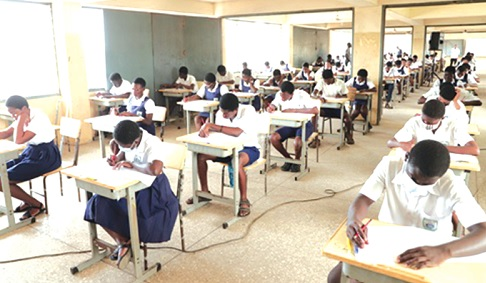
A total of 473,658 final-year senior high school (SHS) students from Ghana will join their counterparts from four other West African member countries to sit the 2026 May-June West African Senior School Certificate Examination (WASSCE) for School Candidates (SC).
The decision to rejoin Liberia, The Gambia, Nigeria and Sierra Leone for the international examination this year follows five years of taking the Ghana-only version due to the COVID-19 outbreak disruption.
The Ghanaian candidates comprise 248,461 males and 225,197 females from 1,020 public and private second cycle schools, representing a 2.58 per cent increase over last year’s figure of 461,736.
The Head of Public Affairs of WAEC, John Kapi, made this known to the Daily Graphic yesterday during a briefing on the arrangements put in place for Ghana to return to the May-June WASSCE-SC.
He said WAEC had started the process for conducting the examination while the printing of the scripts was ongoing.
Asked what the return by Ghana meant, he said, “Simply, it means that we (all WAEC member countries) are all writing at the same time.
That is all, nothing has changed”.
“We need to understand certain basic facts about the examinations that we conduct.
The examinations are international in nature, which means that we involve every member country in our preparatory stages, especially when it comes to the moderating of questions and compilation of the examinations,” he said.
International partners
Mr Kapi said international partners were involved in the conduct of the examination, with each member country represented, and that when the examination was over, the same panel sat and discussed the marking scheme and agreed on what grades could be awarded based on the responses of candidates to questions.
He said when the marking was done, another panel sat and determined the award of grades and, for instance, came up with the cut-off point of A1, B2, B3, up to F9.
“So again, the international partners would sit down and determine all these things before we publish the results because we have this international competition among the candidates – what we call the excellence awards,” he said.
He explained that, unlike previously, when Ghana had to take the WASSCE-SC ahead of the four other countries, all member countries would sit the examination simultaneously this time around.
The conditions, he said, remained the same and that nothing had changed. He added that all the countries had the same timetable and would therefore start and finish at the same time.
Security
On security arrangements put in place, he said the council had, over the years, introduced various measures to ensure the sanctity and credibility of its examinations.
“Over the years, we have introduced a number of measures; we always want to be sure that the printing press is secured.
We do not want any personnel who are not assigned any duties to be there, so we have our own internal security who are supposed to be around always, even when we are not printing.
“When the printing process starts, we have police presence there 24/7, and during working hours, we have additional security from the National Investigations Bureau (BNI). So, at least these stages of security obviously would give us a certain feeling of security around the area,” he said, adding, “for you to even go into the printing hall, there is a dress code, it does not matter who you are,” he said.
Moreover, he said there were closed-circuit television (CCTV) cameras in and around the printing facility.
At the various examination depots where the scripts were kept after printing, he said, there were security personnel who also manned the scripts in sealed plastic bags.
He said apart from the examination officials, security personnel and the National Security operatives, there was also frequent monitoring on the various centres to prevent any malpractice.
“So in terms of security, we have put in place adequate security measures.
This is what we can do from our human point of view, so stakeholders—teachers, students, the community, opinion leaders as well as parents and guardians—would have to assist in the conduct of the examination devoid of malpractice,” he said.
Mr Kapi appealed to stakeholders to join in the fight against examination malpractice, which could be a national security threat.
“If you have them up to that point to cheat, they are going to cheat their way through life,” he emphasised.
As part of measures to prevent examination malpractice, he said the serialisation of questions would be part of the process.
“So once you adopt serialisation, you solve the problem to a very large extent,” he explained.
Latest Stories
-
Trump says he is considering firing US ambassador to Greece
2 hours -
Man City bananas ‘brought fun back’, says Varadi
2 hours -
Meta releases Muse Wonder AI models to challenge Anthropic and OpenAI
2 hours -
Daily Insight for CEOs: The CEO as Chief Decision Maker
2 hours -
Burnham had formal meeting with Man City chair while mayor
2 hours -
Is Ghana producing too many lawyers? What is the best lawyer-to-citizen ratio?
2 hours -
NDC sinking Ghana’s democracy with Emelia Agbenyo’s appointment – Miracles Aboagye
2 hours -
Seedorf back in football as Corinthians head coach
2 hours -
Hincapié and Zubimendi injured in post-match training session
3 hours -
Fridges in French supermarkets hit by cyberattack
3 hours -
Qantas flight grounded after bedbug outbreak
3 hours -
Reality Zone with Vicky Wireko: International Day of the Girl, shaping today’s girl for tomorrow’s future – ZONTA Clubs lead the way
3 hours -
Global health must be led by countries, not designed for them – Mintah Akandoh
4 hours -
Mahama honoured at 2026 World Health Summit in Berlin for global health leadership
4 hours -
Breast cancer is not a death sentence – Besease Kontire Obaapanin, Magmina Foundation lead awareness campaign
4 hours