


Audio By Carbonatix
Fitch Solutions has maintained that Ghana will reach a staff-level agreement with the International Monetary Fund (IMF) by the first quarter of 2023.
This will mean that the country could secure a programme from the Fund by the end of quarter 1, 2023 or the second quarter of 2023.
Some economists and experts were anticipating that the country could reach a staff-level agreement with the Fund before the end of 2022 to pave way for a programme by the first quarter of 2023.
But in its latest paper on “Division within Ghana's Ruling Party to Weigh on Political Stability”, the international research firm also said should the Finance Minister, Ken Ofori-Atta, be replaced, negotiations with the IMF would likely remain largely unaffected.
“While Ofori-Atta remained opposed to an IMF bailout – we believe that he would take a more accommodative approach towards negotiations with the Fund. As such, we believe that a change of finance minister would most likely not impact the timeline of IMF negations and we would retain our view that a staff-level agreement will be reached in Q123 [quarter 1, 2023]”, it explained.
Government to face additional pressure from frequent protests
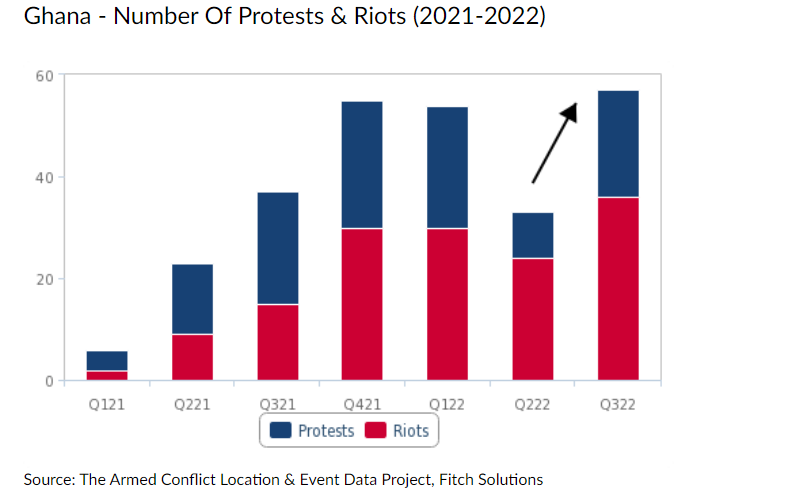
Furthermore, it said the government will face additional pressure from more frequent protests and industrial action.
“Worsening living standards amid rising consumer prices – inflation reached 40.4% year-on-year in October 2022, the highest reading since 2001 – and tighter monetary conditions have led to a 72.7% quarter-on-quarter increase in protests and riots across in quarter 3 2022. The country has also seen large industrial action in recent months, including a three-day retail strike in Accra in October [2022]".
Inflation to remain elevated, weighing on living standards
Fitch Solutions also expects inflation to remain elevated in the months ahead.
“Given that inflation is primarily driven by currency weakness, we expect price growth to remain elevated in the months ahead. Indeed, significant capital and financial account outflows caused by weakening investor sentiment will continue to weigh on the currency”.
“Our view is further informed by the fact that previous periods of significant exchange rate weakness in Ghana all lasted roughly 12-14 months, suggesting that the cedi will continue to depreciate into quarter 1, 2023 (the current sell-off started in January 2022). This will keep inflation high, weighing on living standards and eroding support for the government”.
Latest Stories
-
Government rejects ‘Cocaine Coast’ label, says drug busts show security agencies are working
1 hour -
Banks NPL ratio of 16.1% is still too high – S&P
1 hour -
US death row inmate Christa Pike taken to hospital after surviving two lethal injections, says lawyer
2 hours -
Japan raises residency fee for foreign nationals by twenty-fold
2 hours -
Nollywood actor CJay Nwoks dies in Lagos hospital
2 hours -
Guidelines, regulations of cryptocurrency in Ghana fall short of comprehensive oversight – IMF
2 hours -
Don’t stand and just criticise, propose solutions – RMD urges Nigerians
2 hours -
I didn’t want to be in the spotlight – Tems
2 hours -
COCOBOD’S GH¢16.3bn SPV: Real progress toward a sustainable cocoa sector
2 hours -
Morocco appoints first woman head of government, El Mansouri vows to meet citizens’ expectations
4 hours -
King Mohammed VI appoints Fatima Ezzahra El Mansouri as Morocco’s new head of government
4 hours -
Impossible for England to find another Kane – Tuchel
4 hours -
Ghana lose Morocco friendly as Atlas Lions turn to Mali
4 hours -
Burnham ‘really concerned’ if Man City owners sell up after rule breaches
4 hours -
2026/2027 GPL: Kelvin Nkrumah strike sends Medeama top of league table
4 hours