

Audio By Carbonatix
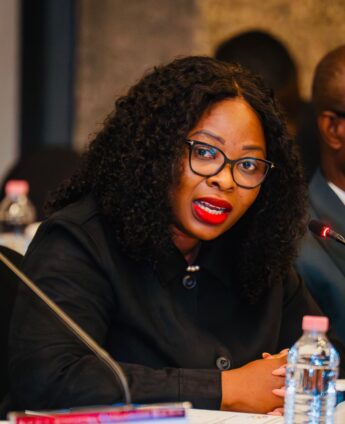
Benedicta Lasi, Executive Chair of the Africa Trade Chamber, has welcomed the Ghanaian government’s initiative to pursue closer engagement with BRICS, describing the move as an opportunity to diversify the country’s international economic partnerships, attract investment and advance its industrialisation and economic transformation agenda.
Speaking during an X Spaces discussion hosted by Koby Amoah under the theme “Ghana’s BRICS Bid: What Does It Mean for Ghana and Africa?”, Ms Lasi commended the government for exploring new avenues of international cooperation, noting that the changing global economic landscape presented opportunities for countries seeking to diversify their development partnerships.
She cautioned against interpreting the absence of a detailed public explanation of Ghana’s diplomatic considerations as evidence that the government lacked a strategy.
According to her, decisions of this nature often followed extensive diplomatic consultations and internal assessments, and Ghana’s interest in BRICS should be considered within the wider context of its national development ambitions.
Ghana is pursuing BRICS Partner Country status, which would enable closer engagement with the grouping without conferring full membership.
Ms Lasi pointed to South Africa’s experience, where the BRICS-established New Development Bank has approved financing for major infrastructure projects, as an illustration of the opportunities associated with stronger economic cooperation.
While participation in BRICS did not automatically guarantee financing or investment, she noted that the grouping offered an additional platform for engagement with economies possessing considerable financial resources, industrial capabilities and technological expertise.
Ms Lasi also highlighted the significance of Ghana hosting the Secretariat of the African Continental Free Trade Area (AfCFTA), emphasising the opportunities this presented for industrial development and expanded continental trade.
She observed that Ghana’s engagement with BRICS economies could complement the AfCFTA by facilitating investment in manufacturing, infrastructure, technology and regional value chains.
With Africa’s continental market encompassing more than 1.4 billion people, she stressed the importance of strengthening domestic industries to enable Ghanaian enterprises to compete effectively across the continent.
Drawing attention to the relationship between industrialisation and economic integration, Ms Lasi challenged African policymakers and businesses to consider the productive foundations of continental trade.
“What are we trading?” she asked, arguing that expanding market access would deliver greater economic benefits when accompanied by investment in competitive industries.
She emphasised the need for African countries to strengthen manufacturing, agricultural processing and other productive sectors, ensuring that international partnerships contributed to domestic value addition, employment and industrial growth.
Beyond international cooperation, Ms Lasi underscored the importance of establishing a long-term national development vision capable of providing continuity across successive political administrations.
She observed that industrialisation, infrastructure development and economic transformation required sustained investment and policy commitments extending beyond electoral cycles.
Greater national consensus on development priorities, she maintained, would allow successive governments to build upon established programmes while providing the policy stability necessary to attract long-term investment.
Ms Lasi further emphasised that Ghana’s international economic relationships should be guided by its national development interests rather than geopolitical divisions.
She noted that the country could maintain strong relationships with traditional development partners while expanding cooperation with BRICS economies and other emerging markets, taking advantage of opportunities for investment, technology transfer and trade.
Commending the government’s efforts to broaden Ghana’s international economic engagement, Ms Lasi expressed optimism about the opportunities associated with the proposed BRICS partnership.
She maintained that Ghana’s position as host of the AfCFTA Secretariat, together with its expanding international relationships, provided a foundation for advancing industrialisation, strengthening domestic enterprises and building a more diversified and competitive economy.
Latest Stories
-
Why Corporate Communications Professionals Must Be Marketing-Oriented: The strategic advantage and the professional mileage
11 minutes -
DVLA hands 357 suspected cloned vehicles to GRA over customs duties
11 minutes -
Appeals will not end strike, FWSC must negotiate – GAUA General Secretary
18 minutes -
Haruna Iddrisu hails Ghana’s academic calendar as best in a decade
19 minutes -
Silent Football: A team, a dream, a $24,000 debt – the struggles of Ghana’s deaf footballers
19 minutes -
Education Minister Haruna Iddrisu demands merit-based admissions, appointments at Defence University
21 minutes -
National Defence University to strengthen Ghana’s response to emerging security threats – Haruna Iddrisu
25 minutes -
Pupil arrested after two teachers shot at French school
31 minutes -
Lamisi takes ‘Let Us Clap’ tour across five countries and 18 dates
49 minutes -
DVLA cuts roadworthy contract cost from $155.4m to GH¢2m – CEO
51 minutes -
Okyeame Kwame calls for free university education for farmers’ children
54 minutes -
Black Stars: Two decades of coaching triumphs and turmoil (2006–2026)
58 minutes -
DVLA plans simulator-based driving tests to assess prospective drivers in Ghana
1 hour -
FDA disposes of 40-foot container of non-compliant diapers imported from Spain
1 hour -
PAC disappointed by Agric Ministry’s failure to present key witnesses in GH¢69bn special audit inquiry
1 hour