

Audio By Carbonatix
President John Dramani Mahama has declared that Ghana’s economy is steadily rebounding, pointing to sharp improvements in key macroeconomic indicators as evidence of recovery and renewed stability.
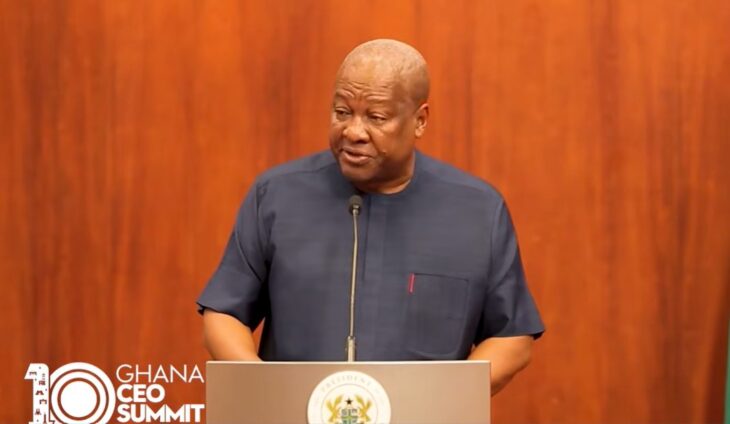
Addressing a delegation from CEO Network Ghana during a courtesy call at the Jubilee House on Friday, April 24, the President stressed that government’s reset agenda is yielding tangible results and positioning the country as an attractive destination for investment.
“So I'm pleased to welcome you to the presidency and over the years um your network has become an important platform for business leadership and policy dialogue,” he said, acknowledging the role of corporate leaders in shaping national economic discourse.
He underscored the importance of collaboration between government and industry, noting that rebuilding the economy requires a shared effort. “Government deeply values the contribution that you're making as we believe rebuilding and transforming the Ghanaian economy must be done in close partnership with the private sector,” he stated.
Reaffirming earlier assurances, President Mahama declared that Ghana is regaining its footing. “Earlier this year I reiterated that Ghana is back working again and open for business and today I speak not in promise but in clear evidence of recovery and stabilization,” he said.
He cited a significant drop in inflation as a key milestone. “Inflation has declined significantly to 3.2% as of March 2026 from 23.4% in March 2024,” he noted, drawing applause from the gathering.
The President added that interest rates have also eased, with current levels hovering around 16%, while the Bank of Ghana reference rate stands at 10%—signals he described as indicative of “steady macroeconomic recovery.”
On Ghana’s debt position, he expressed optimism that the country is nearing a major milestone. “Debts have returned to sustainable levels and Ghana is in pole position to be declared free of debt distress in the next one month or so,” he said.
According to him, these gains are being supported by deliberate fiscal discipline and policies aimed at insulating the economy from shocks. He noted that reduced government borrowing has eased pressure on the financial sector, improving access to credit for businesses.
The strengthening of the cedi, he said, has also brought relief to importers and firms engaged in foreign transactions, with lower real costs at the ports and greater exchange rate stability.
President Mahama emphasized that beyond stabilization, government is implementing targeted reforms to drive long-term growth. “Government is not merely speaking about transformation. We're taking concrete steps with practical frameworks designed to provide clarity, attract investment and drive growth,” he stated.
Among the flagship initiatives he highlighted is a new agribusiness policy focused on developing agro-production enclaves nationwide to attract industrial investment. He also announced plans to strengthen the Ghana Exim Bank to expand financing for export-oriented businesses.
To boost market access, he pointed to Ghana’s strategic positioning under the African Continental Free Trade Area, which offers businesses entry into a market of over 1.3 billion people.
The President further reiterated the importance of the government’s 24-hour economy policy, describing it as a catalyst for increased productivity and job creation across sectors such as manufacturing, agro-processing, pharmaceuticals, and logistics.
“The 24-hour economy policy remains a key intervention to expand production, maximize infrastructure, and increase job creation,” he said, urging CEOs to explore opportunities within the framework.
He also called for sustained engagement between policymakers and the private sector to ensure responsive and effective economic governance. “Government remains committed to structured engagement with the private sector and this meeting should not be a one-off interaction but a step towards stronger collaboration,” he noted.
The meeting forms part of broader consultations between government and business leaders aimed at aligning policy direction with private sector expectations, as Ghana seeks to consolidate its recovery and accelerate growth.
Latest Stories
-
‘There is no competition’ – Justin Kodua confident of NPP General Secretary re-election
54 minutes -
J100 Accra Doubles Champions : Kolesolva/ Ndukwa, Agarwal/Patel seal title victories
56 minutes -
Sydney Wright crowned J100 Accra Champion
1 hour -
J100 Accra Boys’ Singles: Verma denies Beckles back-to-back titles to claim crown
1 hour -
Two friends fined GH¢12,000 for stealing
1 hour -
Son jailed for threatening to stab mother
1 hour -
Drive constitutional reform – GJA urges journalists
2 hours -
NPP Delagates Congress: Confusion delays voting at Ashanti Region TESCON centre
3 hours -
Fire ravages shops, houses near Koforidua Central Police Station
3 hours -
NPP Delegates conference: The wisdom of the masses will prevail – Napo
3 hours -
Flydubai co-pilot attacked captain with axe, UAE official says
3 hours -
NPP Bosome Freho Constituency Chairman reportedly arrested over ballot paper incident
4 hours -
Medical plane with 6 on board missing off Massachusetts coast
4 hours -
Bolt driver jailed 25 years for robbing beautician
4 hours -
Happy 76th Birthday to the Daily Graphic!
4 hours