

Audio By Carbonatix
The Ministry of Gender, Children and Social Protection has announced an electronic payment platform for beneficiaries on the Livelihood Empowerment Against Poverty (LEAP).
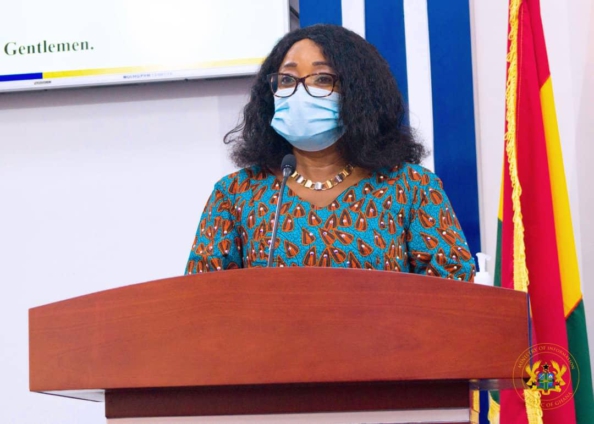
Addressing journalists at the Information Ministry during the “MEET THE PRESS” series on Wednesday, September 2, 2020, the sector Minister, Hon. Cynthia Mamle Morrison stated that all LEAP households have been connected to financial services through the e-payment (Ezwich) platform.
“Five (5) cycles of LEAP cash grants have been paid to 334,084 households to help smoothen their daily consumption. A total of 1,451,656 extremely poor beneficiaries are currently on the LEAP register.
Other achievements chalked under the LEAP include; development of an emergency payment strategy for LEAP in the wake of COVID 19 pandemic, regular engagements with district Social Welfare officers, participating financial Institutions and GHIPSS to discuss and provide solutions to electronic payment challenges.”
According to the minister, 73% of LEAP beneficiaries have been signed unto the National Health Insurance Scheme with 5,522 individuals linked to other complementary and productive activities.
She gave the breakdown is as follows; Labor Intensive Public Works- 3,054, Japanese Social Development Fund -1,235, Village Savings and Loans Association -348 and Complimentary Income Generating Scheme -537.
Touching on data collection, Hon. Morrison also mentioned that the Ghana National Household Registry has been instituted to collect data on the vulnerable in Ghana and become the centre of targeting for social interventions programmes including the Livelihood Empowerment Against Poverty (LEAP), LIPW, NHIS among others.
This data, according to her is useful for planning by the various Metropolitan, Municipal and District Assemblies (MMDAs), Academia, Non-Governmental Organizations (NGOs), Civil Society Groups and other agencies in social development.
The objective of the GNHR database is to improve targeting efficiency and effectiveness and make it easier for the government to identify and target the poor and vulnerable for all social protection interventions in Ghana.
“Currently, Upper West and Upper East regions have data on socio-economic status of 137,565 and 184,125 households respectfully. Northern, North East and Savannah have data on the socio-economic status of 140,000 households so far.
The GNHR is currently continuing with data collection in the North East, Northern and Savannah Regions to obtain an updated and more comprehensive database on poor and vulnerable persons in the country”, she emphasized.
Latest Stories
-
Gender Ministry meets Nana Akua Addo’s husband over domestic violence after hospital discharge
31 minutes -
UG Vice-Chancellor urges swift operationalisation of National Research Fund
49 minutes -
Pope Leo to have surgery after lump found in lung
56 minutes -
Joseph Cudjoe writes: Ghana must break free from the dangerous mindset that natural resources are the foundation for wealth
1 hour -
Children among 109 dead after boat capsizes off Djibouti, UN says
1 hour -
OmniBSIC Bank’s 11th health walk promotes fitness and business growth
2 hours -
2026 World Maritime Day: Danish Embassy organises “The Gulf of Guinea Speaks”
2 hours -
New Economy will tackle unemployment and restore hope – Ato Forson
2 hours -
IMMILAC president recounts personal losses as security women lead breast cancer awareness campaign in Wa
2 hours -
University of Ghana postpones October 12 reopening as GAUA strike persists
2 hours -
Bahass Foundation launches vocational skills training to support mental health recovery in Wa
3 hours -
NPP orders parliamentary aspirants and their supporters to suspend campaign activities
3 hours -
Techiman unites against child marriage: Joy Impact Makers Awardee leads charge on International Day of the Girl Child
4 hours -
Ghana Psychological Association calls for greater involvement of people with lived experience in mental health care
5 hours -
Ablakwa says Ghana could evacuate more citizens from South Africa if the situation worsens
5 hours