

Audio By Carbonatix
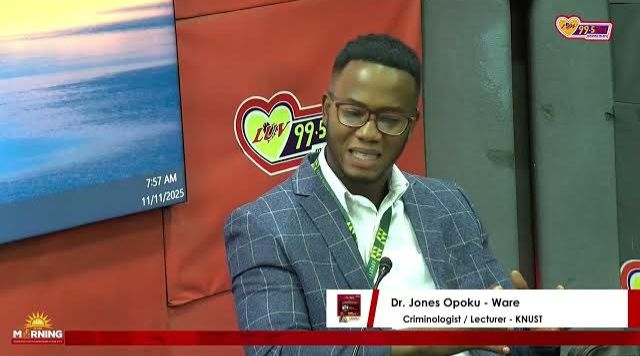
A Criminologist and lecturer at KNUST, Dr. Jones Opoku-Ware, says that the government is not ready to fight the illegal mining, locally known as galamsey.
According to him, the country’s failure to confront galamsey head-on shows a lack of readiness and political will at the highest level of leadership.
He noted that under Article 257(6) of the 1992 Constitution, all minerals in their natural state, whether in the soil, rivers, or public land, belong to the Republic of Ghana and are vested in the President to hold in trust for the people. Yet the persistence and growing sophistication of illegal mining expose a widening gap between constitutional responsibility and governmental action.
“These are not ordinary people. They are heavily armed, well organized, and backed by powerful sponsors, some within the political system itself,” Dr. Opoku-Ware told Luv FM.
“When security agencies flee, it signals that the state is powerless. The moment the state retreats, it tells these groups they are stronger than Ghana.”
According to Dr. Opoku-Ware, illegal miners now operate like a mafia-style cartel, thus highly structured networks that mobilize around common interests and intimidate communities and enforcement agencies.
Political protection and interference, he said, have become major obstacles, leaving security personnel uncertain about who truly backs their operations.
Even joint teams made up of the Environmental Protection Agency (EPA) and the military, he revealed, have been forced to abandon operations when confronted by armed miners.
“In one recent operation, the EPA team was meant to close shops supplying galamsey operators. Intelligence was provided, but the team was not fully prepared for the terrain or the level of resistance. They had to retreat, sending a very bad signal across the country about the state’s weakness,” he explained.
Dr. Opoku-Ware believes these setbacks point to deeper institutional non-readiness in a government that knows the threat but lacks the coordinated structure, resources, and courage to act decisively.
A major element of this challenge, he said, is the proliferation of sophisticated weapons among illegal miners. The Small Arms Commission estimates that millions of firearms are in private hands nationwide, many of them used to secure mining sites or intimidate officers.
“Almost every illegal miner arrested has a weapon. Some even display guns at funerals to show power. If we don’t stop them now, these same guns will soon be turned on us,” warned the Criminologist.
He also questioned the strategy of sending unarmed EPA officers who are not trained for combat to close mining sites, describing it as a symbol of poor planning and a lack of seriousness in the government’s anti-galamsey strategy.
Beyond the immediate security concerns, Dr. Opoku-Ware warned that the infiltration of political and business elites into illegal mining makes the problem far more complex. Intelligence leaks, protection rackets, and internal sabotage have made enforcement almost impossible.
“The government must stop playing lip service. If we don’t act within the next few years, these networks could grow powerful enough to challenge the authority of the state itself,” he cautioned.
He added that until the government demonstrates the capacity to resource its institutions, shield enforcement from political influence, and prosecute offenders regardless of status, Ghana’s illegal mining crisis will persist.
“The minerals belong to the people,” Dr. Opoku-Ware emphasized. “The state has the power to protect them, but so far, it has refused to use it.”
Latest Stories
-
AFCON 2027Q: Ghana face ‘difficult’ Ivory Coast clash without Kudus – Adebayor
22 minutes -
Daily Insight for CEOs: Understanding the Competitive Landscape
22 minutes -
IFC partners with Absa Bank Ghana and Complete Farmer to expand agricultural finance in Ghana
38 minutes -
The thing that transforms An Image into Art is The Point of View
42 minutes -
Mahama: Ghana’s health reset will prioritise local drug production
1 hour -
Mahama lists maternal and child health as first test of Accra Reset
1 hour -
Beyond the GH¢500b Target: A legislative blueprint to protect Ghana’s workforce (Part 2)
1 hour -
Alan Kyerematen explains why he contested 2024 election under Movement for Change
1 hour -
+233 to host Pat Thomas’ 80th birthday concert
2 hours -
EPA warns climate resilience plans face $22.6bn financing demand
2 hours -
Today’s front pages: Tuesday, September 22, 2026
2 hours -
Alan: ‘NPP has abandoned values of UP tradition, but I believe in those values’
2 hours -
Sustaining economic gains is Mahama’s real test – Alan Kyerematen
2 hours -
‘We won political independence, but global power remained elsewhere’ – Mahama
2 hours -
Mahama to take Accra Reset agenda into AU framework in 2027
2 hours