

Audio By Carbonatix
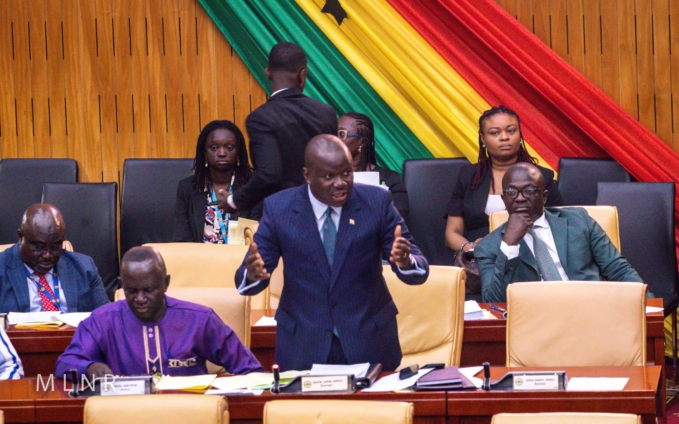
Damongo MP Samuel Abdulai Jinapor has raised concerns over the President’s claim of reducing the size of government by appointing only 60 ministers and deputy ministers.
According to him, while this move has been presented as a step toward efficiency, government has merely shifted appointments to the Office of the President, maintaining the same cost burden on the national exchequer.
Jinapor pointed out that while the President celebrates the reduction in the number of Ministers, he has simultaneously expanded the list of Presidential Advisors, Staffers, and Aides - many of whom enjoy the same benefits as Ministers but do not undergo parliamentary approval.
“The President is praising himself for appointing 60 Ministers, but what he has failed to tell us is that he has found a smart way of making up the numbers by appointing more and more people as Presidential Advisors and Staffers,” he stated.
By convention, these appointments carry the same rankings and benefits as Ministers, he argued.
"The Chief of Staff is ranked just below the Speaker of Parliament but above a Cabinet Minister. Senior Presidential Advisors receive the same emoluments as Cabinet Ministers.
"Presidential Advisors are pegged at the same level as Cabinet Ministers who are not MPs, while Presidential Aides are treated as Deputy Ministers, with corresponding benefits."
He argued that the collapse of certain Ministries has not led to cost savings, as their functions have simply been transferred to the Office of the President with the same financial implications.
Mr Jinapor noted that the Office of the President now houses an increasing number of high-ranking appointees, including one Senior Presidential Advisor on Government Affairs, Dr. Valerie Sawyerr, and nearly 10 Presidential Advisors covering various sectors, including the economy, corruption, and diaspora affairs.
"There are also dozens of Presidential Staffers and Aides, assigned to specialised roles such as Economic Affairs, Special Aides to the President and Vice President, and regional operations.
"Notably, there is even a Director at the Presidency in charge of Agriculture and Agribusiness (Peter Boamah Otukonor), despite the existence of the Ministry of Food and Agriculture and the Ministry of Trade, Agribusiness, and Industry," he stated.
He noted that this pattern suggests a strategy of political accommodation - where every major campaign promise is accompanied by a new Presidential Advisor or Staffer.
The former Lands Minister further highlighted that while the President has maintained that he will not appoint Deputy Regional Ministers, a policy first introduced by President Akufo-Addo, he has instead appointed 16 Presidential Staffers, each assigned to a region.
He questioned whether these individuals are simply Deputy Regional Ministers under a different title.
Raising further concerns about the oversized communications team within the Office of the President, Mr Jinapor revealed that the team currently includes one Presidential Advisor on Media, four Directors of Communication, five Deputy Directors of Communication, two Communication Specialists, five Technical Communication Assistants, one Media Aide, one Assistant Media Liaison Officer, one Communications Consultant, and one Minister for Government Communications.
The former Minister questioned the necessity of having twenty 20 communication-related appointees, stating, “What at all are they going to communicate?”
Beyond concerns over government size and cost, Mr Jinapor stated that the President has failed to uphold key campaign pledges.
One major unfulfilled promise, he said, is the commitment to appoint 30% of Cabinet Ministers as women—a goal that remains unmet.
“If you can’t keep the campaign promise, just let the Ghanaian people know and apologise to them,” he asserted.
“Don’t use the backdoor to appoint Ministers and Deputy Ministers who will not be subject to parliamentary approval.”
Samuel Jinapor concluded that while the President’s move to limit the number of Ministers appears positive on the surface, the financial burden on the state remains unchanged.
The MP argued that shifting roles from Ministries to the Office of the President does not equate to cost savings, raising concerns about transparency and accountability.
He urged the government to be candid with the Ghanaian people, stating that they will be watching closely to see whether this restructuring truly delivers on its promise of efficiency or is simply a case of repackaging old structures under new titles.
Latest Stories
-
Western Regional Minister applauds Karpowership’s role in Ghana’s power sector
12 minutes -
Livestream: Road safety crises: Where are we getting it wrong?
14 minutes -
Enterprise Life celebrates 25 years of protecting families and building trust
22 minutes -
ICC London rules in favor of Ghana against Tullow over $400m tax charge
32 minutes -
We are disappointed in ICC’s ruling over our corporate income tax assessment in Ghana – Tullow Oil
42 minutes -
Cost of building inflation for August 2026 increases to 4.6% – GSS
43 minutes -
Today’s front pages: Wednesday, September 30, 2026
1 hour -
Bawumia highlights agricultural, compulsory insurance reforms in IBAG engagement
1 hour -
Ghana will secure Tullow tax revenues while protecting Jubilee, TEN investments – Ato Forson
1 hour -
Ghana wins $393m Tullow tax arbitration as tribunal upholds GRA assessment
1 hour -
Gender Minister assures women’s group of action on Affirmative Action, Development Bank
2 hours -
Over 2,000 teachers in Dormaa comply with strike – GNAT Secretary
2 hours -
Food Buffer Stock seeks stronger liquidity buffer despite record profit
2 hours -
LPG investments key to achieving 50% access target by 2030 – Energy Minister
2 hours -
Jinapor: New LPG terminal strengthens Ghana’s energy security
3 hours