

Audio By Carbonatix
Cabinet has directed the suspension of some taxes, levies and margins on petroleum products in response to rising crude prices following the US–Israel–Iran conflict.
Announcing the decision, the Minister for Government Communications said the move is intended to reduce the burden on consumers as fuel prices respond to developments in global oil markets.
“Cabinet has directed the Finance and Energy Ministers to take immediate steps to reduce the price of fuel through the removal of some taxes and margins on fuel, effective the next pricing window. The intervention will remain in force for an initial period of four weeks,” he said.
The key question now is which specific taxes or margins will be affected and how the suspension will affect government revenue while providing relief to consumers without destabilising Ghana’s energy sector.
Currently, a litre of petrol or diesel carries total taxes and margins of about GH¢4.20.
At the prevailing price floor of about GH¢13.30 for petrol and GH¢17.10 for diesel, these taxes and margins account for roughly 31% of petrol prices and 24% of diesel prices.
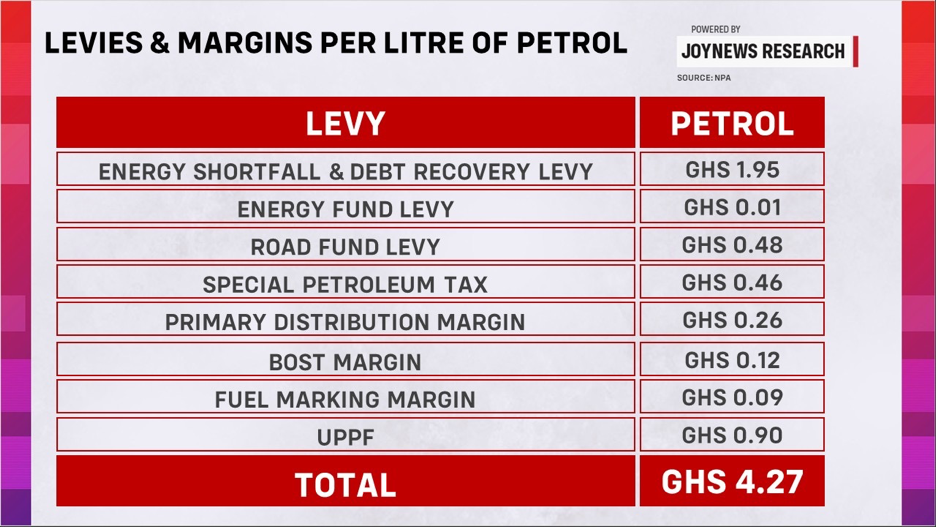
The single largest levy within the tax structure is the Energy Sector Shortfall and Debt Recovery Levy, which stands at GH¢1.95 per litre after the introduction of the additional GH¢1 ESLA levy.
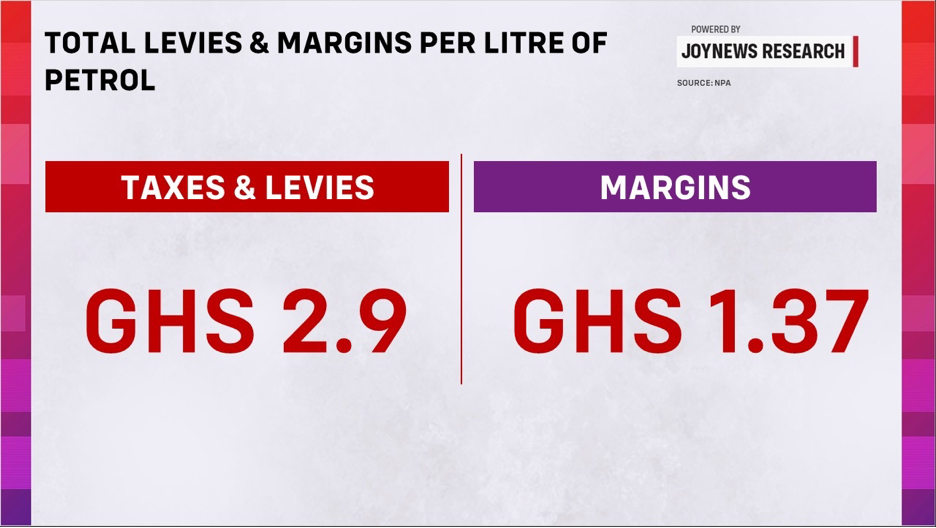
The Energy Fund Levy, Road Fund Levy and Special Petroleum Tax together bring total taxes to about GH¢2.90 per litre, while margins account for approximately GH¢1.37.
Taxes form part of government revenue and are incorporated into the national budget.
Margins, however, are distributed among various agencies within the petroleum sector, including the National Petroleum Authority (NPA), the Petroleum Hub Development Corporation (PHDC) and the Bulk Oil Storage and Transportation Company (BOST).
One of the margins is the Primary Distribution Margin, which consumers pay to cover the cost of transporting petroleum products between depots managed by BOST.
Consumers currently pay about 26 pesewa per litre for this service. However, research by the Africa Centre for Energy Policy (ACEP) suggests that more than half of petroleum products distributed in Ghana are transported outside BOST facilities.
In addition to the distribution margin, BOST receives an additional 12 pesewa per litre, intended to support the maintenance of strategic petroleum stocks.
In practice, however, the company has increasingly assumed a commercial role in recent years, competing with private-sector importers rather than maintaining strategic stock reserves.
Another margin that has become the subject of debate is the Unified Petroleum Pricing Fund (UPPF).
The fund was originally created to ensure that petroleum prices remained uniform across the country so that regions located farther from the ports would not pay significantly higher prices.
Over time, however, the margin has grown significantly. The UPPF stood at 22 pesewas in 2018 but has since risen to 90 pesewas per litre, representing an increase of more than 300% in about five years.
An investigation by ACEP found that the fund now finances more than transportation costs.
According to the report, it also supports fuel supply for security agencies, fuel consumption by political appointees at the Presidency, some programmes of the National Petroleum Authority and support for the Petroleum Hub Development Corporation.
This may partly explain why Cabinet also directed political appointees to stop drawing free fuel allocations.
“The President also reminded ministers and senior government officials to adhere strictly to the ban on fuel allowances and fuel allocations,” the Minister for Government Communications said.
The involvement of several agencies in these margins partly explains why government has not yet announced which specific taxes or charges will be suspended.
“Because of the involvement of multiple stakeholders, they need to be engaged and consulted. A definite announcement will be made about the specific tax and the exact amount involved when the next pricing window is reached,” he said.
Any adjustment to margins, such as the UPPF or BOST charges, would affect institutions that depend on those funds, including the NPA, BOST, PHDC and security agencies, which means stakeholder consultations are likely to influence the final structure of the relief measures.
Analysis by JoyNews Research also suggests the fiscal implications could be significant.
Based on current revenue flows from the various petroleum tax handles and projections in the 2026 budget, every GH¢1 removed from fuel taxes could result in a revenue shortfall of nearly GH¢500 million per month.
If the relief reaches GH¢2 per litre, the revenue gap could approach GH¢1 billion for a single month.
If the government focuses more of the relief on margins rather than taxes, the fiscal impact on the national budget would be smaller because margins do not flow directly into government revenue.
However, any reduction in taxes or levies would require the government to absorb the resulting revenue shortfall.
Some consumers remain cautious about temporary tax relief measures.
During the COVID period, several relief measures were later converted into permanent taxes, including the COVID-19 Health Recovery Levy. As a result, many citizens are seeking assurances that any current relief will not eventually be recouped through taxes.
There is also the possibility that higher global oil prices could generate additional revenue for Ghana.
In the 2026 budget, government assumed an average oil price of about $76 per barrel. In recent weeks, however, crude prices have averaged closer to $100 per barrel, suggesting a potential windfall of about $24 per barrel.
Whether this windfall has actually materialised will depend on the timing of Ghana’s crude liftings and whether any recent cargoes have been sold at these higher prices.
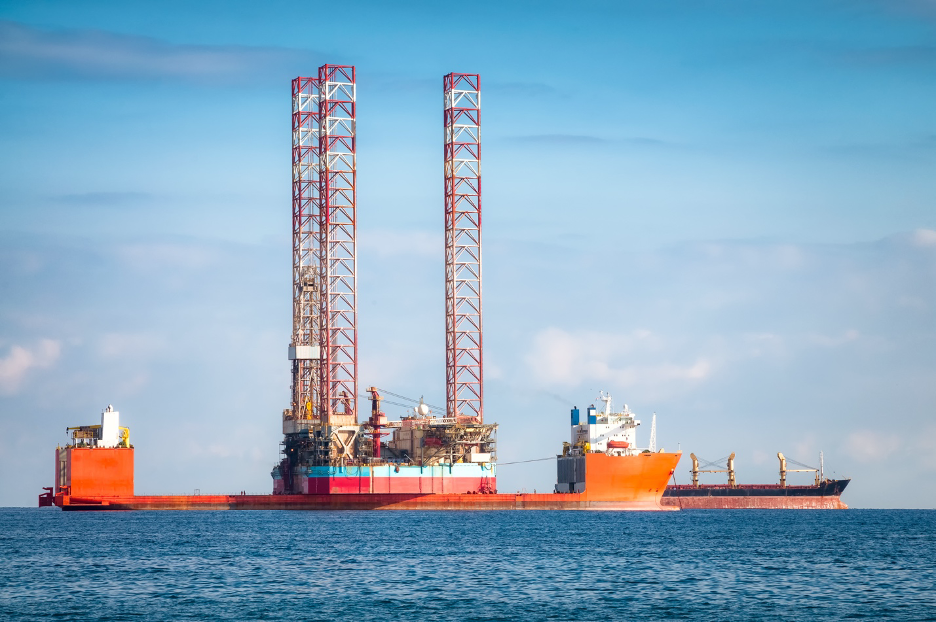
Officials at the Energy Ministry and GNPC would need to confirm whether Ghana has lifted and sold crude during the recent price surge.
Another potential source of support could have been gold export revenues. However, the Chief Executive of the Ghana Gold Board recently indicated that the agency is not selling gold at this time, a management decision due to uncertainty in global markets.

At the same time, Dubai, Ghana’s key gold export destination, has experienced flight disruptions and airspace restrictions linked to the ongoing conflict.
For the government, the decision ultimately involves balancing consumer relief with fiscal sustainability and the financial stability of institutions within the petroleum sector.
The coming pricing window will therefore reveal three key things: which specific taxes or margins will be suspended, how much relief consumers will actually receive, and how the government intends to manage the resulting revenue shortfall.
Latest Stories
-
Ghana Enterprise Brands Awards 2026: Leading brands, business trailblazers to shine on November 30
5 minutes -
T-bills auction: Demand improves as government exceeds target by about 76%; interest rates soften
11 minutes -
Ziope undertakes initiative to build a technologically inclined community, commissions self-help ICT lab
36 minutes -
ECG announces power outage in parts of Tema, Central Region due to network fault, maintenance
1 hour -
When the Gospel Becomes a Weapon: The church, blackmail and the abuse of faith
1 hour -
JoyNews’ Jacqueline Ansomah Yeboah selected for UK Media Excellence for Emerging Technology Fellowship
2 hours -
Mental Health Alliance urges government to operationalise Mental Health Fund
2 hours -
Ghana–Holy See agreement heads to Parliament after Cabinet approval
2 hours -
Luv FM Corporate Games 2026: Kumasi Central Prisons, Amanfiman Bank win big amid fun
2 hours -
WAFU B U17: Ghana top Group A after win over Togo
3 hours -
Ho Central Mosque reopens amid unresolved leadership dispute that led to closure
4 hours -
Minority caucus questions GH¢16.4m in Ablakwa’s SA evacuation spending, demands independent audit
4 hours -
Gender Ministry meets Nana Akua Addo’s husband over domestic violence after hospital discharge
5 hours -
UG Vice-Chancellor urges swift operationalisation of National Research Fund
5 hours -
Pope Leo to have surgery after lump found in lung
5 hours