


Audio By Carbonatix
The Ghana Shippers’ Authority (GSA) on Tuesday, November 11, 2025, brought together senior executives of top import and export firms at a Breakfast Meeting held at the Palms by Eagles Hotel in Accra. The engagement was part of the GSA’s ongoing efforts to strengthen collaboration with industry players and address operational challenges faced by shippers in the southern zone.
The GSA team was led by its Chief Executive Officer, Professor Ransford Gyampo, and included Deputy CEOs Madam Asana Owu (Technical Services) and Mr. Henry Ankrah (Operations). Key Departmental Heads such as Mr. Fred Asiedu-Dartey (Head, Freight and Logistics), Madam Monicah Josiah (Head, Shipper Services and Trade Facilitation), and Mr. Charles Sey (Zonal Head, Eastern Zone) were also present.
The meeting drew strong representation from major players across the shipping, logistics, and manufacturing sectors, including Ghacem, Diamond Cement, Labianca Company Limited, Forewin Ghana, Toyota Ghana, Japan Motors, Wilmar Africa, Nestlé Ghana, and Newmont Ghana, among others.
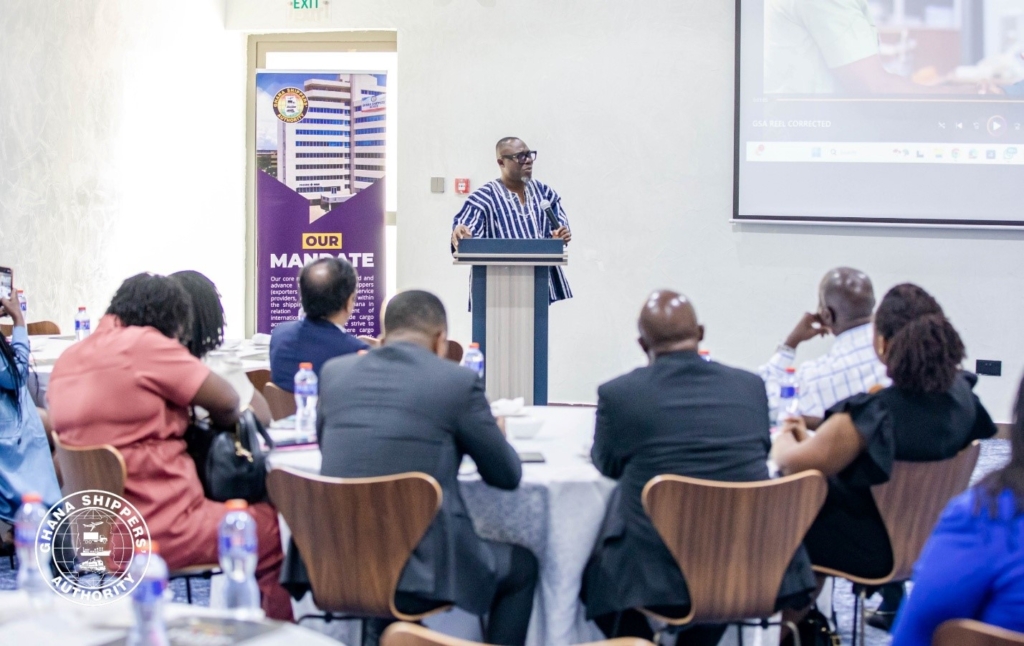
Opening the session, Professor Gyampo described the engagement as “a critical step towards building a stronger, more transparent partnership between the GSA and our valued shippers.” He noted that the meeting represented more than a routine consultation; “it was a deliberate attempt to bridge the gap between regulator and industry players so that together we can drive down the cost of doing business and enhance efficiency in the shipping sector.”
He highlighted the Ghana Shippers’ Authority Act, 2024 (Act 1122), which he said “marks a fundamental reset of the regulatory structure of Ghana’s shipping industry.” The new law gives the GSA clearer powers to check arbitrary charges by shipping service providers, while empowering shippers to lodge complaints for binding and enforceable resolutions.
“Section 36 of the Act prohibits the imposition of unapproved charges,” he explained. “This is an important safeguard for the business community, and I encourage every shipper to report any such charges so we can act swiftly to protect your interests.”
Professor Gyampo also highlighted the development of minimum service standards to guide fair dealings in the industry and announced that the first phase of the Boankra Integrated Logistics Terminal was 85 percent complete. “Once fully operational, Boankra will significantly ease the movement of cargo between the middle belt, northern Ghana, and transit countries,” he said.

He urged shippers to register with the GSA as required by law, noting that registration would help to maintain a reliable database to anticipate disruptions and respond promptly. He also touched on the Bank of Ghana’s directive on the application of official exchange rates, saying, “We are working closely with the Central Bank to ensure uniformity in exchange rate applications by shipping service providers to bring fairness and consistency in billing.”
During the question-and-answer session, participants voiced concerns over arbitrary charges by shipping lines, unclear timelines for demurrage, slow processes at the Ghana Ports and Harbours Authority (GPHA), and the conduct of some consolidators who delay cargo release even after payments. Other issues included delays in processing Bills of Entry (BOEs) by the Ghana Revenue Authority (GRA) and glitches in the Integrated Customs Management System (ICUMS), which sometimes lead to additional demurrage costs. Some participants, however, acknowledged modest improvements from recent system upgrades.
Responding, Mr. Fred Asiedu-Dartey, Head of Freight and Logistics at the GSA, assured participants that the upcoming Legislative Instrument (L.I.) to operationalise Act 1122 would address many concerns. “The L.I. will, among other things, spell out clearly when discharge is deemed complete, so that shippers are not unfairly charged demurrage from the moment a vessel drops anchor,” he said. He added that the GSA was fast-tracking approval of the LI to enhance regulatory clarity.
Mrs Monica Josiah on her part urged shippers to lodge formal complaints with the GSA rather than rely on informal communication. “We can only take pragmatic steps to intervene when issues are properly documented. Verbal complaints make it difficult to follow through with enforcement,” she noted.
The meeting closed with renewed optimism among participants, who expressed confidence in the GSA’s commitment to resolving long-standing bottlenecks in the industry. Professor Gyampo reinforced this commitment, saying, “GSA will continue to champion a transparent, competitive, and efficient shipping environment that supports Ghana’s broader economic growth agenda.”
Latest Stories
-
Vibes The Movie: Big Ghun’s Ghanaian film earns five nominations at 2026 REFFA
20 minutes -
MamaCare CEO warns unresolved conflicts among health workers could undermine maternal and neonatal care
45 minutes -
Health professionals urged to translate medical knowledge into practice to save mothers
51 minutes -
Conflicts among care providers linked to maternal, neonatal deaths – Expert
2 hours -
GIS marks 10th TIME conference, champions improved teaching practices
3 hours -
BRICS Or Balance? What Ghana’s bid really means
3 hours -
GPRTU wants full TRAFFITECH-GH implementation to start in 2027
3 hours -
Mahama announces plans to import electric wheelchairs for PWDs
3 hours -
KGL U17 Colts 2026: Western beat Prempeh Elite Academy to set up final final with Greater Accra Region
4 hours -
Late Solanke strike salvages 10-man Spurs draw at Man United
4 hours -
Gender Ministry to monitor welfare of Nana Akua Addo’s children amid domestic violence case
4 hours -
Benedict Okyere Yeboah: Ghana’s football problem goes beyond sacking a coach
4 hours -
GPL 2026/27: Darkwah Wiafe’s winner sees All Blacks beat Kotoko
4 hours -
ITF World Tour : Patel Wins Boys’ Singles Final at J100 Accra
4 hours -
Ghana must pursue BRICS partnership if it brings economic benefits – Kpebu
4 hours