

Audio By Carbonatix
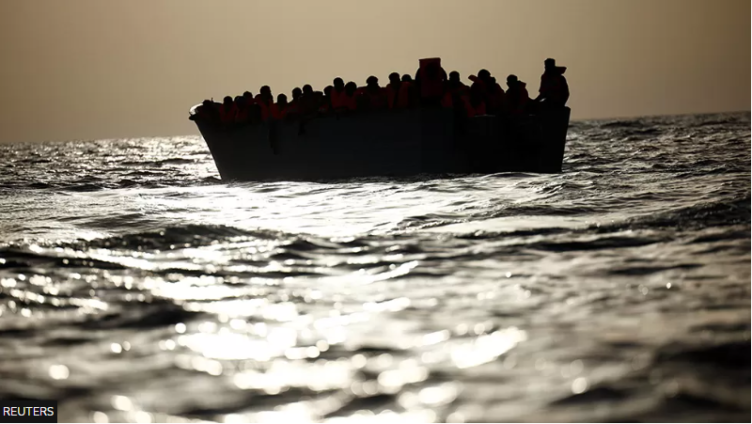
The number of boats carrying migrants from North Africa across the Mediterranean is growing fast - but Europe is struggling to come to terms with this mass movement of people. The BBC Today programme's Nick Robinson has spent the past week looking close-up at the impact of refugees from Africa all the way to Germany.
Tunisia in North Africa is now the launch pad for the majority of migrants who take the risk-laden journey across the Mediterranean Sea. There, I find hopes and dreams as well as desperation.
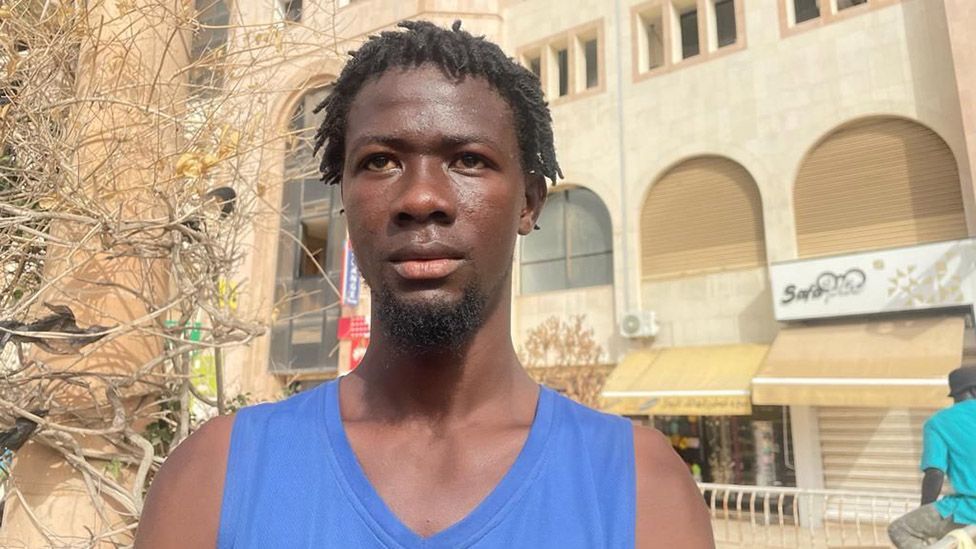
"I just want to be a basketballer," says Mohammed "BB" Lain Barrie, who has travelled 5,000km (3,100 miles) from his home country, Sierra Leone. "I know I'd be good," he says. "I want to make it for my family. My dream is to go to the United States to play basketball."
His face lights up as he talks. Yet just a few miles down the coast is a reminder of the risks he, along with tens of thousands more, is willing to take.
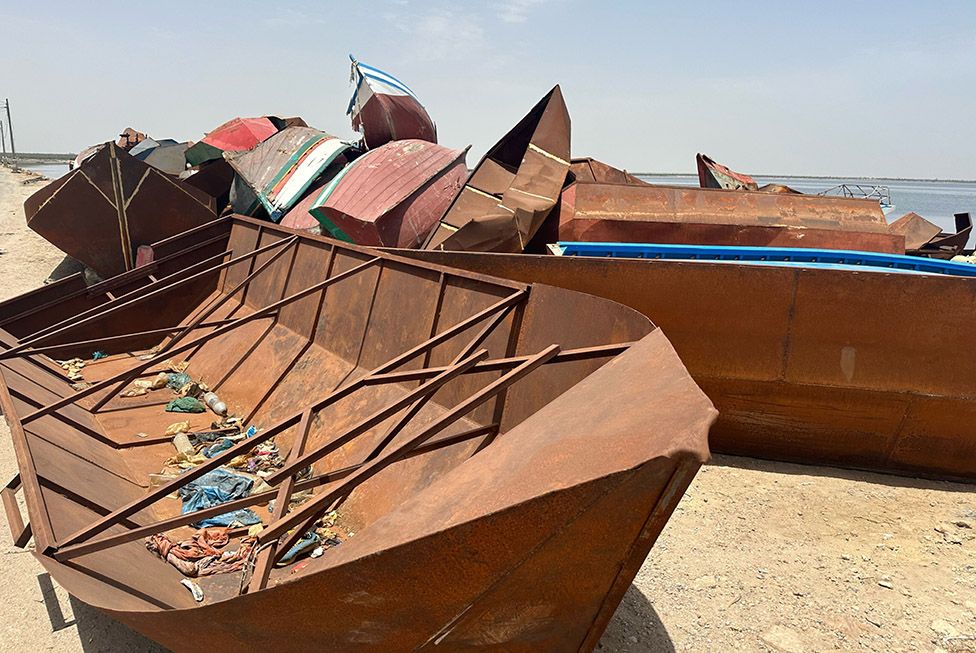
Fishing nets lie on the dockside of the port of La Lusa. But all too often the daily catch here includes the dead bodies of migrants who perished when their badly made boats sank or capsized.
Wahid Dahech is known here as the "corpse finder". People tell him when they find a body. He tells the authorities. It is his duty, he tells me. When some local boys went swimming recently they came across the body of a dead baby.
Yet there is no shortage of people prepared to pay huge sums to get on those boats.
Most head for Italy. So far this year more than 72,000 people have made the journey. That's more than double the number who made it last year. The surge is made up largely of sub-Saharan Africans who are desperate to flee the continent.
And they are changing the politics of Europe.
Italy has a new right-wing prime minister, Giorgia Meloni, who was elected with a promise of a naval blockade - her version of Rishi Sunak's promise to "stop the boats" crossing the English Channel.
In Sicily, where the majority of those coming from Africa land, I speak to one of Meloni's allies - the newly elected mayor of Catania, Enrico Trantino. He tells me it's hypocritical to expect his home region to cope with the current influx of refugees: "It's impossible that they can come here and all of them can have the support they need to have a better life."
Meloni, once shunned for having roots in Italy's far-right, has now been embraced as part of "Team Europe". That's how she was introduced by the president of the European Commission, Ursula von der Leyen, when she accompanied her on a recent trip to Tunisia.
The EU is dangling the prospect of up to $2bn (£1.53bn) in support if Tunisia's president, Kais Saied, helps to stop the boats. That's controversial as Saied's been accused of stirring up racial hatred - earlier this year he suggested that there was a conspiracy in his country to replace local Arabs with black Africans.
It is not just in the Mediterranean that anti-migrant feeling is stirring. In Germany, the far-right AfD party is on the rise. A recent poll put them neck-and-neck with Chancellor Scholz's governing Social Democrats. And with important elections approaching, that matters.
Rosenheim in the German state of Bavaria - a few miles from the Austrian border - is the first stop for many migrants coming to the country. In 2015, thousands of Syrian refugees took their first step on German soil here. The country welcomed more than a million refugees in that crisis.
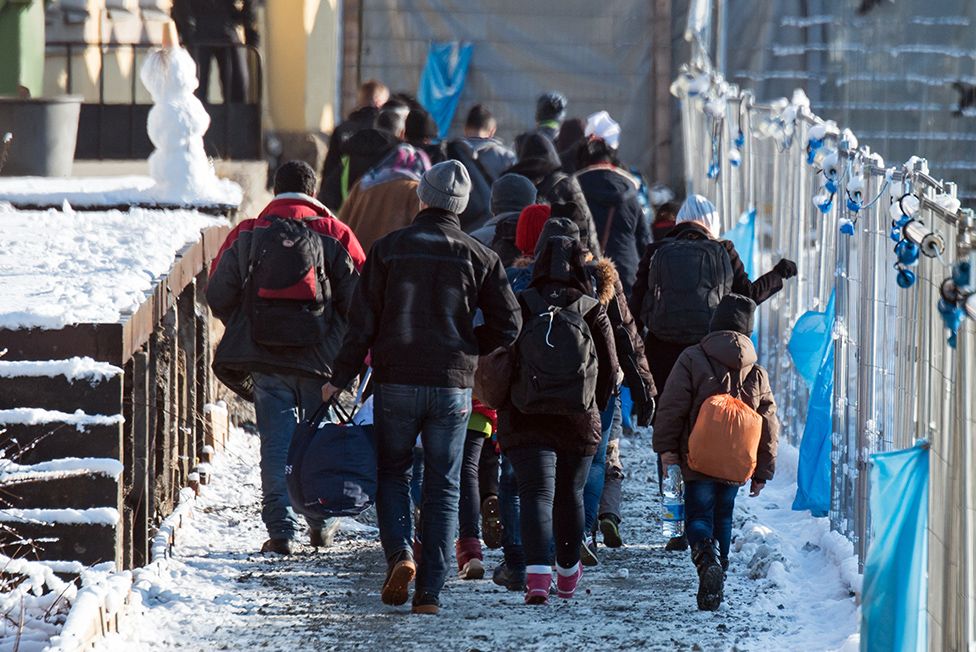
The local mayor, Andrea Marz of the conservative CSU party, tells me that with queues for health care, kindergarten places and housing voters can easily be persuaded that migrants are to blame.
The irony is that Europe - Italy and Germany in particular - needs more people. More workers. The government in Berlin is thinking the previously unthinkable, and proposing that asylum seekers already in Germany - who are forbidden from working until their claims are processed - could be given a fast track into the workforce to help solve "desperate" labour shortages.
But just as business across Europe is crying out for more workers, voters across Europe are pressurising their politicians to put their own people first.
The Dutch government collapsed last week because the governing coalition could not agree on new restrictions on immigration, and the once uber-liberal Scandinavian countries have also adopted tough policies. Denmark's Social Democrat-led government passed a law in 2021 allowing it to relocate asylum seekers to countries outside the EU while their cases are reviewed.
Few would not be moved by the dreams so many migrants speak of - whether it's to play professional basketball or to send money home to a struggling family or simply to escape war and violence.
But that sympathy for individuals has not turned into a collective willingness to open up Europe to those who want to come. If anything, precisely the reverse.
Latest Stories
-
White vs traditional marriage: Aesthetics above culture?
9 minutes -
Tumu Municipal Hospital receives new delivery bed to boost maternity care
16 minutes -
Telecel Ghana unveils Project X with Black Sherif partnership
26 minutes -
Rev. Kwadwo Bempah defies restriction on preaching on buses; warns it won’t succeed
40 minutes -
French Embassy to partner Kobby Kyei Media for bloggers’ training
43 minutes -
Nestlé and NBA announce multi-year international marketing partnership
57 minutes -
Mahama sends condolences to Nigeria over plane crash that killed 25
57 minutes -
Our lifestyles may be killing us but our spatial planning is too
1 hour -
12 arrested as police seize firearms, suspected drugs in Tamale
1 hour -
Chamber of Mines challenges Reuters report on proposed mining law
1 hour -
LA 2028: Black Queens take first leg advantage with 3-0 win over Mauritius
1 hour -
UG academic calendar could collapse if GAUA strike extends into next week – Awandare
1 hour -
Black Sherif partners with Telecel Ghana to promote Telecel Cash
1 hour -
Nestlé Ghana expands Tema factory, raises evaporated milk production capacity
1 hour -
Telecel Ghana launches CARE Month with customer rewards and community outreach
1 hour