

Audio By Carbonatix
The International Labour Organization (ILO) Country Director for Ghana and Liaison for ECOWAS, Dr. Vanessa Phala, has lauded Ghana for its proactive efforts in promoting responsible business practices.
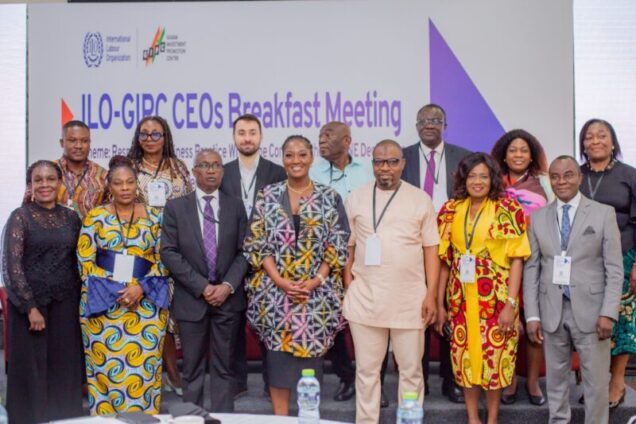
Speaking at the ILO-GIPC CEOs Breakfast Meeting, Dr. Phala highlighted Ghana's pivotal role in advancing the ILO's Multinational Enterprises (MNE) Declaration, a framework designed to guide businesses in adopting sustainable and socially responsible operations.
Under the theme "Responsible Business Practice Within the Context of the ILO MNE Declaration," Dr. Phala noted Ghana’s designation of four tripartite-appointed national focal points, representing the Ministry of Employment and Labour Relations, the Ghana Investment Promotion Centre (GIPC), the Ghana Employers Association, and the Trades Union Congress of Ghana.

These focal points collaborate to promote the principles of the MNE Declaration, aligning business conduct with international labour standards.
“Ghana is one of the 12 ILO member states that has taken the significant step of appointing national focal points to lead the charge on responsible business practices. A unique feature is that the GIPC, in collaboration with the Ministry of Employment and Labour Relations and the social partners, is working to ensure that foreign investors also adhere to these principles,” she noted.
She further commended Ghana for being the first country to designate its national investment promotion agency as one of the focal points to promote the MNE Declaration.

A model, she revealed has since inspired Cabo Verde, to follow suit by appointing similar focal points.
Dr. Phala applauded the concerted efforts of Ghana’s national focal points in advocating for decent work, sustainable growth, and the elimination of child labor.
She stressed that coordinated action by the government, employers, and workers is crucial for addressing the root causes of child labor and other labor-related issues.
“The MNE Declaration offers practical guidance for national and multinational enterprises to promote responsible practices, ensuring that business operations align with the goals of decent work and sustainable development.
“It provides clear guidelines on respecting workers’ rights and how enterprises can contribute positively to both economic and social development,” she stated.

The Country Director further reaffirmed the ILO’s commitment to fostering dialogue among enterprises, governments, and workers' organisations to achieve sustainable and inclusive growth.
The ILO MNE Declaration, adopted in 1977, has undergone several reforms, most recently in 2022, to include the "Safe and healthy working environment" in its core principles.
It remains a critical tool for guiding businesses toward responsible conduct that promotes economic development, workers' rights, and social well-being.
The Director for Investor Services Division at the Ghana Investment Promotion Centre (GIPC), Edward Ashong-Lartey, has emphasised the importance of balancing economic growth with social responsibility as Ghana continues to attract international enterprises and foreign direct investments.
Mr Ashong-Lartey highlighted Ghana’s rise as a top investment destination in Africa but stressed the need for businesses to prioritise the welfare of workers alongside profit.
He acknowledged that while international enterprises are welcome, it is essential to foster an environment where businesses contribute not just to economic growth but also to social development.
“The declaration provides a comprehensive framework for multinational enterprises to adopt fair labor practices that promote decent work, equitable treatment and respect for workers’ rights.

“These principles are not only aligned with Ghana's national labor laws but also reflect our broader aspirations for creating a more inclusive and just society,” he stated.
He further highlighted the GIPC’s commitment to monitoring compliance with investment laws, emphasizing that responsible business practices go beyond mere legal adherence.
“We find subtle ways to check if they are adhering to these practices,” he remarked, underscoring the need for ongoing dialogue between businesses and regulatory bodies to ensure alignment with the principles of decent work as outlined in the ILO MNE Declaration.
He therefore encouraged both multinational enterprises and local businesses to actively promote responsible business practices, noting that this approach is vital to maintaining Ghana’s reputation as a country that values both profit and people.
This initiative falls under the ILO/EU Trade for Decent Work Program, a project sponsored by the European Union (EU) and the Ministry of Foreign Affairs of Finland. The program is supported by key stakeholders including the Ghana Employers Association, the Trades Union Congress (TUC), and the Government of Ghana. It aims to ensure that multinational enterprises operating in Ghana and beyond adhere to the principles of decent work as outlined in the MNE Declaration.
Latest Stories
-
Global Organised Crime Index says fraud and tax evasion are widespread across Ghana’s economy
49 seconds -
Threats to journalists limit coverage of cocaine trade in Ghana – Global Organised Crime Index
3 minutes -
Kumawu MP commissions 4-unit nurses’ quarters at Bodomase
4 minutes -
Two arrested after suspected narcotics intercepted at Kasoa
5 minutes -
‘Our pipes stock are all gone’ — Duraplast marketing manager counts losses after Avenor fire
9 minutes -
Ntim Fordjour calls for cancellation of Ghana-Colombia maritime deal over drug trafficking concerns
11 minutes -
Daily Insight for CEOs: The CEO’s Q4 leadership priorities
14 minutes -
Cybersecurity is a business risk, not just an IT issue – CSA Director-General
14 minutes -
NSA releases 70,072 postings for 2026/2027 national service year
15 minutes -
Osu residents oppose road expansion over planned demolition of ancestral homes
17 minutes -
Kwakye Ofosu calls Aboagye ‘neophyte and time waster’ over cocaine debate
17 minutes -
Parliamentary immunity must not shield MPs from criminal investigations – Srem-Sai
22 minutes -
Global Organized Crime Index links Chinese trawlers to depletion of Ghana’s fish stocks
23 minutes -
Reject ‘Cocaine Coast’ label through action, not words – Miracles Aboagye tells government
24 minutes -
Fire at North Industrial Area triggers power outage in parts of Accra
25 minutes