


Audio By Carbonatix
Iranian musician Mehdi Rajabian says he is facing trial for working with female singers and dancers.
The 30-year-old, who has already been imprisoned twice on charges relating to his music, says he was arrested two weeks ago over his latest project.
The album, which is not yet complete, is due to include female vocalists - who are effectively banned in Iran.
Iran's Ministry of Culture and Islamic Guidance have not yet responded to the BBC's request for comment.
"This regime wants to stifle my voice," Rajabian told the BBC. "They insist that I stop playing music."
The musician, who is based in Sari in northern Iran, says he was summoned by the security police on 10 August, who arrested him and took him to court.
Rajabian says a judge told him his latest project "encouraged prostitution". He was freed only because his family was able to post bail.
"If I make music, they will immediately remove my bail," said the musician. "I have to wait for the day of judgment for now."
Rajabian said the arrest came after he gave an interview to the BBC about his forthcoming album; and the publication of a video featuring renowned Persian classical dancer Helia Bandeh interpreting his music.
The BBC has contacted Iran's Ministry of Culture and Islamic Guidance for comment and clarification on the case but has yet to receive a response.
Under Iran's penal code, singers and dancers can be prosecuted if authorities deem their acts "indecent" or "immoral". Women are theoretically allowed to perform in a choir or as a solo vocalist for a female-only audience, but permission is rarely granted.
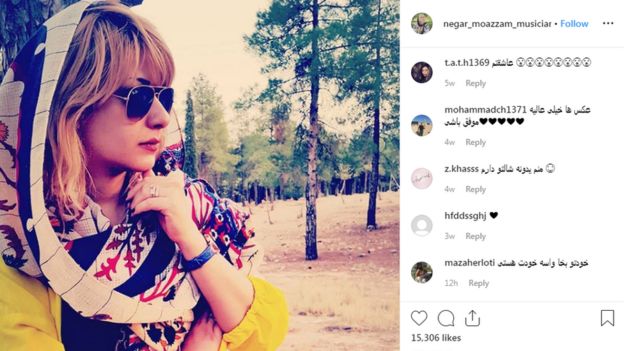
Rajabian is far from alone in facing legal action for his art. Last May, the female singer Nezzar Moazzam was summoned to court for singing for a group of tourists while wearing traditional costume.
A few months earlier, composer Ali Ghamsari was banned from performing "until further notice" for refusing to remove a female singer from the line-up of a concert in Tehran.
Rajabian has been jailed twice before for his music. The first time, in 2013, he was kept blindfolded in solitary confinement for three months.
He was later sentenced to six years in Tehran's notorious Evin prison, emerging on probation only after going on hunger strike, and attracting the attention of Amnesty International and freedom of expression campaigners Freemuse.
On release, his activities were closely monitored by the regime. Rajabian says he now lives in near-isolation.
"Coronavirus days are a normal day for me because I have been completely alone at home for years," he says. "It was as if I had been transferred from a smaller prison to a larger one."
The musician says fellow artists are afraid to support him and, earlier this month, a music journalist was arrested and detained in Evin for several days after mentioning women's music and Rajabian's name in an article.
"Now the pressure is on me not to even produce another work of art," he says. "It means complete death. In general, their plan is my complete destruction."
However, the pressure has not deterred him. Last year, he released a new album, Middle Eastern, with Sony Music in Turkey.
Recorded in secrecy, it features contributions from almost 100 artists in 12 countries, including Syria, Yemen, Jordan, Lebanon and Iraq. Many of the musicians faced similar persecution to Rajabian. One of the songs was recorded during an air strike, another by a fleeing refugee in a boat.
But it was the decision to work with "a number of female singers from various Middle Eastern countries" (although none of them are in Iran itself) on a new album that attracted renewed attention from Iran's authorities.
"Why is the Iranian government so frightened? This is the question for me," he says.
The answer, he believes, is that any art that provokes thought is considered dangerous.
"Art without a message and philosophy is needed more for fun than for thought," he says. "I do not want them [the regime] to enjoy my art, I want philosophy and pain from the heart of my music to be like a trumpet for humanity.
"Even if I go to prison hundreds of times. I need female singing in my project, I need female dance along with philosophy and thinking.
"Whenever I feel the need to produce this music, I will definitely produce it. I do not censor myself."
Iran's underground music scene - Behzad Bolour, BBC Persian
After the 1979's Revolution, Ayatollah Ruhollah Khomeini banned the broadcast of music on TV or radio, arguing that it made the human brain "inactive and frivolous". Only revolutionary music and religious songs were considered permissible, and almost all Iran's pop singers left for the USA.
Gradually, classical Persian music, under the banner of Sufi music began to resurface. But in the 1990s, a parallel Iran was developing under the skin of the major cities, with young people crafting their own instruments and making their own unofficial songs (which were only broadcast on the BBC Persian request programme).
In early 2000, after a relaxation on the laws around music, the pop market opened up in Iran and, through the internet, underground music which was percolating behind closed doors began to spread out. Bands were playing rock, fusion, rap and alternative folk. And they all talked about a different Iran, an Iran that wants to be modern and level with the rest of the world.
Mehdi Rajabian is from the later generation of these Children Of The Revolution - and an important underground voice in Iran's music scene.
Latest Stories
-
US, Iran fail to reach peace agreement after marathon talks in Pakistan
54 minutes -
Port crises loom as 11,000 drivers threaten four-day strike
2 hours -
A source of excellence across generations – Vice President Opoku-Agyemang lauds Mfantsipim
2 hours -
(Photos) Mfantsipim School launches historic 150th anniversary
3 hours -
Knights and Ladies of Marshall group backs Catholic Bishops’ stance on anti-LGBTQ+
3 hours -
Bright Simons writes: All the Filla in the Ibrahim Mahama/E&P – Gold Fields Saga
4 hours -
Monetise Idiocy In Ghana
4 hours -
ECG kicks off Phase Two of transformer upgrades at Lashibi; brief outages expected
5 hours -
The Ghanaian prophet and the mysterious death of his scottish wife Charmain Speirs
5 hours -
Nearly 400 sentenced in Nigeria for links to militant Islamists
5 hours -
Ghana’s recovery supported by gold strength despite global oil price pressures – Standard Bank Research
5 hours -
Methodist Church hails Mfantsipim@150; calls for “fresh consecration” to excellence
6 hours -
‘Excellence is our inheritance’ – Nana Sam Brew-Butler hails Mfantsipim’s 150-year reign in leadership
6 hours -
Kwaku Azar writes: A-G vs OSP
6 hours -
Mfantsipim–Adisadel rivalry built excellence, not division – Sam Jonah
6 hours