

Audio By Carbonatix
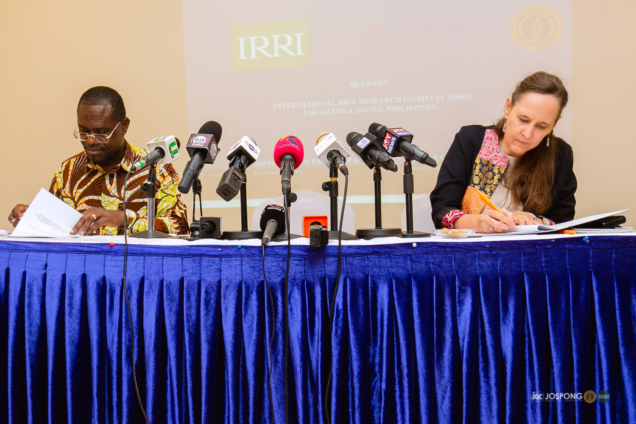
Jospong Group has signed a Memorandum of Understanding with the International Rice Research Institute (IRRI) to bring the latest and best rice technologies to Ghana.
The agreement seeks to tap into the expertise of IRRI to accelerate the development of the rice industry in Ghana, by supporting the Council for Scientic and Industrial Research (CSIR) with knowledge sharing, while building the capacity of rice growers, researchers with the necessary skills set.
“This new connection builds on the recent agreement between Jospong Group and the CSIR, forming a tripartite partnership that will ensure Ghana has access to the latest scientific advancements and innovations,” noted Dr. Joseph Siaw Agyepong, Chair and Founder of Jospong Group.
“This new partnership will be very important for ensuring nutritious, high yielding and climate resilient rice varieties are available in Ghana, like high zinc rice, as well as new production methods to harness the potential of these varieties,” highlighted Dr Joanna Kane-Potaka, Deputy Director General, Strategy, Engagement & Impact, at IRRI.

She added that the partnership will make rice farming more profitable in Ghana, which means smallholder farmers will benefit more. "And it will be done sustainably in an environmentally friendly manner," she emphasised.
The Director General of the CSIR, Prof. Paul Bosu, who described the event as historic, was hopeful that the project will be successful and will address the country's import cover on rice.
"It is disturbing to note that Ghana spends so much to import rice and the success of this project will address that. We therefore have no option than to succeed," he challenged his colleagues.
He stressed that the Jospong Rice project is not a knee jerk reaction but rather seeks to bring all the stakeholders together to forge and support a national agenda.
"The knowledge component has been placed in a high pedestal to ensure the project succeeds. We are making considerable preparation before take off," he underscored.
Dr. Abdelbagi Ismail, IRRI-Africa Director, noted that, “The agreement and the tripartite link is expected to be a model for other countries in Africa to show how it can accelerate research and delivery of high-quality rice and develop effective rice value chains for national and regional food and nutrition security”.
This partnership was brokered by the High Commissioner, Florence Akonor, who visited IRRI’s global headquarters requesting technical advice and collaboration with the Ghana Rice Project, private industry and other key stakeholders. It will ensure better yields and livelihoods for farmers, at the same time ensuring sustainable production using the latest nutritious and healthy rice available.
Scale will be reached through investments by the Jospong Group and supporting small holder farmers with high quality seeds, modern production technologies and training.
Jospong Group is focused on scaling up the rice industry in Ghana to replace the large and increasing quantities of rice being imported.
Rice consumption in Ghana has almost tripled in the last 10 years with individuals now consuming approximately 45 kilogramme of rice each year. There are excellent opportunities to build new rice-based industries in Ghana as well as there being an urgent need to produce locally to reverse the financial stress on the country of increasing imports and demand for foreign exchange.
IRRI is dedicated to abolishing poverty and hunger among people and populations that depend on rice-based agri-food systems. Through its work and partnerships, IRRI aims to improve the health and welfare of rice farmers and consumers; promote environmental sustainability in a world challenged by climate change; and support the empowerment of women and the youth in the rice industry.
In 2023, Asian African Consortium a subsidiary of the Jospong Group entered into partnership with major rice industry players in Thailand and Ghana to develop an integrated rice farming project. This move by Jospong Group stemmed from the government’s decision to boost the economy through import substitution.
A core team later visited Thailand for the Ghana-Thailand Business conference in March 2023 with researchers from various universities in Ghana as well as major players in the rice industry.
It is on record that Ghana spent over ¢6.8 billion (equivalent to $560million at current market rates) importing rice, a grain that can be produced locally.
Latest Stories
-
Bahass Foundation launches vocational skills training to support mental health recovery in Wa
14 minutes -
NPP orders parliamentary aspirants and their supporters to suspend campaign activities
47 minutes -
Techiman unites against child marriage: Joy Impact Makers Awardee leads charge on International Day of the Girl Child
58 minutes -
Ghana Psychological Association calls for greater involvement of people with lived experience in mental health care
2 hours -
Ablakwa says Ghana could evacuate more citizens from South Africa if the situation worsens
3 hours -
Violence against girls must be tackled through individual responsibility – Gender advocate
3 hours -
Ghana’s BRICS bid must be guided by national interest – International Affairs Analyst
3 hours -
Journalists look back on a decade of breast cancer reporting in Ghana
3 hours -
President Mahama ends Resetting Ghana tour of Ahafo Region
5 hours -
African negotiators seek delivery of climate commitments at COP31
5 hours -
BoG develops AI rules for financial sector
5 hours -
‘Big Push’: Government assures contractors of prompt payments
5 hours -
Court fines miner for breaking into gold buying shop
6 hours -
Tarkwa court jails labourer for three years over GH¢123,000 theft
7 hours -
GAEC must retain nuclear scientists for Ghana’s nuclear ambitions – Minister
7 hours