

Audio By Carbonatix
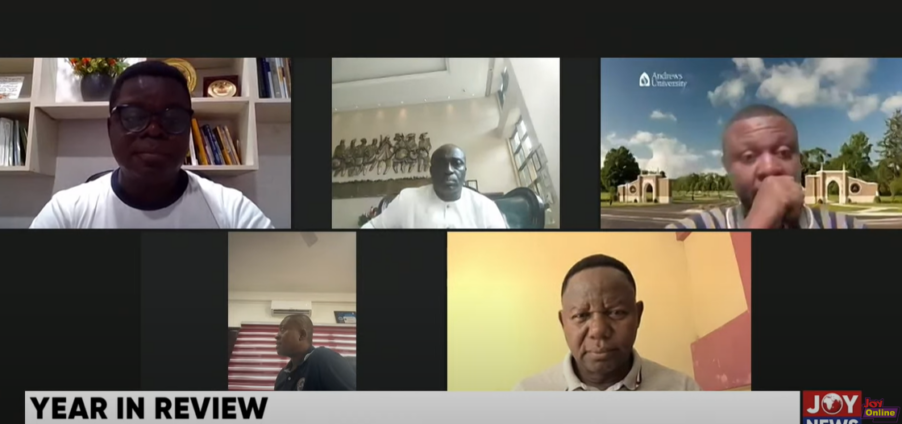
Panel members of the Joy Business End of Year Review programme have described Ghana’s economic condition in 2023 as a difficult and challenging year.
They are however hopeful the year 2024 will bring some relief for businesses as government expects the $600 million second tranche funding from the International Monetary Fund (IMF).
The panel was made up of Economist, Prof. Peter Quartey; President of the Ghana Union of Traders Association (GUTA), Dr. Joseph Obeng, and Finance Lecturer, Professor Williams Peprah.
The rest are the Chief Executive Officer of the Association of Ghana Industries (AGI), Seth Twum-Akwaboah; President of the Ghana Hotels Association, Dr. Edward Ackah-Nyamike Jnr and General Secretary of the General Agricultural Workers Union (GAWU), Edward Kareweh.
Describing the year as difficult, Prof. Quartey pointed out that high food inflation was a major issue that affected households and income of consumers.
He stated that for example that data from the Ghana Statistical Service showed that consumers spent a lot of their incomes on food at high prices.
“We saw very high inflation rate. It will surprise you that food inflation in the food growing area were much higher than Accra. Data from the Ghana Statistical Service showed that poverty levels were extremely high. About 23 districts had multidimensional poverty above 50%. You find most of these districts in the northern part of the country. For me this is very challenging”, he said.
He added that the situation was compounded by a domestic debt exchange programme that resulted in investors losing a substantial part of their investments, while the financial sector take a hit.
“2023 has been a challenging year. We had IMF programme. We have had a debt exchange programme. People have lost income. The banking sector lost a lot of interest income and we are still seeing the effect”, he said.
He however expressed hope that the IMF programme will instil some discipline in government’s expenditure to help propel the economic recovery faster.
GUTA blames government for high inflation
On his part, the President of GUTA, Dr. Obeng blamed government for the high inflation recorded in 2023.
He warned that the number of tax measures announced by the government to be implemented in 2024 could derail the gains made in bringing inflation down since traders will pass on cost to consumers.
“I always say that the high inflation we saw in this year was a result of cost push effect. It is the reason why the Bank of Ghana policy rate is not working. The most important thing that helped inflation to go down was the stable exchange rate”, he said.
He is of the view that the policy rate has not impacted on inflation as the stable exchange rate regime.
Providing some insight, Dr. Obeng said anytime the cedi depreciates against the dollar, the effect is price hikes which cause inflation.
Cost of doing business still high - AGI
The CEO of AGI, Seth Twum-Akwaboah lamented that cost of doing business in Ghana is still high compared to other countries in the sub-region.
“We have always made this call that the cost of finance is too high. That is not the only thing. Cost of power is also unbearably high and this has made it difficult for Ghanaian manufacturers to be competitive”.
He appealed to government to work with the Bank of Ghana to reduce interest rates and also reduce the cost of electricity to industry.
GAWU charges government to implement PFJ II
The General Secretary of GAWU, Edward Kareweh charged government to implement phase two of the Planting for Food and Jobs programme to improve the food security of the country.
“The whole of this year government’s Planting for Food and Jobs programme have not worked. The government announced that they are going to use the guarantor system under the phase two but it's yet to be done. We saw the effect in food inflation going up”,
He advised government to also pay attention to food inflation.
Hospitality calls for more from government
Sounding optimistic, the President of the Ghana Hotels Association, Dr. Edward Ackah-Nyamike Jnr said the hospitality sector benefited from some funding from the government.
“The sector got some ¢10 million from the government for COVID-19 support fund. It was not enough but we are optimistic of 2024”, he said.
He pointed out that the tourism sector has more to offer in the economic growth of the country in 2024.
Finance Lecturer at Andrews University, Michigan in the U.S.A, Prof. Williams Peprah advised Ghanaians to live within their means since 2024 is an election year.
Latest Stories
-
Tema native petitions EOCO over GH¢889,000 payment
18 minutes -
VIP Jeoun Service opens new terminal in Ho, expands transport network
22 minutes -
Tema Fire Commander calls for private-sector support
26 minutes -
Adaklu is not a safe haven for environmental degradation – DCE
30 minutes -
Judiciary urged to expedite corruption cases
34 minutes -
Adenta-Accra travel time improves significantly under contra-flow – GAPTE
38 minutes -
Government reviews diesel subsidy as transport fare increase takes effect
40 minutes -
SEND-Ghana, UCC students march for mandatory food warning labels
45 minutes -
Auditor-General vows tough surcharges, unveils tracker, AI audits
51 minutes -
Government vows no political protection for drug trafficking suspects
1 hour -
Government clarifies Interior Minister’s ‘involvement’ comment in drug probe
1 hour -
Mahama orders security agencies to make Ghana’s ports ‘ironclad’ against drug trafficking
2 hours -
Government admits turf war among security agencies is undermining port security
2 hours -
Government rejects ‘Cocaine Coast’ label, says drug busts show security agencies are working
2 hours -
Banks NPL ratio of 16.1% is still too high – S&P
2 hours