

Audio By Carbonatix
Director of Regulations, Inspections and Compliance at the National Road Safety Authority (NRSA), Kwame Kodua Attuahene, has called for urgent action to address infrastructure deficiencies within Ghana’s road network as part of efforts to improve road safety and reduce road fatalities.
Mr Atuahene acknowledged that Ghana has made visible improvements in its road infrastructure but stressed that the country’s road network remains far from perfect.
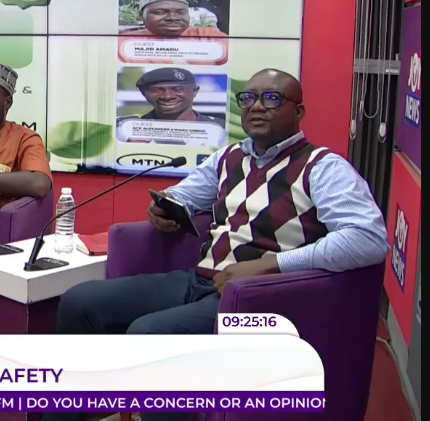
Speaking on the Joy FM Super Morning Show on Thursday, August 27, as part of Joy Sustainability Month, he said deficiencies in road infrastructure continue to be an important part of the road safety challenge and require sustained attention from government and relevant institutions.
“We do not have a perfect road network. Even though we’ve seen some visible improvements, we are not at a stage where we cannot go to school,” he said.
According to him, concerns about road infrastructure have been raised repeatedly over the past three to four years, with calls for government to take the necessary steps to address identified gaps.
The comments formed part of a broader discussion on Ghana’s road safety performance and the factors contributing to road crashes.
Mr Atuahene noted that road safety should not be assessed solely by looking at the absolute number of fatalities.
He explained that there are three major indicators used to assess road safety performance: the absolute number of deaths, the fatality rate based on the number of vehicles, and population risk.
While the absolute number of road deaths may show an increase, he said the other indicators provide a different picture of the country’s performance.
“Fatality rates, which is death by 10,000 vehicles, there’s been an improvement from about 9.3 deaths per 10,000 vehicles to about 6,” he said.
He added that population risk had also recorded an improvement.
Mr Atuahene said vehicle and population numbers change over time, making it important to analyse fatalities in relation to the number of vehicles and the size of the population.
He noted that the data showed a generally declining trend in the relevant indicators between 2016 and 2023, although the trend changed in 2024.
Despite the improvement in fatality rates, he cautioned that the country should not become complacent.
“Every death that occurs on our roads is one that keeps all of us to worry about,” he said.
He called for renewed urgency among institutions and stakeholders responsible for road safety, stressing that the existence of a national strategy should translate into stronger action.
Mr Atuahene also rejected the idea that responsibility for road safety should rest entirely with one institution.
He explained that road safety involves several interconnected areas, including infrastructure, enforcement, vehicle conditions and road-user behaviour.
He said deficiencies on the infrastructure side must be addressed alongside other factors contributing to crashes.
“If there are deficiencies from the infrastructure side as the report seeks to suggest, you may be able to answer those,” he said.
Latest Stories
-
Power restoration fault suspected in Kumasi Central Market fire
1 hour -
The 7-foot giant of Ngleshie Amanfro: Seven-foot Ghanaian Ephraim Saawa dreams of joining the national basketball team
2 hours -
Government promises support for Kumasi Central Market fire victims
2 hours -
Vibes The Movie: Big Ghun’s Ghanaian film earns five nominations at 2026 REFFA
3 hours -
MamaCare CEO warns unresolved conflicts among health workers could undermine maternal and neonatal care
3 hours -
Health professionals urged to translate medical knowledge into practice to save mothers
3 hours -
Conflicts among care providers linked to maternal, neonatal deaths – Expert
5 hours -
GIS marks 10th TIME conference, champions improved teaching practices
5 hours -
BRICS Or Balance? What Ghana’s bid really means
5 hours -
GPRTU wants full TRAFFITECH-GH implementation to start in 2027
6 hours -
Mahama announces plans to import electric wheelchairs for PWDs
6 hours -
KGL U17 Colts 2026: Western beat Prempeh Elite Academy to set up final final with Greater Accra Region
6 hours -
Late Solanke strike salvages 10-man Spurs draw at Man United
6 hours -
Gender Ministry to monitor welfare of Nana Akua Addo’s children amid domestic violence case
6 hours -
Benedict Okyere Yeboah: Ghana’s football problem goes beyond sacking a coach
6 hours