

Audio By Carbonatix
The Chief Executive Officer and Founder of Margins ID Group, Moses Kwasi Baiden Jnr, has emphasised the need to develop a clear ethical and legal framework for the proper use of artificial intelligence (AI) in Ghana.
He believes this framework must be created in collaboration with key international players and through building local capacity to ensure that the benefits of artificial intelligence are not eroded by its threats.
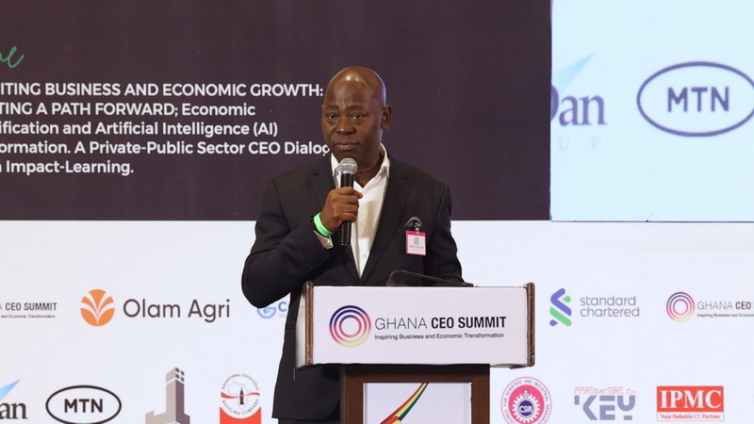
He made this call while delivering a keynote address at the 8th Ghana CEO Summit under the theme: Transforming Ghana’s National Identity Infrastructure through Artificial Intelligence Transformation.
Mr. Baiden emphasised that while Ghana has set some strong fundamentals in its digitization agenda, which it can leverage for greater efficiency through AI, a conscious effort must be made to navigate the downsides of artificial intelligence, especially the potential risks it poses to the identification systems of the country.
“We must consider the potential drawbacks of integrating AI with the Ghana Card system. One of the major concerns is the issue of data privacy.
“As we collect and store vast amounts of personal information, there is an increased risk of data breaches and unauthorised access.”
Read also: Moses Baiden, CEO of Margins adjudged overall best CEO
These concerns, he said, could be mitigated by implementing robust cybercrime laws, regulations, and defence tools, among others, to combat the risks posed by AI.
“Our preparedness for the integration of AI as a country is crucial. While the Ghana Card and our technology infrastructure demonstrate that we are ready, we must be ready as a people. “This means familiarising ourselves with AI and becoming experts in its use, both in business and government,” he emphasised.
He stressed that integrating artificial intelligence responsibly with identification systems has the potential to significantly impact the socio-economic and political future as the 4th industrial revolution evolves.
Additionally, he said Ghana is fortunate to have overcome the challenges faced by many other countries by building robust identification systems that can be harnessed to propel the country’s digitisation agenda by leveraging AI and machine learning.
“Through its continuous learning, AI can facilitate scalability and future-proofing through predictive scaling.
“AI can predict future demands on our National Identity System, allowing for proactive scaling of infrastructure, and ensuring that the Ghana Card remains future-proof and adaptable within a legal framework,” he added.
He noted that data generated by the National Identification system could be used by the government to plan budgets and test the assumptions underlying policies, manifestos, and other initiatives aimed at delivering services to the public, such as education, infrastructure, subsidies, and healthcare.
“With accurate data, generative AI can predict the future with remarkable speed and precision and enable leaders, such as Presidents, to make accurate decisions at the touch of a button and manage the distribution of resources.”
Furthermore, the registration of babies from birth provides accurate information on the birth rate in each area, which could be used with the help of AI to construct intuitive reports.
“For instance, if 5,000 babies were born in the Techiman Municipality, in Bono East, 40% higher than usual, it means the primary schools and available infrastructure will need to be upgraded by the year 2026 to ensure that those children have adequate support in education, health, and other activities.”
Latest Stories
-
Police restore calm at Larteh following Odwira festival disturbance
40 minutes -
‘All the camps will dissolve’ – Bawumia demands one NPP for 2028
42 minutes -
There is no time to waste – Bawumia orders NPP to begin 2028 work
50 minutes -
Sarkodie visits MobileMoney Fintech LTD
52 minutes -
John Boadu unveils new NPP strategy to win back youth and modernise party
57 minutes -
Hawa Koomson elected NPP National Women’s Organiser
1 hour -
John Boadu begins NPP rebuild from grassroots ahead of 2028 election
1 hour -
Titus Glover wins NPP National Organiser race on second attempt
1 hour -
Winning 2028 election won’t be easy; we must work harder – Bawumia
1 hour -
You’ll be part of 2028 campaign; there’s enough work for all of us – Bawumia to NPP aspirants
1 hour -
John Boadu moves to unite NPP after heated leadership contest
1 hour -
Today is not a day of victory but a day of responsibility and great unity – John Boadu
1 hour -
Let us choose unity over division – John Boadu to NPP
1 hour -
Our task is to build a renewed NPP – John Boadu
1 hour -
Teamwork, discipline will drive NPP’s 2028 victory – Justin Kodua after retaining General Secretary position
1 hour