

Audio By Carbonatix
President John Mahama has set up three global panels as pillars of the next phase of the landmark United Nations Resolution A/RES/80/250 Declaring the Trafficking of Enslaved Africans and Racialised Chattel Enslavement of Africans as the Gravest Crime Against Humanity.
These are the Global Advisory Panel on Reparatory Justice, the Expert Panel on the Restitution of Cultural Artefacts and the Global Legal Panel on Reparatory Justice.
The President made the announcement in his remarks at the opening of the High-Level Consultative Conference on the Next Steps to the landmark United Nations Resolution A/RES/80/250 Declaring the Trafficking of Enslaved Africans and Racialised Chattel Enslavement of Africans as the Gravest Crime Against Humanity.
The Global Advisory Panel on Reparatory Justice comprises Heads of State and Government, eminent leaders, and public figures to provide strategic guidance.
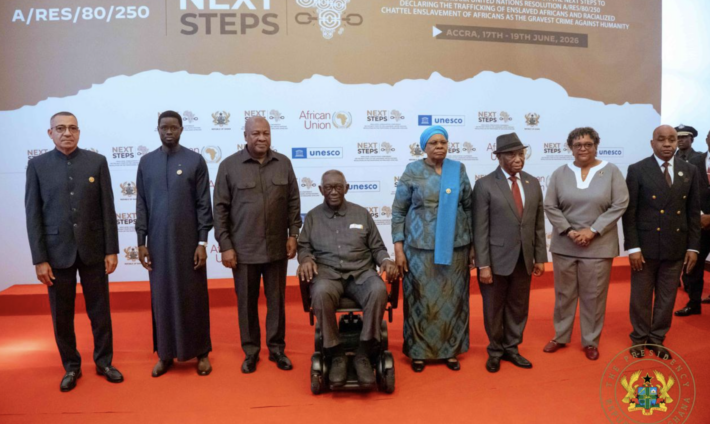
Members of the Global Advisory Panel on Reparatory Justice include President Netumbo Nandi-Ndaitwah of Namibia, President Joseph Nyuma Boakai, Sr of Liberia, President Bassirou Diomaye Faye of Senegal, and the Prime Minister of Barbados, Mia Amor Mottley.
The Expert Panel on the Restitution of Cultural Artefacts will support the return of cultural properties, archives, sacred objects, and historical treasures to their rightful communities.
The Global Legal Panel on Reparatory Justice will bring together distinguished jurists and legal scholars to explore legal pathways consistent with international law, human dignity, and justice.
Among the world leaders attending the Accra Summit are President Netumbo Nandi-Ndaitwah of Namibia, President Joseph Nyuma Boakai, Sr of Liberia, President Bassirou Diomaye Faye of Senegal, and the Prime Minister of Barbados, Mia Amor Mottley.
Others are the Prime Minister of Equatorial Guinea, Manuel Osa Nsue Nsua, the President of São Tomé and Príncipe, Carlos Vila Nova and the Speaker of the Algerian Parliament, Mr Azouz Nasri.
The two-day meeting seeks to reinforce the historic step taken by the international community to recognise the enduring legacy and global consequences of the enslavement of Africans and the racialised chattel enslavement of Africans.
President Mahama noted that the CARICOM 10-point plan would serve as an important starting point for the work of these panels.
He said the adoption of the resolution was never intended to mark the end of the journey, but rather to provide the foundation for a more meaningful process of engagement, reflection, and action.
He recalled that on 25 September 2025, he stood before the UN General Assembly and announced Ghana’s intention to introduce a resolution declaring the traffic of enslaved Africans as the gravest crime against humanity.
President Mahama said exactly six months later, on 25 March 2026, the UN General Assembly adopted Resolution A/RES 80/250 with 123 member states voting in support.
“I express profound appreciation to all 123 member states and the many institutions, scholars, civil society organisations, faith leaders, activists, and advocates who made this adoption possible,” the President said.
He added, “For Ghana, this effort is not just an exercise in diplomacy. It is a moral obligation rooted in our history, identity, and responsibility.
“We do not seek to reopen old wounds. We seek to heal those wounds. We do not seek division. We seek justice, understanding, and reconciliation grounded in truth.”
He said few places in the world bear such vivid physical testimony to this history as Ghana, stating that from Elmina and Cape Coast to Assin Manso and Osu, Ghana’s land holds visible reminders of a system that uprooted millions.
“Today, the descendants of those journeys have returned, not in chains, but as presidents, prime ministers, scholars, jurists, activists, historians and citizens of the world,” President Mahama said.
President Netumbo Nandi-Ndaitwah of Namibia paid tribute to those who endured unimaginable suffering, as well as to generations of their descendants who continue to seek justice, dignity and a reconnection with their ancestral heritage.
She reaffirmed Namibia’s commitment to restorative justice, noting that the country’s pursuit of justice and reconciliation regarding the genocide committed against the Ovaherero and Nama communities between 1904 and 1908 forms part of the broader African journey towards historical recognition, accountability and redress.
President Emmanuel Macron of France, in a televised address to the meeting, warned against reducing reparations for slavery to mere financial compensation.
He noted that justice for historical wrongs must also encompass truth-telling, education, memorialisation and restitution.
Latest Stories
-
Vibes The Movie: Big Ghun’s Ghanaian film earns five nominations at 2026 REFFA
11 minutes -
MamaCare CEO warns unresolved conflicts among health workers could undermine maternal and neonatal care
35 minutes -
Health professionals urged to translate medical knowledge into practice to save mothers
42 minutes -
Conflicts among care providers linked to maternal, neonatal deaths – Expert
2 hours -
GIS marks 10th TIME conference, champions improved teaching practices
2 hours -
BRICS Or Balance? What Ghana’s bid really means
3 hours -
GPRTU wants full TRAFFITECH-GH implementation to start in 2027
3 hours -
Mahama announces plans to import electric wheelchairs for PWDs
3 hours -
KGL U17 Colts 2026: Western beat Prempeh Elite Academy to set up final final with Greater Accra Region
4 hours -
Late Solanke strike salvages 10-man Spurs draw at Man United
4 hours -
Gender Ministry to monitor welfare of Nana Akua Addo’s children amid domestic violence case
4 hours -
Benedict Okyere Yeboah: Ghana’s football problem goes beyond sacking a coach
4 hours -
GPL 2026/27: Darkwah Wiafe’s winner sees All Blacks beat Kotoko
4 hours -
ITF World Tour : Patel Wins Boys’ Singles Final at J100 Accra
4 hours -
Ghana must pursue BRICS partnership if it brings economic benefits – Kpebu
4 hours