

Audio By Carbonatix
Media and democracy experts have called for sustainable financing for journalism to strengthen information integrity and safeguard democracy in West Africa.
They said tackling disinformation required structural reforms beyond fact-checking and training, including viable media business models, stronger institutions, improved media literacy and collective action to protect democratic values.
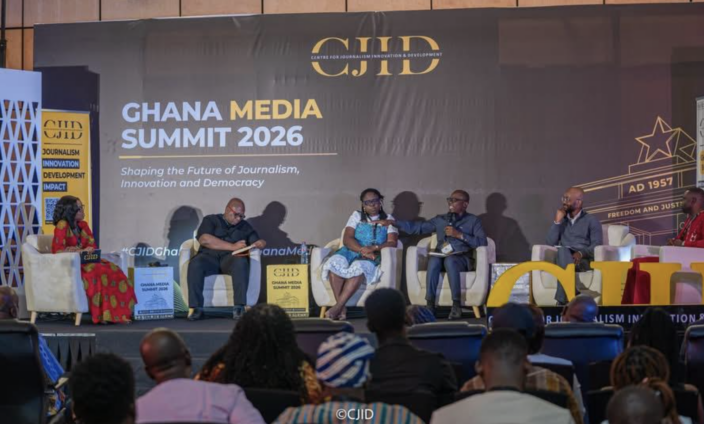
The call was made during a panel discussion on the theme, “Defending Democracy in the Age of Disinformation: Strategic Priorities for Media Development in Ghana and West Africa,” at the Ghana Media Summit organised by the Centre for Journalism Innovation and Development (CJID) in Accra.
The summit, held on the theme, “Defending Democracy in West Africa: The Role of Media,” marked seven years of DUBAWA Ghana’s contribution to strengthening information integrity and provided a platform to discuss the future of media development in the sub-region.
It brought together journalists, editors, civil society leaders, academics, media development practitioners and policymakers to examine the challenges confronting the media and democracy in West Africa.
Dr Kojo Asante, Director of Advocacy and Policy Engagement at the Centre for Democratic Development (CDD)-Ghana, said declining public confidence in democracy, growing authoritarian tendencies and shrinking civic spaces were placing increasing pressure on information integrity.
He said the economic vulnerability of media organisations required urgent attention, stressing the need to invest in profitable and sustainable journalism capable of providing decent careers while maintaining professional standards.
Dr Asante also called for greater accountability by dominant technology platforms and their algorithms, saying information integrity was a societal responsibility that extended beyond journalism.
Professor Abena Yeboah-Banin, Dean of the School of Information and Communication Studies at the University of Ghana, said although Ghana’s liberalised media environment had expanded freedom of expression, political polarisation and the weak financial position of many news organisations were eroding public trust.
She said the University of Ghana’s 2023 “State of the Ghanaian Media” report found that the country’s media landscape was “unnecessarily politically coloured.”
“And when it is unnecessarily politically coloured, as we’ve managed to create for ourselves, everything becomes subject to debates along political lines. When that happens, the basis of truth, that should entail that trust in democracy, becomes questioned because who is saying it and what are their allegiances…” she said.
Prof Yeboah-Banin said the study also found that many media organisations operated at a loss, while numerous journalists were not formally remunerated, conditions that often undermined ethical journalism.
She advocated curriculum reforms, enhanced media and information literacy, and stronger collaboration among universities, media organisations and civil society to prepare journalists and citizens for an evolving information environment.
Mr Sulemana Braimah, Executive Director of the Media Foundation for West Africa, distinguished between the wider media ecosystem and journalism, saying the profession faced an existential challenge from digital content creators and social media platforms.
He said years of newsroom training had produced limited results because many journalists continued to work under poor conditions with inadequate remuneration, including salary arrears.
Mr Braimah said sustainable incentives and renewed commitment to journalism as a profession were essential to building resilient and ethical newsrooms.
Mr Selase Kove-Seyram, Media Innovation Leader, Producer and Entrepreneur, urged journalists to position themselves as trusted interpreters of information rather than simply breaking news.
He said journalism’s enduring value lay in helping citizens make informed decisions through verification, context and analysis.
Mr Kove-Seyram said Artificial Intelligence and digital technologies presented opportunities to rethink journalistic practice and strengthen collaboration among the media, civil society and academia.
Mr Manasseh Azure Awuni, an investigative journalist, said traditional journalism was increasingly challenged by a digital ecosystem driven by speed, online traffic and coordinated attacks on credibility.
He said trust remained journalism’s greatest asset and warned that disinformation campaigns and online harassment were intended to undermine public confidence in independent reporting.
Latest Stories
-
Walter Mosley visits W.E.B. Du Bois Centre in Accra: A New York Secretary’s homecoming story on where Du Bois spent his final years.
1 hour -
MTN set to deploy 5G services after winning spectrum licenses worth US$202m
4 hours -
NPP national elections: 3,000–4,000 police to handle security, traffic in Kumasi – Karbo
6 hours -
Atta Akyea fumes as Manhyia MP is to spend another night in EOCO custody
6 hours -
SSNIT says La Beach clearance was to protect hotel investments, beaches to remain public
7 hours -
APSU congratulates St Augustine’s College after back-to-back National Investment Quiz wins
7 hours -
Renewed flood intervention at Mallam Junction raises hopes among residents, businesses
8 hours -
St Augustine’s College retain National Investment Quiz title after nail-biting grand finale
8 hours -
Education infrastructure investment will drive Banda’s development – Ahmed Ibrahim
8 hours -
Teacher unions strike: Gov’t presents fresh proposals as talks end inconclusively
9 hours -
51,000 teachers’ promotion arrears to be validated for October payment – Education Minister
9 hours -
Kwabena Boamah appointed Board Chair for Impact Investing Ghana
9 hours -
Striking teacher unions to meet Fair Wages and Salaries Commission on October 6
10 hours -
EOCO working with AG to arraign Nana Baffour Awuah before weekend court
10 hours -
Duraplast reassures customers after fire, announces October 5 reopening
10 hours