

Audio By Carbonatix
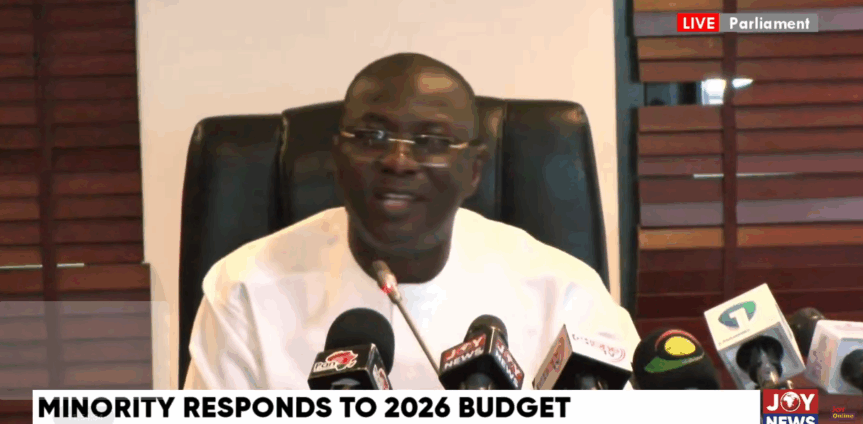
The Minority in Parliament has described the 2026 Budget as “growthless, jobless, and minimalist,” saying it falls short of addressing Ghana’s urgent economic challenges.
Speaking to the press on Friday, November 14, on behalf of the caucus, former Finance Minister and Member of Parliament, Amin Adam, criticised the budget for lacking substance and for offering only “cosmetic rhetoric” from what he called a “crawling government.”
“Ghana needs a better budget that strengthens revenue realism, expands productive investment, protects fiscal credibility, and enables the private sector to lead job creation. We can therefore describe the 2026 budget, the Galamsey budget, as growthless, jobless, and minimalist,” he said.
He further said that the budget structure does not reflect a major shift towards job creation, productivity, or economic transformation.
“Investment levels remain low, revenue projections are overly optimistic, and borrowing pressures are high. Key fiscal risks are under-discussed. Flagship programmes lack transparency and clear budget commitment,” he said.
He warned that the government’s approach of shrinking expenditure to create the appearance of fiscal prudence could backfire.
“The lower GDP base and revenue shortfalls mechanically raise the debt-to-GDP ratio, even if the cash deficit is narrow. Sustainability requires sustained growth and credible revenue mobilisation, not austerity that undermines both,” he explained.
The Minority also highlighted hidden fiscal risks, including uncovered government auctions, unattractive short-term debt maturities, and unquantified liabilities of state-owned enterprises beyond cocoa and energy. Climate and disaster risks, he said, are not sufficiently integrated into the macro-fiscal framework.
“Without addressing these risks, fiscal stability could be short-lived. Policies without clear budget risk are becoming slogans rather than deliverable programmes,” he added.
The Minority criticised the government’s broader economic management, saying, “The state of the economy cannot be as good as the minister wants us to believe. It is associated with empty pockets, vanishing customers, sophisticated investors avoiding government auctions, and ministries struggling to function due to lack of basic resources.”
He said the need for “genuine economic leadership rather than broken promises, real fiscal discipline rather than opportunistic austerity, and a government that delivers results rather than excuses.”
“What we need is economic transformation, which Ghanaians were promised. But what we see now is economic stagnation masquerading as progress. The 2026 budget does not offer the hope needed to take us out of this,” he added.
Latest Stories
-
ICU urges GHABA members to transform hairdressing skills into sustainable enterprises
13 minutes -
Ghana eyes stronger trade ties as Australia hosts multicultural trade and investment forum
23 minutes -
Margaret-Marie Krakue
25 minutes -
Ayariga announces plans for live broadcast of MMDAs’ meetings on local radio stations
28 minutes -
Mrs Anna Tackie
30 minutes -
Ghana links Afghan heroin and Brazilian cocaine to global drug markets – Global Organised Crime Index
38 minutes -
NHIA launches nationwide inter-school quiz to deepen students’ knowledge of NHIS
44 minutes -
Political protection could be masking Ghana’s cocaine trade – Global Organised Crime Index
49 minutes -
AFCON 2027Q: ‘We have to dissolve the GFA’ – Effia MP after Black Stars lose to Gambia
51 minutes -
NPP announces voting schedule and ID requirements for October 3 national elections
53 minutes -
Lupus can mimic HIV symptoms and damage kidneys if untreated – KNUST expert
56 minutes -
Focus on Sickle Cell Foundation seeks to introduce sickle cell education through comics in Ghanaian schools
1 hour -
NPP rewrites the campaign playbok as opposition reality shapes National Executive contest
1 hour -
Road safety education will fail without enforcement – NRSA boss
1 hour -
Daily Insight for CEOs: Finishing Q3 strong and entering Q4 with purpose
1 hour