

Audio By Carbonatix
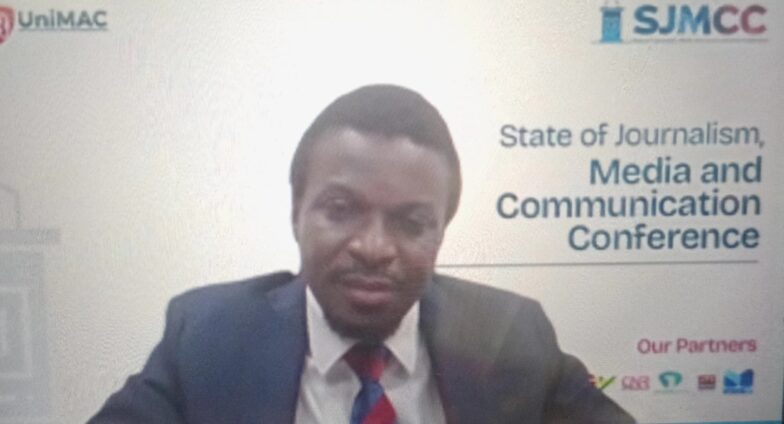
The Dean of the School of Journalism and Media Studies at the University of Media, Arts, and Communication (UniMAC), Professor Godwin Etse Sikanku, has warned that the growing spread of misinformation and disinformation is undermining public confidence in the media and weakening journalism's contribution to democratic governance and national development.
Speaking at the opening of the inaugural State of Journalism, Media and Communication Conference (SJMCC 2026) on Wednesday, July 15, Prof. Sikanku said the journalism profession is confronting one of the most significant periods of transformation in its history, driven by rapid technological change and the rise of artificial intelligence.
According to him, while digital technologies have transformed news production and information consumption, they have also fueled an environment where false information continues to threaten media credibility.
"Misinformation and disinformation continue to challenge democratic societies, and this has affected public trust in the media; it has affected the credibility of the media and the media's own ability to be able to contribute in a very consensus way to national advancement."
Prof. Sikanku noted that artificial intelligence and digital platforms are fundamentally reshaping journalism, making it imperative for scholars and practitioners to rethink how the profession responds to emerging challenges.
"Artificial intelligence is reshaping news production, and digital platforms are now redefining how audiences consume information."
He said the conference was convened to critically examine these developments and identify practical solutions that can strengthen journalism and communication practice.
"We are here to contemplate the effects of all of this and see how we can provide innovative solutions moving forward."
The Dean said the conference would provide a platform for rigorous academic inquiry and meaningful engagement between researchers and practitioners.
"We are going to engage in deep reflection, there's going to be rigorous research going on, meaningful dialogues happening at this conference; this is why this conference matters."
Prof. Sikanku explained that the conference was intentionally designed to bridge the gap between academic research and professional practice.
"SJMCC 2026 is designed as a meeting point between scholarship and professional practice."
He said that bringing together experts from different disciplines would help generate evidence-based recommendations to inform journalism practice and media policy.
"It brings together a lot of people from different industries and disciplines. It is an interdisciplinary one, and hopefully we'll be able to explore practical solutions and evidence-based research to guide the industry."
While acknowledging that the conference is the first international research conference organised by UniMAC since the merger of the Ghana Institute of Journalism, the National Film and Television Institute, and the Ghana Institute of Languages, Prof. Sikanku said its significance extends beyond the university.
He noted that the discussions and research presented at the two-day conference have the potential to shape media policy, strengthen journalism practice, and help restore public confidence in the media.
Latest Stories
-
I do not see myself as better than anyone – NPP’s 1st Vice Chair Kojo Bamba
26 minutes -
Police blur the line between invitations and arrests – Reindorf Twumasi Ankrah
1 hour -
Turning invitations into arrests is making citizens reluctant to assist police – Twumasi Ankrah
2 hours -
The Traffitech-GH SMS spot-fine system: The good, the sad, and the funny – Bright Simons writes
2 hours -
Hawa Koomson pledges experienced and mature leadership of NPP women’s wing
3 hours -
Young woman found dead at Kasoa Peace Town
3 hours -
Playback: The Law examined lawful arrest in Ghana
4 hours -
Mahama urges African governments to treat healthcare as an investment, not budget cost
4 hours -
Bawumia congratulates John Boadu and new NPP executives, pledges support ahead of 2028
4 hours -
Aksa Energy delegation pays courtesy call on GRA Commissioner-General
4 hours -
‘No talent should be left out’ – Bawumia pledges inclusive NPP campaign for 2028
5 hours -
Prof. Mike Oquaye recounts how he blocked the Special Prosecutor’s attempt to arrest Bawku Central MP
5 hours -
Make health sovereignty a priority for Africa – Mahama
5 hours -
Dorimon Naa, Wa West DCE lead massive clean-up exercise; threaten sanctions against recalcitrant residents
5 hours -
Photos from Adom FM Y2K Jam
5 hours