

Audio By Carbonatix
Extreme misogyny will be treated as a form of extremism under new government plans, the Home Office has said.
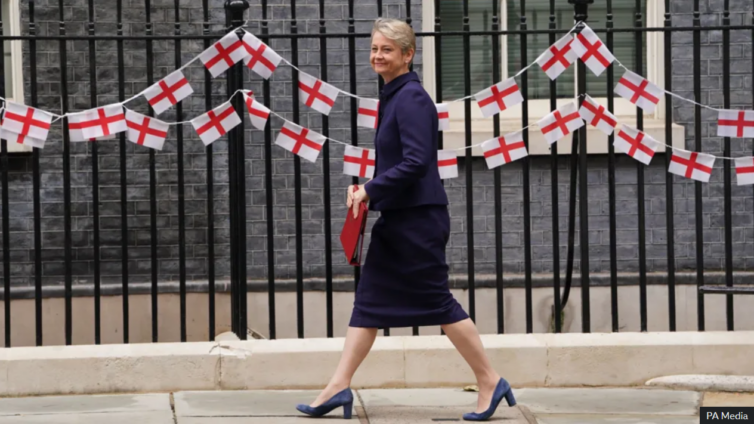
Yvette Cooper, the home secretary, has ordered a review of the UK's counter-extremism strategy to determine how best to tackle threats posed by harmful ideologies.
The analysis will look at hatred of women as one of the ideological trends that the government says is gaining traction.
Ms Cooper said there has been a rise in extremism "both online and on our streets" that "frays the very fabric of our communities and our democracy".
The review will look at the rise of Islamist and far-right extremism in the UK, as well as wider ideological trends, including extreme misogyny or beliefs which fit into broader categories, such as violence.
It will also look at the causes and conduct of the radicalisation of young people.
Ms Cooper said the strategy will "map and monitor extremist trends" to work out how to disrupt and divert people away from them.
It will also "identify any gaps in existing policy which need to be addressed to crack down on those pushing harmful and hateful beliefs and violence", she said.
Ms Cooper said that action against extremism has been "badly hollowed out" in recent years.
The work will inform a new counter-extremism strategy, which was promised in Labour's manifesto and which the Home Office says will "respond to growing and changing patterns" of extremism across the UK.
It is not clear how long this "rapid review" will take. It is one of a number of policy reviews Labour has announced since coming to power in July, including the Strategic Defence Review, spending review and a review of the National Curriculum.
Critics might argue that some reviews are a proxy for actual action, but Labour has pointed out that there has been no new Counter Extremism Strategy since 2015, and that an assessment of new and emerging threats is overdue.
This is also not the first time the government has considered misogyny as a form of extremism.
For some years there has been concern around "Incel culture", an online movement of mainly young men who describe themselves as "involuntarily celibate" and blame women and "alpha males" for their problems.
A mass shooting in Plymouth in 2021 by 22-year-old Jake Davison, who killed five people before fatally shooting himself, was linked to Incel ideology.
At the time no further policy action was taken, but incidents like that one, and also the rise of social media influencers such as Andrew Tate - a self-proclaimed misogynist - may have pushed the new government to think again.
Latest Stories
-
Don’t let speed of information become your judgement – CJ tells new lawyers
22 minutes -
World Cup visa scandal: People have leveraged public office to facilitate fraud – Senyo Hosi
28 minutes -
Glut! Farmers count losses as prices crash, customers happy
1 hour -
GSA postpones auction of unserviceable vehicles
1 hour -
Man charged with attempted murder after stabbing
1 hour -
World Cup visa scandal: Senyo Hosi says issue goes beyond calls for Sports Minister’s resignation
1 hour -
Yaw Ampofo Ankrah hasn’t taken or received any money to facilitate visas – Lawyer insists
1 hour -
World Cup visa scandal: Senyo Hosi urges focus on constitutional accountability
1 hour -
La Beach demolition: Senyo Hosi condemns lack of consultation
2 hours -
Russian glide bomb attack on Zaporizhzhia kills at least 15 people
2 hours -
Jinapor warns underperforming energy sector CEOs of consequences, says no protection for failure
2 hours -
Fire destroys head of tipper truck on Lower Volta Bridge
2 hours -
Palmer signs new Chelsea contract until 2034
2 hours -
World Cup visa scandal: Mahama will act on corruption allegations – Abass Nurudeen
2 hours -
Abass Nurudeen accuses Minority of ‘scandal scavenging’ over World Cup visa controversy
2 hours