

Audio By Carbonatix
Urban Development Planner, Kofi Kekeli Amedzro, says gaps in local land use planning are making it easier for illegal developments to take place, even in zones officially designated as protected or unsuitable for construction.
Speaking on Joy News’ PM Express on Tuesday, he explained that while national planning frameworks exist, enforcement breaks down at the local level where critical plans are often missing.
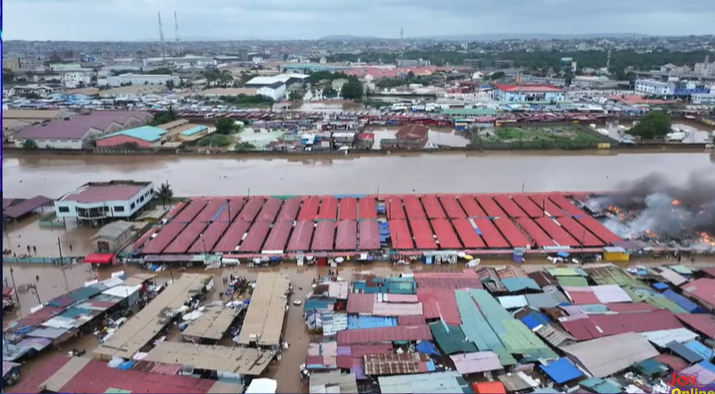
The devastating floods that hit Accra, parts of the Central Region and other areas on Monday, which left at least 18 people dead and caused extensive property destruction running into millions of cedis, have reignited concerns over weak spatial planning and unchecked development in protected areas.
“Ideally, before anyone should build, as the Land Use and Spatial Planning Act says, any form of development before it comes up, that development must conform with the land use plan of the area,” he said.
He stressed that ownership alone does not justify development in an area if zoning regulations do not permit it.
“And if you are talking about the ownership alone does, it not determine the land use, so once an area has been designated or planned for a particular zone, the district assembly, what we call the special planning committee, that is made up of planners, engineers, EPA, other professionals, geologists, and what have you, who sit on the panel to decide on the permit, do that based on the plan that has been prepared for that specific area,” he explained.
However, he warned that implementation collapses when local-level plans are missing or incomplete.
“But the challenge is that at some time when you are looking at it from a point of skill at the regional perspective within those areas they might be zoned as green areas or green belt buffers, what have you, but if it comes to the local assembly level, where it’s supposed to cascade down to the local plans for them to designate those places as green areas or nature reserves, and what have you, sometimes there are gaps.”
According to him, these gaps open the door for land capture and unauthorised development, often influenced by powerful interests.
“You go there, and you request the local plan, specifically for those areas, and they are absent. So, in the absence of these things, sometimes the land owners, through their politics and what have you, get their way, and they do what they want to do,” he said.
He added that enforcement becomes difficult for local authorities, especially where influential individuals are involved.
“So, it’s very difficult for the district assembly sometimes to enforce this, as you’ve rightly pointed out, and as you are aware of,” he noted.
Mr Amedzro further warned that some of the affected areas are technically unsuitable for construction due to their terrain, yet continue to be developed.
“So, when you go to these areas, even when you do analysis, the gradient again from a planning perspective, from where they are to build, is far beyond the normal expectations. Yet you go there, and they are building,” he said.
He concluded that the problem is not only technical but also political, as these dynamics prevent proper land use plans from being fully implemented.
Latest Stories
-
Kemi Badenoch backs face covering ban at protest
1 second -
Man City not ‘above the rules’, says No 10 after backlash to Burnham remarks
16 minutes -
Real Madrid submit ‘substantial’ dossier in Barca payments case
17 minutes -
Messi completes purchase of second Spanish club
26 minutes -
Government must engage horticulturists on tomato crisis – GhIH
28 minutes -
King Promise’s ‘Can’t Tame Us’ becomes official Chelsea anthem
33 minutes -
Afenyo-Markin demands Baffour Awuah’s release from EOCO’s custody, end to alleged political intimidation
37 minutes -
Rapper Rick Ross arrested on domestic violence charges
47 minutes -
Minority demands security review of Ghana-Colombia visa waiver and port deals
57 minutes -
Pursue drug kingpins, not persecute political opponents – Afenyo-Markin tells EOCO
1 hour -
‘I am disappointed’ – Yaw Ampofo Ankrah breaks silence after NSA suspension
1 hour -
UK in talks with EU partners to release strategic fuel reserves if needed, BBC understands
1 hour -
I don’t think EOCO has legitimate basis to investigate SIC transaction – Atta Akyea
1 hour -
Douglas Boateng receives IMM Institute Supply Chain Lifetime Achievement Award
2 hours -
From small beginnings in Navrongo to Doctor of Pharmacy: Theobald Kambonga’s scholarship story
2 hours