

Audio By Carbonatix
Government will transfer more than 80 per cent of the District Assemblies Common Fund (DACF) directly to Metropolitan, Municipal and District Assemblies (MMDAs) as part of efforts to deepen fiscal decentralisation and strengthen local governance, the Chief of Staff, Julius Debrah, has said.
He said the move would enhance the autonomy of assemblies and enable them to respond more effectively to the development needs of their communities.
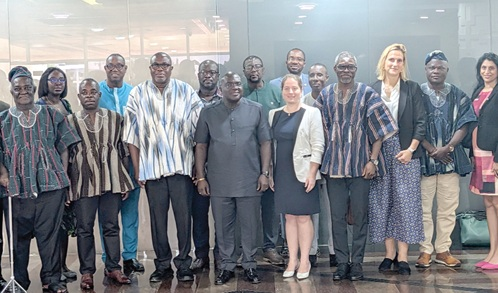
Mr. Debrah, who also served as a former Minister of Local Government and Rural Development made the announcement during a high-level engagement between the government and Development Partners on the implementation of the National Decentralisation Policy and Strategic Framework (NDPS) 2026-2030 at Jubilee House in Accra last Tuesday.
Decentralisation agenda
The Chief of Staff said the new decentralisation policy underscored the government's commitment to building stronger local governance institutions, improving service delivery and promoting inclusive development.
He explained that the policy framework would also improve inter-governmental coordination and accelerate development at both the national and local levels.
Mr Debrah commended Development Partners for their continued support for Ghana's decentralisation programme through technical assistance, policy engagement, institutional strengthening and financing support.
"The success of decentralisation depends on strong partnerships and sustained collaboration among all stakeholders," he said.
Implementation phase
The Executive Secretary of the Inter-Ministerial Coordinating Committee on Decentralisation (IMCCoD), Dr Gameli Kewuribe Hoedoafia, described the approval of the policy as a major milestone.
He, however, said the focus must now shift to implementation to ensure that the policy translates into tangible benefits for citizens.
Dr Hoedoafia acknowledged the contributions of Development Partners to the formulation of the policy and called for continued collaboration through the Sector-Wide Approach (SWAp) to decentralisation.
Political reforms
The Minister of Local Government, Chieftaincy and Religious Affairs, Ahmed Ibrahim, described the policy as a new phase in the country’s decentralisation reforms.
He said a key component of the agenda was political decentralisation, including plans to move towards a more democratic process for selecting Metropolitan, Municipal and District Chief Executives (MMDCEs).
According to him, the reform would deepen local democracy and give citizens a greater role in determining their local leadership.
Partner support
Speaking on behalf of Development Partners, the Deputy Ambassador of Switzerland to Ghana and Chargé d'Affaires, Janine Walz, welcomed the approval of the policy and pledged continued support for its implementation.
She praised Ghana's progress in decentralisation but urged further efforts to strengthen accountability, citizen participation and the financial independence of local assemblies.
Latest Stories
-
Republic Bank-JoyNews Habitat Fair: Day 1 ends on positive note as patrons explore housing solutions at clinic
3 minutes -
Vanderpuye: NDC welfare system needed to support former officials, cadres
7 minutes -
Chamber of Mines extends support to Akropong, Mampong Special Schools
10 minutes -
Tumu chiefs, MP back clearance of road corridor for Ghana-Burkina road corridor
15 minutes -
‘Democracy Is Not For Sale’: Monetisation of elections could lead to wrong people entering Parliament – UDS lecturer
26 minutes -
COCOBOD increases cocoa producer price to GH¢42,400 for 2026/27 season
29 minutes -
Atebubu College of Education receives GETFund boost after years of infrastructure neglect
32 minutes -
64 arrested over alleged unlawful possession of firearms at Achimota lounge
50 minutes -
Savannah Regional Minister calls for clear rules to distinguish generosity from vote-buying
53 minutes -
TOR secures 950,000 barrels of Sankofa crude from GNPC
55 minutes -
NAGRAT calls for probe into alleged inflation of School Feeding enrolment figures
1 hour -
Four more arrested over alleged 2026 school placement fraud
1 hour -
646 military recruits pass out after six-month infantry training at Shai Hills
1 hour -
The importance of technology and artificial intelligence in tourism
1 hour -
PURC warns of water supply challenges as Sekyere Hemang plant operates below capacity
2 hours