

Audio By Carbonatix
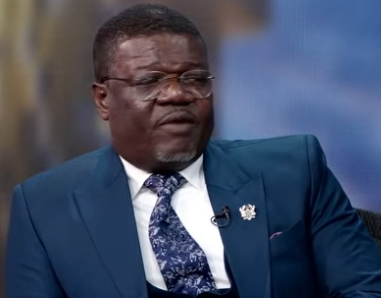
Majority Chief Whip Rockson-Nelson Dafeamekpor has rejected attempts to liken the proposed charge on mobile money-to-bank transfers to the Electronic Transfer Levy (E-Levy), insisting that the two are entirely different in nature, character, and legal basis.
His comments come amid growing debate over the Bank of Ghana’s decision to suspend the proposed 0.75 percent charge on direct wallet-to-bank transfers following public backlash and concerns raised by stakeholders.
Speaking on PM Express on Tuesday, Mr Dafeamekpor responded to concerns raised by the Minority over the suspended proposed charge.
“Look, they are just trying to push that angle for the sake of propaganda because it is not E-Levy, not in form, not in character, not in nature at all,” he said. “It has no relationship with E-Levy. It is not an E-Levy; it is a levy that a private company intends to impose.”
According to him, the proposed charge should rather be viewed as a service fee introduced by a private entity and not a government-backed tax measure.
“I am saying that this is a service fee. It is never in the nature, character, and form of E-Levy. It is not backed by law, it is not sponsored by the government, and it is not sponsored even by a government agency. So these are the clear material distinctions,” he stated.
The proposed charge, which was expected to take effect from 1 June, was to apply to wallet-to-bank transfers. However, the Bank of Ghana subsequently announced a suspension of the policy, citing the need for further consultations after concerns were raised by the public and industry stakeholders.
The suspension has since triggered criticism from the minority in Parliament, which questioned both the initial announcement of the charge and the explanation offered by the central bank.
Addressing a press conference on Tuesday, May 26, Minority Leader Alexander Afenyo-Markin expressed concern over the justification that the suspension was intended to allow for “further consultation."
He argued that the justification of “further consultation” was inconsistent with earlier assurances that major policy decisions would follow due process and broad stakeholder engagement before implementation.
According to him, such fiscal measures should ordinarily be subjected to full parliamentary scrutiny rather than being introduced and later suspended after public outcry.
However, Mr. Dafeamekpor maintained that comparisons with the former E-Levy were misplaced, stressing that, unlike the E-Levy, the proposed charge did not originate from government policy or parliamentary legislation.
According to the Majority Chief Whip, the proposed mobile money transfer charge lacks those legal and procedural characteristics and therefore cannot be categorised as an E-Levy.
Latest Stories
-
Popular Nigerian gospel singer Toluwanisings dies
9 minutes -
Spio-Garbrah proposes debt swaps to fund reparative justice in Africa and Caribbean
16 minutes -
Alban Bagbin calls for governance reforms and coordinated action to address Africa’s debt crisis
19 minutes -
AAK Academy Ghana trains 22 chocolate and confectionery companies in production techniques
20 minutes -
Adwumawura Programme trains second cohort of young entrepreneurs in Bono East
22 minutes -
Destroying Jimi River for gold could cost us our lives – Asantehene
29 minutes -
Sammy Gyamfi didn’t say BoG has ceded its forex role to us – GoldBod
1 hour -
High Court sets November 4 for ruling on Wontumi’s bail application
2 hours -
Tetteh Kwetey files nomination for NDC Greater Accra Regional Chairmanship
2 hours -
Korle Bu appeals for more doctors, nurses as A&E Centre struggles under pressure
2 hours -
AFCON 2027Q: ‘I’m optimistic Black Stars can turn things around’ – Agyemang-Badu
2 hours -
Digital innovation could widen Africa’s inequalities if people are left out – Sam Jonah
2 hours -
Galamsey is an economic, health and moral problem – Sam Jonah
2 hours -
Africa must create AI technology instead of paying to use it – Sam Jonah
2 hours -
2026 U-17 WWC: Black Maidens to face Norway, Brazil and Canada in Group C
2 hours