

Audio By Carbonatix
More than 25,000 people have now been killed in Gaza during Israel's offensive there, according to the Hamas-run health ministry.
It said there had been 178 deaths in the last 24 hours, making it one of the deadliest days in the war so far.
As fighting continued, Israel's Prime Minister Benjamin Netanyahu again rejected creating a Palestinian state.
The White House has said the US and Israel "clearly see things differently" when it comes to a two-state solution.
Israel began its offensive following the 7 October attack in which Hamas fighters killed 1,300 people in southern Israel and took more than 240 hostage.
In its first public account of the October assault, published on Sunday, Hamas described it as a "necessary step" against the Israeli occupation of the Palestinian territories and a way to secure the release of Palestinian prisoners.
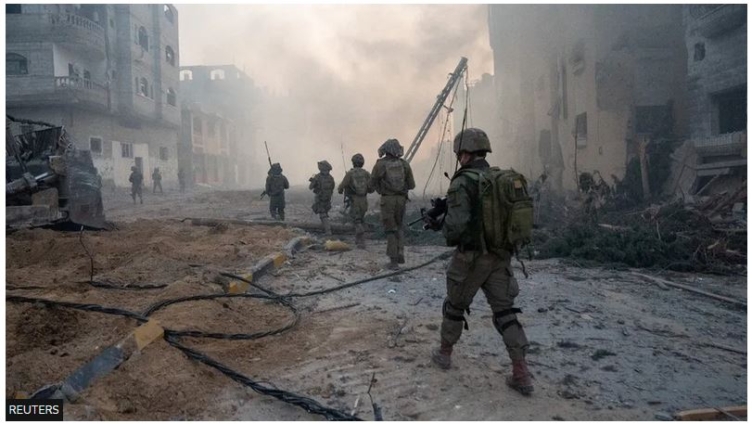
Israel's air and ground operation is currently focusing on southern Gaza, where the military are convinced top Hamas commanders are holed up in, or beneath, the city of Khan Younis.
That is where the Israel Defense Forces (IDF) said it had discovered another tunnel, some 830m (2,700ft) long and containing booby-traps and blast doors.
The IDF footage showed what appeared to be a tunnel with mattresses and cells inside - it is where Israel believes around 20 hostages, including children, were held at various points. None were found when the tunnel was discovered, though.
Israeli soldiers have also faced renewed attacks in the north of the Gaza Strip, where Hamas is said to have seized an opening around the town of Jabalia as Israel moved troops and tanks south.
More than three months since the conflict erupted, Israel - whose army far outstrips Hamas's capabilities - is still facing significant resistance across Gaza.
US intelligence agencies reportedly estimate that the Israeli military has killed 20-30% of Hamas fighters, which falls far short of Mr Netanyahu's stated aim of "completely destroying" the armed group.
The classified report is also said to have found that Hamas still has enough munitions to continue striking Israel and Israeli forces for months, raising the spectre of a prolonged war in which Israel could get bogged down.
The apparent slow progress, the fact no top Hamas commander has yet been captured or killed, and the collective trauma over the 130 or so Israeli hostages still missing, is prompting growing anti-government anger in Israel.
Protests are continuing by relatives of those still held by Hamas, calling for Mr Netanyahu to prioritise their release over the potentially impossible aim of destroying Hamas. And a still relatively small anti-war movement is also demonstrating, horrified by the damage wrought on Gaza - one of the most intense and destructive military campaigns in recent history.
Most Israelis have rallied around their flag - but not around their prime minister, who, according to a recent poll, only 15% of the public believe should stay in office once the war ends.
How it does end is the subject of growing disagreement between Mr Netanyahu and Israel's western allies. After speaking to US President Joe Biden for the first time in almost a month, the Israeli prime minister reiterated his rejection of a future Palestinian state.
In a post on X - formerly Twitter - he said Israel must retain "security control over the entire area west of [River] Jordan", which also encompasses the Israeli-occupied West Bank territory.
Mr Netanyahu has been fiercely opposed to a Palestinian state throughout his political career. But by repeatedly asserting it now, an increasingly unpopular prime minister appears to be doubling down on a view that he feels chimes with the majority opinion in a nation too horrified by the attacks to countenance an independent Palestinian state.
His apparent fight for political survival is clashing with exasperated Israeli allies, who hope that the current bloodshed could force both sides into meaningful diplomacy over a sustainable two-state solution.
UK Defence Secretary Grant Shapps told the BBC earlier that Mr Netanyahu's stance was "disappointing". The White House has said the US and Israel "clearly see things differently".
Antonio Guterres, secretary-general of the United Nations, went further, calling the refusal to accept a Palestinian state "completely unacceptable". He added it "would indefinitely prolong a conflict that has become a major threat to global peace and security".
Latest Stories
-
Mahama’s proposed airline looks to South America, Caribbean as Ghana confronts mounting drug trafficking cases
6 minutes -
5% progress on Suame Interchange Phase One inadequate – Roads Minister tasks contractor to speed up work
8 minutes -
Photos: Vice President joins GAAS Awards to celebrate outstanding women leaders
10 minutes -
OSP vs Ken Ofori-Atta, SML and others: Court gives OSP four more weeks to serve Ofori-Atta with summons
11 minutes -
High Commission sends caution to Ghanaians in South Africa ahead of planned protests
14 minutes -
Okai Mintah outlines vision for NDC Youth Wing as he engages MMDCEs
20 minutes -
Mahama Ayariga leads renewed push for stronger local governance through partnerships
23 minutes -
NDC youth organiser aspirant Okai Mintah consults MMDCEs ahead of elections
24 minutes -
PHOTOS: Ayikuma Methodist Basic School wins National Juniors Challenge
27 minutes -
Silence has entered our homes : Salomey Awiti Bafoh and the chilling effect of free expression in Ghana
27 minutes -
UG Pro-VC calls for stronger research funding to curb brain drain
29 minutes -
Woman in critical condition after shooting at funeral grounds in Yeji
31 minutes -
Breast Cancer awareness must lead to action – Deputy Health Minister
34 minutes -
UK identified as leading destination for Ghana’s illicit cannabis exports – Report
36 minutes -
Drug money allegedly finances Ghana’s political parties and real estate – Global Organised Crime Index
41 minutes