

Audio By Carbonatix
The Monetary Policy Committee of the Bank of Ghana (BoG) has kept the Policy Rate at 30.0%.
The Committee kept the rate at which it lends to commercial banks unchanged due to concerns about inflation outlook.
This is the second consecutive time it has maintained the rate.
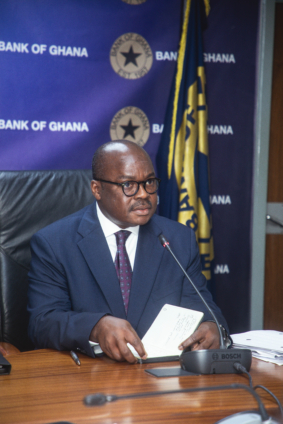
Addressing the media, Governor of the Bank of Ghana, Dr. Ernest Addison, said the Committee is also worried about some global developments which could impact negatively on the economy.
He pointed out that headline inflation has continued to decelerate in the past few months consistent with forecasts.
Dr. Addison stated that the latest Bank of Ghana forecast indicates that the disinflation process is expected to continue, supported by the current tight monetary policy stance, relatively stable exchange rate, and base drift effects.
“All the core measures of inflation and inflation expectations are pointing downwards, and the Bank will remain vigilant on risks to the disinflation process.”
“The Committee noted that although inflation is decelerating, it remains high relative to target. Therefore, there is a need to keep the policy rate tighter-for-longer until inflation is firmly anchored on a downward trajectory towards the medium-term target. Given these considerations, the Committee decided to maintain the monetary policy rate at 30.0%”.
Interest rates broadly tightened
On the money market, interest rates broadly tightened at the short end of the yield curve.
The 91-day and 182-day Treasury bill rates fell marginally to 29.40% and 31.37% respectively, in October 2023, from 31.53% and 32.61% respectively, in October 2022.
The rate on the 364-day instrument, however, increased to 33.16% from 32.32% over the same comparative period.
The interbank weighted average rate, the rate at which banks lend among themselves, increased to align with the policy corridor.
The weighted average rate increased to 28.49 percent in October 2023 from 23.98% in October 2022, in line with movements in the monetary policy rate and an increase in the Cash Reserve Ratio.
This led to an improvement in the policy transmission as the average lending rate of banks increased
to 32.69 percent in October 2023, from 31.40% recorded in the corresponding period of 2022.
Latest Stories
-
GPL 2026/27: Medeama ease past Basake Holy Stars
4 minutes -
Appiah Adomako writes: Why DVLA must stop treating every expired licence holder as delinquent
7 minutes -
Localization must transfer decision-making power, not just project responsibilities
16 minutes -
Modernising Ghana’s traditional markets through the 24-Hour Economy markets initiative
19 minutes -
New economy will boost local production and create jobs – Finance Minister
25 minutes -
Real-Time VAT on cross-border digital services – not a new tax and does not violate double taxation principle
1 hour -
Digitalisation, AI key to Ghana’s tourism transformation – GHATOF
1 hour -
Stronger GTA-private sector partnership needed to grow tourism – GHATOF
2 hours -
Amazon eyes Ghana for broadband expansion after talks with Mahama
2 hours -
National Investment Quiz 2026: Six schools qualify for quarter-finals
3 hours -
‘Do not let Russia pay for its madness with lives of your people’ – Zelensky to Ghana, 46 other countries
3 hours -
6,079 promotion cases fully processed and paid – CAGD says amid nationwide teachers’ strike
3 hours -
Teacher unions to meet government Monday over nationwide strike
4 hours -
Photo story: Republic Bank-JoyNews Habitat Fair clinic wraps up after three days of housing solutions, expert engagement
4 hours -
National Peace Council urges investment in youth to sustain Ghana’s peace
4 hours