

Audio By Carbonatix
A report by the Centre for Impact Analytics has identified six major areas of concern among the public regarding the conduct of public office holders.
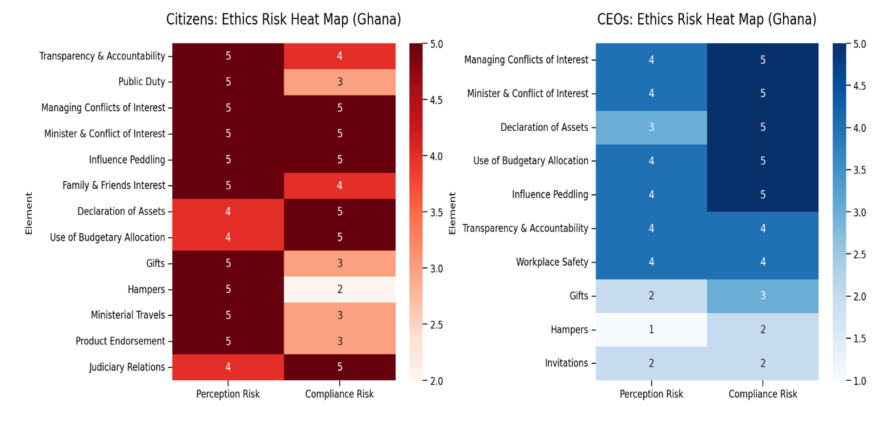
According to the report, which evaluated the effectiveness of the Code of Ethics launched in May 2025 by President John Dramani Mahama, accountability, asset declaration and conflict of interest issues rank among the top concerns of citizens.
The study was conducted to provide evidence-based insights into whether the code resonates with citizens and aligns with institutional risk priorities.
“Roughly six key issues are responsible for between 70 and 75 per cent of public concern. At the forefront are accountability and public duty, followed closely by conflict of interest, the declaration of assets and liabilities, influence peddling, and the need to ensure a safe, fair and respectful workplace,” the report stated.
The report noted that public trust is heavily influenced by visible conduct and behaviour by public officials.
“This pattern underscores a broader reality: citizens are particularly sensitive to what they can see and experience in governance. Their trust is shaped, often rapidly, by visible actions and behaviours, meaning that credibility can be strengthened or eroded in a very short time,” it added.
The report also examined the ethical priorities of chief executive officers of public institutions and found that their concerns, although similar to those of the public, are shaped by different considerations.
“Similar concentration emerges when examining the concerns of chief executive officers, although their perspective is shaped by different priorities,” the report said.
It explained that for CEOs, about five key issues account for nearly 80 per cent of their ethical focus.
“These include conflict of interest, the use of budgetary allocations, accountability, ensuring a safe and respectful workplace, and influence peddling,” the report noted.
According to the study, while public concerns are largely rooted in perception and trust, CEOs tend to approach ethics from a risk management perspective.
“Their attention is directed toward areas most likely to attract audits, regulatory scrutiny, sanctions, or legal consequences,” the report stated.
The report observed that the perspectives of the public and CEOs reveal “an important divide”.
“While citizens focus on visible conduct and integrity as signals of trustworthiness, organisational leaders are more attuned to compliance and institutional risk,” it added.
To bridge the gap, the report recommended not only strong ethical systems but also transparent practices that align with public expectations.
The report involved consultations with citizens across the country as well as chief executive officers of several public institutions.
Latest Stories
-
Manhyia South MP charged with conspiracy, financial loss and money laundering
3 minutes -
Attorney-General charges Manhyia South MP over alleged GH¢9.85m financial loss
6 minutes -
Food Security: Buffer Stock CEO calls for more investment in Agri-Tech
6 minutes -
Three missing children found dead in parked vehicle in Tamale
16 minutes -
Nana Akomea denies reports linking his absence from NPP executives’ introduction to Kojo Bamba
16 minutes -
2026 U-17 WWC: Black Maidens arrive in Morocco for tournament
19 minutes -
GSA suspends pre-shipment inspection of imported used vehicles
26 minutes -
Elevate Africa confirms presidents, vice presidents and ministers for 2026 Annual Convening in Accra
50 minutes -
Keta MP commissions 60-seater kindergarten facility to replace unsafe structure
55 minutes -
Salomey Awiti-Baffoe’s lawyers welcome GH¢100,000 bail after earlier rejection
56 minutes -
Domestic tourism and its impact on the local economy
1 hour -
Top-Up Pharmacy wins Community Pharmacy Chain of the Year at 2026 PSGH Pharma Excellence Awards
1 hour -
Nigeria military aircraft with 32 on board crashes
1 hour -
Black Stars need a coach who can inspire players to perform – Ignatius Osei Fosu
1 hour -
Revenue collector crushed to death on Kasoa-Winneba highway
1 hour