

Audio By Carbonatix
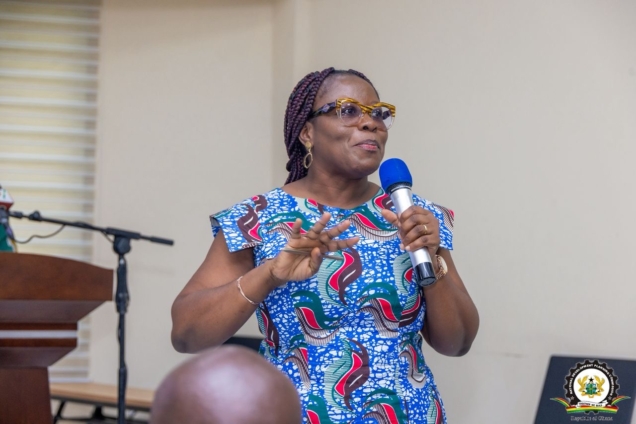
The Director-General of the National Development Planning Commission (NDPC), Dr Audrey Smock Amoah, has emphasised the need for strict compliance with planning guidelines and improved performance standards to ensure that development plans translate into tangible results.
Delivering a presentation on Plan Preparation, Annual Progress Reports (APRs), and the Regional Integrated Plan, on Thursday, 19th February 2026, Dr Amoah highlighted L.I. 2232, which governs the preparation of APRs. She commended the Eastern Region for its strong performance, noting that most APRs submitted last year were rated excellent, very good, or good.
However, she stressed that rankings alone are not enough.
“We want to get to a point where, apart from the rankings, when we step into the districts or the regions, we see actual development,” she stated, explaining that APRs must comprehensively capture annual activities, financial performance, implementation challenges, and recommendations for improvement.
Dr Amoah further announced that several districts had successfully secured certification of their development plans, while others were yet to address outstanding review comments.
“We are still waiting for you to address your comments so that you receive your certificates,” she urged, applauding compliant districts and noting that the Regional Coordinating Council had also attained certification.
On her part, the Eastern Regional Minister, Rita Akosua Adjei Awatey, underscored the importance of coherent and well-aligned development planning, cautioning against the persistent challenge of abandoned projects.
“Where there is one consolidated, comprehensive, and collectively owned development plan, the likelihood of project abandonment significantly reduces,” she said.
Earlier, the NDPC team paid a courtesy call on the President of the Eastern Regional House of Chiefs, who underscored the critical need for a long-term, sustainable approach to development. Reflecting on agricultural practices, he observed that while farmers may sell their produce to the highest bidder today, such short-term gains could prove costly in the future.
“In ten years, the farmers could be the poorest,” he cautioned, stressing that true growth must safeguard future livelihoods rather than focus solely on immediate profits.
He emphasised that sustainable development remains key to ensuring lasting economic progress for communities across the region.
Latest Stories
-
US seeks changes to rejected $109m health compact with Ghana – Mahama
1 minute -
Nine dead in mass shooting at Pennsylvania home
19 minutes -
‘Time for Ukraine to get new president,’ says Trump after Zelensky condemns diesel deal
21 minutes -
Hincapie injury adds to Arsenal issues after Guimaraes rescue act
30 minutes -
Henderson scores twice as Chelsea thumb Bournemouth
40 minutes -
Photos: Mentapulse Africa convenes health and labour summit to address talent retention
52 minutes -
Mahama inspects Nkokɔ Nketenkete plant, eyes Bechem as chicken capital
58 minutes -
Ghana not seeking full BRICS membership, applying as Partner Country – Ablakwa
59 minutes -
Woman injures three people in third Poland school knife attack in a week
1 hour -
Ghana should join BRICS as partner, not member – NPP Bono East Regional Secretary
1 hour -
Ghana High Commission warns nationals in South Africa over protests in Johannesburg, Durban
1 hour -
Mahama praises Roads Minister for keeping Big Push contractors on their toes
1 hour -
World Cup Visa Scandal: ‘My client has not collected money for visas’ – Ampofo Ankrah’s lawyer
1 hour -
US immigration officials defend ICE agents who shot man in same car as child
1 hour -
Commentator Katie Zacharia picked as new White House press secretary
2 hours