

Audio By Carbonatix
The National Development Planning Commission and the United Nations Capital Development Fund have reaffirmed their commitment to promoting climate resilience and sustainable local development by implementing the LoCAL programme in Ghana.
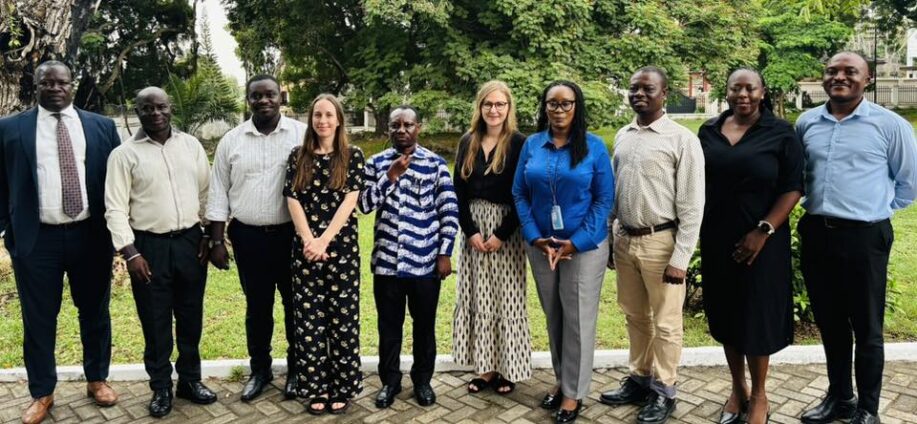
During a courtesy visit by officials from the Danish Ministry of Foreign Affairs and UNCDF to the Commission on Tuesday, May 6, 2026, to review progress under the LoCAL Plus implementation from the Commission's perspective, a renewed commitment was expressed.
The LoCAL programme, which has been operational in Ghana since 2015 through collaboration between NDPC and UNCDF, aims to strengthen communities' capacity to withstand climate change impacts by empowering Metropolitan, Municipal and District Assemblies (MMDAs).
The programme supports climate-smart investments at the local level through Performance-Based Climate Resilience Grants (PBCRGs).
Welcoming the delegation, Director for Research at NDPC, Richard Tweneboah-Kodua, underscored the importance of deeper collaboration among institutions engaged in climate adaptation and development planning.
Leading the delegation, Technical Specialist at UNCDF, Ms Angela Kwashie, explained that the visit formed part of a routine financial monitoring exercise under the Danish Ministry of Foreign Affairs’ grant management framework.
She noted that such exercises are conducted once or twice within a five-year grant cycle and are intended to assess UNCDF’s implementation processes rather than audit local institutions.
According to Ms Kwashie, the mission was designed to better understand implementation experiences on the ground, especially as remote reviews from Denmark often do not fully capture local realities and operational challenges.
She added that Ghana was selected because it is regarded as one of the success stories under the LoCAL programme, having progressed to the second phase alongside Uganda.
Speaking on behalf of NDPC, Principal Planning Analyst, Ms. Mercy Azoomah Issah, stated that the Commission’s participation in the LoCAL initiative aligns with its constitutional responsibility to provide policy direction and ensure equitable, efficient and environmentally sustainable national development planning.
She explained that NDPC develops the Medium-Term National Development Policy Framework (MTNDPF) and issues planning guidelines to District Assemblies for the preparation of development plans, which are later reviewed for compliance before approval.
Ms Issah further indicated that approved district plans are essential for accessing government funding in collaboration with the Ministry of Finance, making NDPC’s role both regulatory and facilitative within the LoCAL framework.
She observed that climate change, once treated as a secondary development issue, has now become central to policy implementation.
Through its partnership with UNCDF, she said, NDPC has worked to ensure that all 13 participating District Assemblies incorporate climate adaptation measures into their development plans.
Highlighting achievements under the partnership, Ms Issah revealed that NDPC, with support from UNCDF, conducted a gap analysis to identify missing climate-related elements within existing policy documents and planning guidelines.
The identified gaps, she noted, were subsequently integrated into revised policy frameworks to mainstream climate considerations into district planning processes.
She also disclosed that NDPC has organised training and orientation programmes for District Assemblies to strengthen their capacity to integrate climate-responsive interventions into medium-term development plans.
Also addressing the meeting, Wilfred Ebo Sam-Awortwi said the inclusion of climate-related findings in national planning guidelines now ensures that ministries, regions and districts incorporate climate adaptation measures into their planning processes.
He, however, identified inadequate financing and coordination difficulties as major challenges confronting climate interventions, noting that climate change remains a cross-sectoral issue involving several stakeholders.
Mr Sam-Awortwi added that although the initiative has delivered positive results across the 13 participating districts, expanding it nationwide would improve coordination, knowledge sharing and overall impact.
Director for Monitoring and Evaluation at NDPC, Mr Bright Atiase, explained that the Annual Progress Report (APR) serves as a key accountability mechanism for tracking Ghana’s development performance across sectors, including health, education, governance, forestry, infrastructure and energy.
He disclosed that NDPC has introduced the District Development Data Platform (DDDP) to support real-time sub-national data reporting across all 261 districts in line with national, Economic Community of West African States, African Union and Sustainable Development Goal reporting frameworks.
According to Mr Atiase, the pilot phase involving about 60 districts is currently underway, with plans to fully digitise the submission and review of APR reports from district to national level.
He further stressed the need to strengthen data systems, improve reporting efficiency through quarterly updates and integrate State-Owned Enterprises into the reporting framework to address existing data gaps.
Concluding the meeting, Mr Richard Tweneboah-Kodua commended participants for their contributions towards advancing coordinated climate adaptation efforts in Ghana and reiterated the need for sustained collaboration to drive meaningful progress in climate resilience and sustainable development nationwide.
Latest Stories
-
Mahama Ayariga urges banks to take responsibility for beautifying public spaces
33 minutes -
Account for the old economy before selling us a new one
60 minutes -
Abanga sets 4 million youth-vote target for Bawumia ahead of 2028 election
1 hour -
Gold edges lower with focus on Fed minutes, rate path clues
1 hour -
Oil prices rise as storms and air strikes threaten supply
2 hours -
Nigeria nears 2,000 repatriations from South Africa after latest evacuation flight
2 hours -
‘How can an office…close at 5pm?’ – Abanga questions 24-Hour Economy
2 hours -
‘4 million is possible’ – Abanga unveils NPP’s youth-vote battle plan
2 hours -
‘I never gave up’ – Abanga Fusani reflects on journey to NPP Youth Organiser victory
3 hours -
World Bank maintains Ghana’s growth rate forecast at 4.8% in 2026
3 hours -
Cedi was worst African currency in quarter 2, 2026 – World Bank
3 hours -
US death row inmate Christa Pike awake and speaking after failed execution, lawyers say
3 hours -
AI gains can lift three times as many people out of poverty in Ghana – World Bank
3 hours -
Scammers target ECG customers with fake meter sales and MoMo payment calls
5 hours -
Abanga Fusani credits hard work and consistency for NPP Youth Organiser victory
5 hours