

Audio By Carbonatix
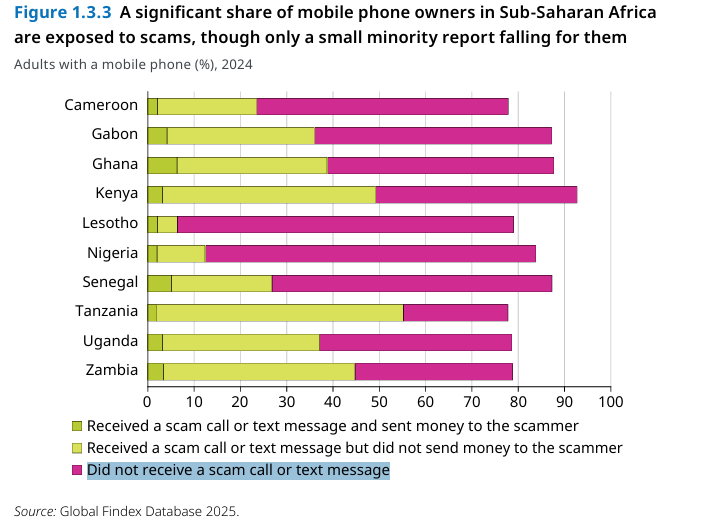
Nearly, 8.0% of Ghanaians who use mobile phones received a scam call or text message and sent money to the scammer.
According to the 2025 Global Findex Report by the World Bank, about 32% of Ghanaians who use mobile phones, also received a scam call or text message but did not send money to the scammer.
Also, about 48% did not receive a scam call or text message.
The report said adults who are exposed to a digital scam are asked if they sent money to their scammer.
“In a few economies, however, mobile phone owners have both high levels of exposure to scams or extortion and a high tendency to send funds, including Gabon, Ghana, and Senegal”, it explained.
It added that women are not overall more likely than men to receive scams or extortion attempts or to send money in response.
The report continued that consumer awareness about scams and the methods of scammers has shown promise for increasing people’s ability to avoid them.
For example, a study in Uganda that employed interactive games, delivered through interactive voice response, to teach people about fraud decreased the shares of both women and men falling for scams.
Opportunities Exist to Increase Responsible Digital Use
Though the Global Findex 2025 Digital Connectivity Tracker shows that a relatively small share of people experiences such harassment, any level is unacceptable. International efforts to address issues surrounding such violence include the UN’s Global Digital Compact, which aims to establish principles for an open, free, and secure digital future that respects human rights.
Globally, the report mentioned that only 53 out of 190 economies reviewed in one study impose criminal penalties for offenses associated with cyber harassment.
It is therefore calling for legal frameworks to revolve to recognise online harassment and treat it with the same seriousness as physical harassment.
“At the same time, tailored training programs in digital literacy for vulnerable populations— particularly women, adolescent girls, and marginalized communities—can help build preventive capacity by teaching users to recognize warning signs and employ privacy-enhancing settings on their mobile phones”, it added.
Finally, it wants accessible, confidential reporting channels with transparent processes for handling cases can enable victims to seek help without stigma.
Latest Stories
-
Breast Cancer awareness must lead to action – Deputy Health Minister
1 minute -
UK identified as leading destination for Ghana’s illicit cannabis exports – Report
3 minutes -
Drug money allegedly finances Ghana’s political parties and real estate – Global Organised Crime Index
8 minutes -
NSA outlines seven steps for successful posting and validation of national service personnel
9 minutes -
GPRTU taskforce clamps down on unapproved fares at Kasoa
10 minutes -
Prime Insight: Making room for meaningful national conversations on Joy Prime
21 minutes -
FABAG commends Ato Forson’s over removal of 20% excise duty on locally manufactured fruit juices
28 minutes -
HIV stigma discourages testing, prevention and treatment in Ghana – Ghana AIDS Commission
31 minutes -
Blocking cocaine probe lends weight to claims of political protection for traffickers – Assin South MP
34 minutes -
NPP Vice Chair race: I may be the youngest, but most experienced – Nana B
36 minutes -
Last UK and US troops leave Iraq as anti-Islamic State mission ends
36 minutes -
Don’t stay home idle, embrace entrepreneurship while awaiting posting – Unemployed nurses urged
48 minutes -
Aayalolo buses not speeding on contra-flow lanes – GAPTE assures commuters
51 minutes -
Effia MP calls for Kurt Okraku’s removal, overhaul of Ghana football structure
52 minutes -
CAS hearing on AFCON final appeal by Senegalese Football Federation set for October 8
52 minutes