

Audio By Carbonatix
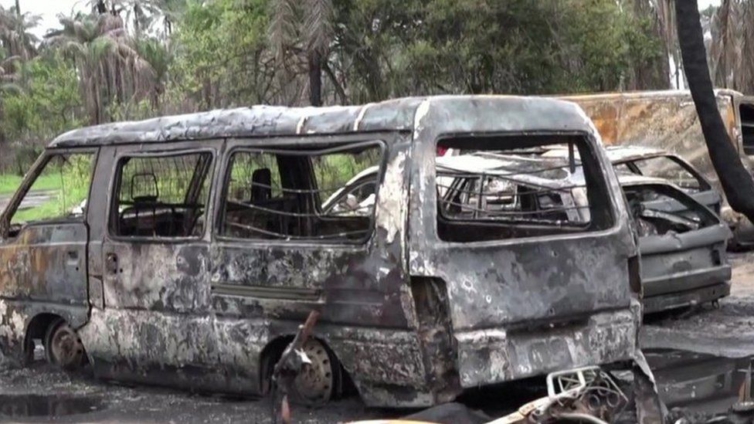
Nigeria's president has said the country is in "shock and trauma" following the deaths of at least 100 people from an explosion at an illegal oil refinery.
President Muhammadu Buhari described the incident in Imo state, southern Nigeria, as a "catastrophe and a national disaster".
Many victims were burnt beyond recognition.
The police are now looking for the owner of the illegal refinery.
The damage to fishing and farming caused by the oil industry over the decades and the failure to share the oil wealth has led some to find other ways to make money.
Illegal refining is attractive as in parts of the oil-rich Niger Delta it is seen as being relatively easy to pull off, despite efforts to halt the practice.
Dozens of people were thought to have been working at the refining plants when they were caught in the huge fire.
The death toll has risen as emergency workers go through the scene. Ifeanyi Nnaji of the National Emergency Management Agency told BBC Igbo that the number killed now stood at 109.
"We learnt many bodies are in nearby bushes and forests as some illegal operators and their patrons scampered for safety," he earlier told the AFP news agency.
Charred human remains, as well as fragments of belongings, such as flip flops, bags and clothing, were witnessed across the scene of the disaster by a journalist for the Reuters news agency.
In a statement on Sunday, Mr Buhari offered his condolences to families of the victims and said those responsible for the explosions must be caught and brought to justice.
The authorities have been struggling to curb the proliferation of illegal plants where stolen crude oil is refined. The president ordered security forces to intensify efforts to shut these refineries.
It is not yet clear what caused the explosion that happened sometime overnight into Saturday, but accidents have been common in the past at similar dangerous sites where safety measures are not enforced.
There have been concerns over a lack of precautions at such facilities as well as over the environmental pollution they cause.
But Nigeria's official oil refineries do not work to capacity, causing frequent fuel shortages and price increases across the country.
Latest Stories
-
US immigration officials defend ICE agents who shot man in same car as child
1 minute -
Commentator Katie Zacharia picked as new White House press secretary
5 minutes -
Drone strike by Sudan paramilitary kills 41 near Ethiopian border, rights group says
11 minutes -
King warns malicious online actors are evolving tactics
18 minutes -
Several injured as Saudi capital airport reportedly hit again
21 minutes -
Christa Pike discharged from hospital and returned to prison, her lawyers say
23 minutes -
Ghana’s BRICS move requires clear strategy to manage risks – Godfred Bokpin
2 hours -
Pay teachers realistic income – Duncan Amoah to gov’t
2 hours -
Bechem to become chicken capital of Ghana – Mahama projects
2 hours -
Gov’t targets recruitment of 16,500 health professionals in 2026
3 hours -
Two-week strike will not derail academic calendar – GNAT President
3 hours -
Headmaster detained after BBC investigation into alleged sexual abuse of students
3 hours -
GNAT pushes for clear implementation procedures of teachers’ conditions of service
3 hours -
Recurrent strikes threaten quality of education and academic calendars – Prof Bokpin
4 hours -
‘Cockroach’ group leaders among hundreds detained in Delhi protest
4 hours