

Audio By Carbonatix
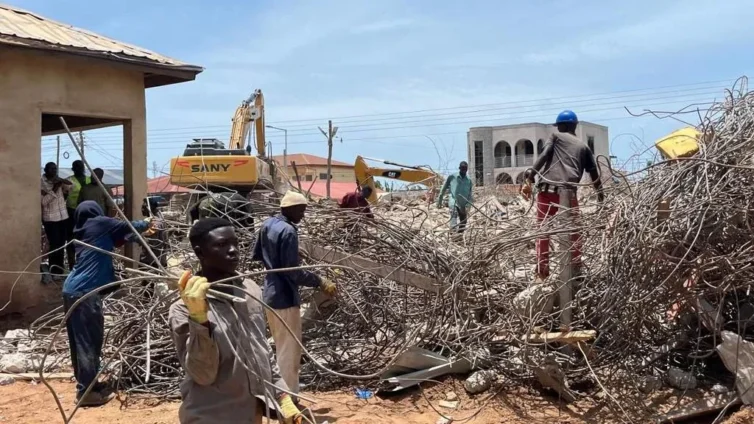
In the wake of recent building collapses across the capital, the International Facility Management Association (IFMA) Ghana Chapter has called for a mandatory "no certificate, no entry" policy for all multi-storey structures in the country.
In a statement released on Monday, 30th March 2026, the association’s President, Sampson Opare-Agyemang, urged developers and regulatory authorities to stop the dangerous practice of allowing tenants into buildings that have not been formally certified as fit for habitation.
The IFMA leadership emphasised that a Certificate of Occupancy (CO) serves as a critical life-saving safeguard rather than a mere bureaucratic formality.
According to the association, the document acts as a verified guarantee that a structure has met stringent safety standards and is structurally sound.
“A Certificate of Occupancy is more than just a document; it’s a guarantee that a building has met the required safety standards and is fit for habitation,” Opare-Agyemang asserted.
The association reminded stakeholders that the Ghana Building Code (2018) provides clear legal backing for these demands. Specifically, Section 145 of the Code mandates that occupancy permits must be supported by certification letters confirming full compliance with national safety regulations.
Despite the existence of these laws, the IFMA noted that recent tragedies in Accra suggest a gap between regulation and reality. While commending the efforts of current regulatory bodies, the President insisted that "more needs to be done" to ensure developers do not bypass these vital checks.
As professionals dedicated to the long-term management and safety of the built environment, IFMA Ghana has issued a three-point ultimatum to building owners and authorities:
- Mandatory Certification: COs must be obtained before any person is allowed to move into a new project, as required by law.
- Rigorous Oversight: Authorities must conduct regular, unannounced inspections and enforce consistent maintenance.
- Safety First: Developers must shift their priority from rapid ROI (Return on Investment) to the ultimate well-being of occupants.
“Let’s work together to prevent building collapses and save lives,” the statement concluded, framing the issue as a collective national responsibility.
Latest Stories
-
He entered at eight. He is now 16: Ghana’s children growing up in prayer camps
35 seconds -
‘Development must not always begin from Accra’ — Anwelle Foundation launched in Jirapa
3 minutes -
PKO trio eye victories at Odwira Festival
3 hours -
346 Ghana Navy recruits pass out after 26 weeks of intensive training
3 hours -
Newsfile to discuss EOCO-MP arrest, drug trafficking, speech arrests and $235m water debt
3 hours -
JoyNews gets results as listeners raise GH¢40,000 to help 17-year-old student with cerebral palsy attend SHS
4 hours -
Vice President calls for stronger local pharmaceutical production to reduce medicine imports
4 hours -
The brewing tension at KNUST; Beware the Ides of October….
4 hours -
Health Ministry moves to integrate traditional medicine into mainstream healthcare
5 hours -
550 pupils in Kintampo South get educational lifeline as ‘Seeds of Hope’ reaches farming communities
5 hours -
Opoku Mensah urges Christian Council, House of Chiefs to speak up on democratic freedoms
5 hours -
Teacher unions’ strike: Minority demands immediate payment of teacher arrears, 20% deprived area allowance
5 hours -
The Accra-Kumasi Expressway: Building it right
6 hours -
Beyond gold exports: Building value and economic resilience from Ghana’s gold
6 hours -
2027 AFCONQ: Ghana under pressure as Gambia beat Somalia 2-1
6 hours