

Audio By Carbonatix
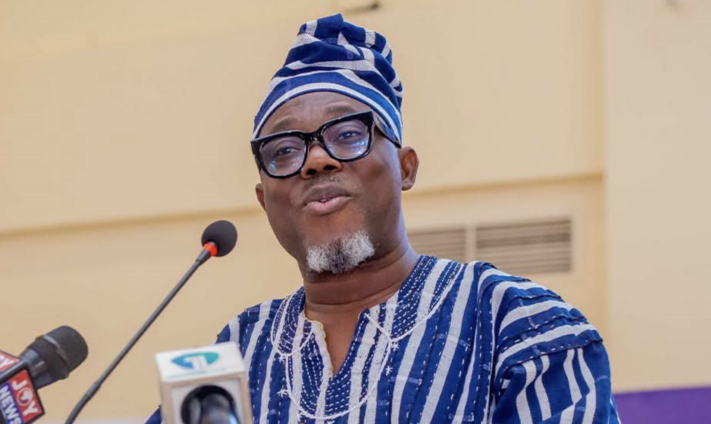
Prof. Ransford Gyampo, Chief Executive Officer of the Ghana Shippers Authority, has said meaningful and sustainable development cannot be achieved in a deeply polarised society where policy discontinuity undermines national progress.
He made the remarks as guest speaker at the 8th Biennial Social Science Conference organised by the Faculty of Social Sciences Education and the Faculty of Liberal and Social Studies Education of the University of Education, Winneba (UEW).
The two-day conference, held on the theme: “Bringing the Gown to Town: Seeking Sustainable Development in a Polarised World,” brought together scholars from universities across Ghana and beyond.
Prof. Gyampo described policy discontinuity as one of the greatest obstacles to sustainable development, noting that changes in government often result in the abandonment of ongoing projects and shifts in national priorities.
He said sustainable development required collective commitment and immediate action that safeguarded opportunities for future generations.
According to him, universities have a critical role to play as repositories of knowledge and custodians of long-term national vision by educating citizens and promoting continuity in development policies regardless of changes in political leadership.
“Long-term thinking depends on a minimum level of social cohesion and the ability of people to agree, at least in principle, on what constitutes the common good,” he said.
“We must agree, for instance, that it is wrong to destroy a road simply because a new administration wants to construct another.”
Prof. Gyampo said political polarisation weakens social cohesion, encourages short-term policymaking and turns complex development challenges into political contests, making sustainable development difficult and uncertain.
He therefore called on universities, lecturers and students to move beyond their traditional roles as producers of knowledge to become facilitators of dialogue, mediators of competing interests and builders of public trust.
He stressed that communities should not be treated as passive recipients of knowledge but as active partners whose experiences and indigenous knowledge should shape research and development.
Such collaboration, he said, would produce more relevant and widely accepted solutions, consistent with the quadruple helix model of innovation, which recognises civil society alongside academia, government and industry as key actors in development.
“The inclusion of civil society is not merely an addition but a transformation. Development cannot be imposed; it must be negotiated, contextualised and co-owned,” he said.
Prof. Gyampo identified trust as the foundation of sustainable development, warning that without it, policies would face resistance, innovations would be rejected and public institutions would lose credibility.
He urged universities to create public value through research and active engagement with society while producing graduates who are not only technically competent but also equipped to navigate the complexities of a polarised world.
“Universities cannot afford to remain on the sidelines. They must become active participants in building a more sustainable, inclusive and united society.
“If the ivory tower symbolises withdrawal, then the future of the university must be a civic engine driving knowledge, dialogue, trust and transformation—not merely to educate, but to serve,” he said.
Latest Stories
-
MTN set to deploy 5G services after winning spectrum licenses worth US$202m
1 hour -
NPP national elections: 3,000–4,000 police to handle security, traffic in Kumasi – Karbo
4 hours -
Atta Akyea fumes as Manhyia MP is to spend another night in EOCO custody
4 hours -
SSNIT says La Beach clearance was to protect hotel investments, beaches to remain public
5 hours -
APSU congratulates St Augustine’s College after back-to-back National Investment Quiz wins
5 hours -
Renewed flood intervention at Mallam Junction raises hopes among residents, businesses
6 hours -
St Augustine’s College retain National Investment Quiz title after nail-biting grand finale
6 hours -
Education infrastructure investment will drive Banda’s development – Ahmed Ibrahim
6 hours -
Teacher unions strike: Gov’t presents fresh proposals as talks end inconclusively
7 hours -
51,000 teachers’ promotion arrears to be validated for October payment – Education Minister
7 hours -
Kwabena Boamah appointed Board Chair for Impact Investing Ghana
7 hours -
Striking teacher unions to meet Fair Wages and Salaries Commission on October 6
7 hours -
EOCO working with AG to arraign Nana Baffour Awuah before weekend court
8 hours -
Duraplast reassures customers after fire, announces October 5 reopening
8 hours -
Call off strike, gov’t will not renege on promotion arrears pledge – Haruna Iddrisu to teacher unions
8 hours