

Audio By Carbonatix
Assin South MP and Ranking Member on Parliament’s Foreign Affairs Committee, Rev. John Ntim Fordjour, has called on the government to cancel the direct shipment agreement between Ghana and Colombia with immediate effect.
Speaking on Adom FM’s Dwaso Nsem, the MP said the deal offers little economic benefit to Ghana but raises serious security concerns.
“If the government has the interest of Ghana at heart, we must cancel the deal with Colombia, because we don’t see any use of that agreement,” he stated.
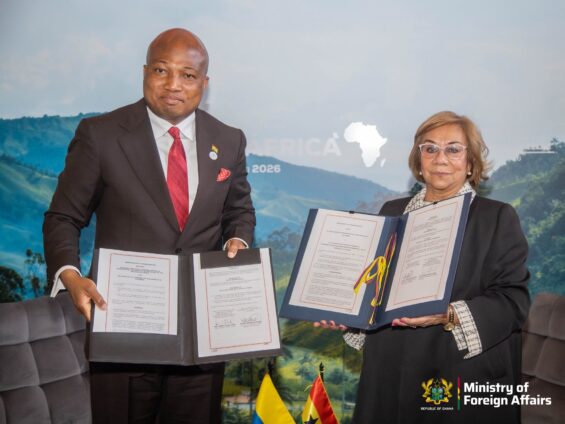
Ghana and Colombia in March 2026 entered into an agreement to establish a direct maritime shipping route between the Port of Tema and the Port of Cartagena after negotiations in Bogotá.
The Minister for Foreign Affairs and Regional Integration, Samuel Okudzeto Ablakwa, said the new corridor was expected to streamline trade, improve logistics, reduce transit times, and create fresh business opportunities for exporters and importers on both sides of the Atlantic.
The initiative received strong backing from Colombia’s Vice President, Francia Elena Márquez Mina, and Foreign Minister Rosa Yolanda Villavicencio.
Government figures described the route as a chance to turn the Atlantic, once associated with the transatlantic slave trade, into a channel for economic growth, jobs, and shared prosperity between Africa and Latin America.
However, the lawmaker has argued that Colombia was not a major producer of goods that Ghana needs in large volumes, unlike countries such as China.
“If it was the case that Colombia was the leading country in furniture, textiles, diamonds, fruit juices, or products like China is doing, then we will know that at least they produce 70% of the things Ghanaians need, so expanding shipment will help us,” he said.
Drawing on the UN Office on Drugs and Crime report, Mr Fordjour noted that Colombia, aside from Brazil, is identified as a major source of cocaine trafficking and produces about 70 per cent of the world’s cocaine.
He questioned why Cabinet would approve a bilateral trade agreement involving the Port of Cartagena, a port widely known as a key route through which a significant volume of drugs is shipped.
The deal, he observed, would allow direct shipment between Ghana and Cartagena without passing through traditional transit points such as Belgium or France.
“What was the basis of the government’s decision to sign that agreement? We know our borders are porous and the security agencies have not been well resourced. So why would we do this? The government knows what they are doing,” he said.
Latest Stories
-
GHS urges health managers to use community scorecards to improve healthcare delivery
6 minutes -
Ekyeamamfrom-Pivot irrigation project 90% complete but stalled over unpaid certificates
10 minutes -
When the Gavel speaks, where is the choir that once sang for Wontumi?
10 minutes -
NPP does not need a new chairman: It needs a brand architect
13 minutes -
GNFS contains fire at Avenor North Industrial Area in Accra
16 minutes -
NITA appoints Anthony Owusu-Ansah as Acting Deputy Director-General
23 minutes -
RANA warns Salomey Bafoh case could have chilling effect on free expression
24 minutes -
Who is the ‘hero’ Indian pilot who was stabbed on Israel-bound flight?
41 minutes -
NPP External Branches demand 90-day roadmap for ROPAA implementation
42 minutes -
No sustainable digital economy without trust, cybersecurity – CSA
44 minutes -
SSNIT increases stake in Société Générale Ghana to 24.36%
47 minutes -
Ghana-Colombia port deal sparks fresh cocaine trafficking security concerns
48 minutes -
EOCO moves to search Baffour Awuah’s office, residence after interrogation
54 minutes -
GoldBod, Kyrgyzstan discuss partnerships in gold and critical minerals
56 minutes -
SMEs can use vehicles, movable assets as collateral under Borrowers and Lenders Act
56 minutes