

Audio By Carbonatix
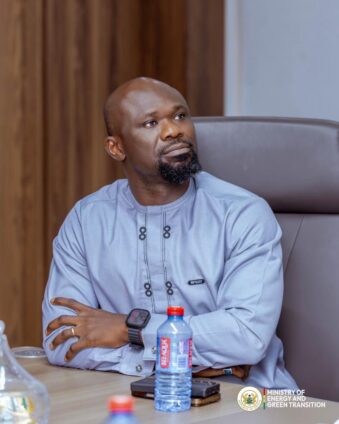
The Deputy Chief Executive Officer in charge of Operations and Technical at the Petroleum Hub Development Corporation, Onasis Kobby Rosely, has blamed the erstwhile New Patriotic Party (NPP) government for Ghana’s sustained decline in crude oil production, citing mismanagement and policy failures.
His remarks follow the release of the 2025 Semi-Annual Report by the Public Interest and Accountability Committee (PIAC), which revealed that crude oil output has fallen for the sixth consecutive year.
Production dropped from 71.4 million barrels in 2019 to 37.3 million barrels in 2025, representing a compounded annual average reduction of about 9%.
Since Ghana began commercial oil production in December 2010, cumulative output has reached approximately 694 million barrels.
Commenting on the PIAC findings, Rosely described the trend as “a slow-motion collapse driven by an NPP government that took its eye off the ball.”
He argued that the administration relied excessively on the Jubilee, TEN, and Sankofa fields without diversifying production sources, while failing to attract new investments.
He said the upstream sector saw no new petroleum agreements signed from 2018 onward.
"A reactive approach to maintenance led to costly, prolonged shutdowns, particularly on the Jubilee FPSO.
This was compounded by NPP government delays in critical infrastructure, like gas processing plant expansions, which further limited production capacity," Rosely stated.
He added that a reactive approach to maintenance resulted in costly, prolonged shutdowns, particularly on the Jubilee FPSO.
This challenge, he said, was further compounded by delays under the NPP government in expanding critical infrastructure, such as gas processing plants, which significantly constrained production capacity.
Below is the breakdown of his key lapses between 2017 and 2024:
Over-Reliance on Aging Fields: The government allowed the country to become dangerously dependent on just three mature fields Jubilee, TEN, and Sankofa.
As these fields naturally entered terminal decline, they were expected to pump over 500,000 bpd but ultimately failed.
Investment Drought & Regulatory Toxicity: The upstream sector saw zero new petroleum agreements signed from 2018 onward.
A "toxic" regulatory environment, marked by tax disputes and contract disagreements with major operators like Eni and Springfield, drove international oil companies away.
Operational & Infrastructure Failures: A reactive approach to maintenance led to costly, prolonged shutdowns, particularly on the Jubilee FPSO.
This was compounded by NPP government delays in critical infrastructure, like gas processing plant expansions, which further limited production capacity.
Ineffective Revenue Management: Despite the bleeding, billions from the Annual Budget Funding Amount (ABFA) were spent without a clear strategic plan to reinvest into the sector, failing to stem the decline.
Latest Stories
-
GPL 2026/27: Medeama go three clear as Hearts of Oak recover and Bechem stage stunning comeback
3 minutes -
Ntiamoah Foundation launches “BEYOND 20” anniversary campaign
22 minutes -
Credit Risk Management Directive: BoG to begin implementation for banks, others from July 1, 2027
40 minutes -
Ghana Brands Awards 2026: Leading brands, business trailblazers to shine on November 20
56 minutes -
T-bills auction: Demand improves as government exceeds target by about 76%; interest rates soften
1 hour -
Ziope undertakes initiative to build a technologically inclined community, commissions self-help ICT lab
1 hour -
ECG announces power outage in parts of Tema, Central Region due to network fault, maintenance
2 hours -
When the Gospel Becomes a Weapon: The church, blackmail and the abuse of faith
2 hours -
JoyNews’ Jacqueline Ansomah Yeboah selected for UK Media Excellence for Emerging Technology Fellowship
3 hours -
Mental Health Alliance urges government to operationalise Mental Health Fund
3 hours -
Ghana–Holy See agreement heads to Parliament after Cabinet approval
3 hours -
Luv FM Corporate Games 2026: Kumasi Central Prisons, Amanfiman Bank win big amid fun
3 hours -
WAFU B U17: Ghana top Group A after win over Togo
4 hours -
Ho Central Mosque reopens amid unresolved leadership dispute that led to closure
5 hours -
Minority caucus questions GH¢16.4m in Ablakwa’s SA evacuation spending, demands independent audit
5 hours