

Audio By Carbonatix
One person in the Upper East Region has been confirmed dead after testing positive for monkeypox.
The Upper East Regional Director of Health Services, Dr Emmanuel Kofi Dzotsi confirmed this to JoyNews. According to him, this is the region’s first monkeypox case.
In a press release, he indicated that "the confirmed case was seen on the 22 July 2022 at the Upper East Regional Hospital with history of fever and skin rash."
"Unfortunately, the case died on the 26th of July 2022. Samples were taken on July 22, 2022, for confirmation at the Noguchi Memorial Institute for Medical Research (NMIMR) in Accra. We received feedback on July 28, 2022, indicating the sample tested positive for Monkeypox disease."
Dr Dzotsi added that 13 contacts close to the confirmed case have been identified for contact follow-up and monitoring.
"As of 31st July 2023 no additional cases have been confirmed," he stated.
Meanwhile, the monkeypox outbreak has been declared a global health emergency by the World Health Organization.
The classification is the highest alert that the WHO can issue and follows a worldwide upsurge in cases.
More than 16,000 cases have now been reported from 75 countries, said WHO director-general Dr Tedros Adhanom Ghebreyesus.
There are only two other health emergencies currently – the coronavirus pandemic and the continuing effort to eradicate polio.
About monkeypox
Monkeypox is endemic in countries such as Benin, Cameroon, the Central African Republic, the Democratic Republic of the Congo, Gabon, Ghana, Ivory Coast, Liberia, Nigeria, the Republic of the Congo, Sierra Leone, and South Sudan.
Transmission of virus
Transmission occurs primarily via respiratory droplet particles usually requiring prolonged face-to-face contact, which puts household members of active cases at greater risk of infection.
Transmission can also occur via inoculation or the placenta (congenital monkeypox). There is no evidence, to date, that person-to-person transmission alone can sustain monkeypox infections in the human population.
Secondary, or human-to-human, transmission can result from close contact with infected respiratory tract secretions, skin lesions (open wounds/injuries) of an infected person or objects recently contaminated by patient fluids or lesion materials.
Symptoms
The infection can be divided into two periods:
The invasion period (0-5 days) characterised by fever, intense headache, lymphadenopathy (swelling of the lymph node), back pain, myalgia (muscle ache) and an intense asthenia (lack of energy);
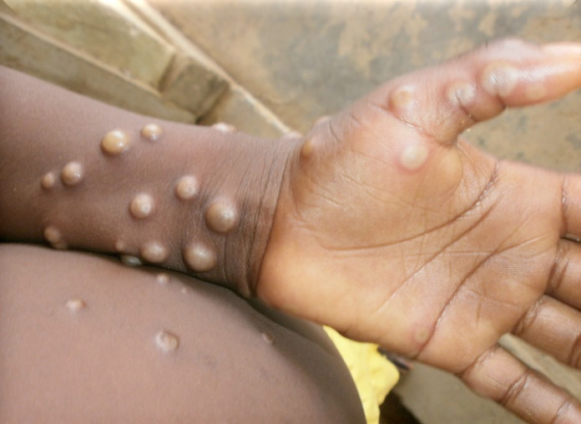
The skin eruption period (within 1-3 days after the appearance of fever) where the various stages of the rash appears, often beginning on the face and then spreading elsewhere on the body.
The face (in 95% of cases), and palms of the hands and soles of the feet (75%) are most affected.
Treatment/Vaccine
There are no specific treatments or vaccines available for monkeypox infection, but outbreaks can be controlled.
Vaccination against smallpox has been proven to be 85% effective in preventing monkeypox in the past but the vaccine is no longer available to the general public after it was discontinued following global smallpox eradication.
Prevention
In the absence of specific treatment or vaccine, the only way to reduce infection in people is by raising awareness of the risk factors and educating people about the measures they can take to reduce exposure to the virus.
Regular hand washing should be carried out after caring for or visiting sick people.
Reducing the risk of animal-to-human transmission. Efforts to prevent transmission in endemic regions should focus on thoroughly cooking all animal products (blood, meat) before eating.
Public health educational messages via the media – broadcast, electronic and social – is highly advised.
Healthcare workers and those treating or exposed to patients with monkeypox or their samples should consider being immunized against smallpox via their national health authorities.
Latest Stories
-
Godfred Dame questions 2-night EOCO detention of Baffour Awuah over GH¢2.2m legal fees
5 minutes -
GH¢1.64bn NHIS claims paid in 2026 as Private Health Facilities welcome improved reimbursements
12 minutes -
Blue Medics champions healthy ageing at Akuapem North older persons commemoration
17 minutes -
NPP elects national executives today in Kumasi ahead of election 2028
23 minutes -
Godfred Dame accuses EOCO, CID, AG of using state power to punish political opponents
34 minutes -
Walter Mosley visits W.E.B. Du Bois Centre in Accra: A New York Secretary’s homecoming story on where Du Bois spent his final years.
2 hours -
MTN set to deploy 5G services after winning spectrum licenses worth US$202m
5 hours -
NPP national elections: 3,000–4,000 police to handle security, traffic in Kumasi – Karbo
7 hours -
Atta Akyea fumes as Manhyia MP is to spend another night in EOCO custody
7 hours -
SSNIT says La Beach clearance was to protect hotel investments, beaches to remain public
8 hours -
APSU congratulates St Augustine’s College after back-to-back National Investment Quiz wins
8 hours -
Renewed flood intervention at Mallam Junction raises hopes among residents, businesses
9 hours -
St Augustine’s College retain National Investment Quiz title after nail-biting grand finale
9 hours -
Education infrastructure investment will drive Banda’s development – Ahmed Ibrahim
9 hours -
Teacher unions strike: Gov’t presents fresh proposals as talks end inconclusively
10 hours