

Audio By Carbonatix
Parliament has passed the controversial 2.5 percent hike in the Value Added Tax (VAT) rate.
Presenting the 2023 Budget, the Finance Minister Ken Ofori Atta announced government’s decision to increase the Value Added Tax (VAT) by 2.5 percent.
This will move the tax policy from its current percentage of 12.5 per cent to 15 per cent.
According to him, the review is to directly support road construction projects and the digitisation agenda.
But the Minority opposed the introduction of an additional VAT rate, arguing that it will exacerbate the hardship of Ghanaians.
However, debating the issue on the floor of Parliament, the Chairman of the Finance Committee, Kwaku Kwarteng touted the tax measure as key in turning around the fortunes of the economy.
According to him, the reason of the Minority’s opposition has been considered and incorporated under paragraph 6.3 of the committee’s report, adding that the recommendation by the committee was a majority decision.
“Mr Speaker, the object of the bill is to amend the Value Added Tax Act 2013, Act 870 to increase the VAT rate, adjust the VAT threshold, review the transitional provisions for the implementation of the electronic value added tax system, revise the administrative penalties for noncompliance in relation to the electronic value added tax on gambling, betting and other games of chance,” he explained.
But his colleague Dr. Cassiel Ato Forson described the revenue measure as one which will worsen the plight of Ghanaians and is not needed during this period of economic hardship.
He noted that “this administration has resorted to introducing taxes that will further erode the disposable income of the ordinary Ghanaian.”
“Mr Speaker, we in the Minority believe that VAT is a good tax however, Mr Speaker we strongly believe that this is not the time to introduce an additional VAT rate,” he said.
For this reason, he urged the Finance Ministry to put it on hold and get the VAT introduced when the economy is stable.
For his part, the Minister for Lands and Natural Resources, Samuel Abu Jinapor said the Minority cannot thwart the government's efforts at raising revenue and keep expecting developmental projects.
His argument, however, was opposed by the Yapei-Kusawgu MP, John Jinapor and Deputy Ranking Member on the Finance Committee of Parliament, Isaac Adongo who also spoke against the tax measure.
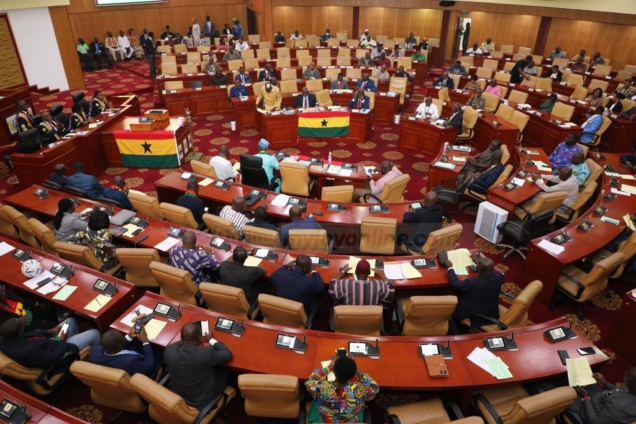
At the end of the debate, it was put to a vote which the Minority lost by 136 to 135.
Latest Stories
-
Zonda Tec launches HOWO T3M truck to support agric and logistics
6 minutes -
Obuasi SHTS scandal: Eduwatch calls for sex offenders’ register and mandatory background checks for teachers
18 minutes -
GloMeF CEO urges intensified public education on new road traffic regulations
30 minutes -
‘Any tax on ChatGPT is an attack on education and innovation’- Akim Swedru, MP
33 minutes -
Obuasi SHTS sexual abuse scandal exposes systemic failure in child protection – Moving Masculinity
34 minutes -
Hubtel CEO calls for national data-sharing framework to boost AI development
36 minutes -
Twelve Golden Rules of real estate development in Ghana, Africa
41 minutes -
Five new telephony cell sites in Ashanti Region to be activated in October 2026 – Sam George
41 minutes -
Mahama cuts sod for Afienya Industrial Park, targets 120 enterprises
46 minutes -
Rush for fuel from accident tankers is stealing, punishable by law – NPA boss, Edudzi Tamakloe
52 minutes -
GhIG pushes for legislation to regulate geoscientists’ activities
58 minutes -
Mfantsipim @150: Ace Anan Ankomah leads project to preserve school’s musical heritage
1 hour -
Gov’t launches rCOMSDEP in Ahanta West, Mpohor Fiase to promote responsible community mining
1 hour -
AI is forcing professionals to rethink how they deliver value – Hubtel CEO
1 hour -
Daily Insight for CEOs: Strengthening the CEO’s Leadership Legacy
1 hour